Institute for Global Health, University College London, London, UK.
Faculty of Medicine, Universidad Autónoma Madrid, Madrid, Spain.
BMC Infect Dis. 2021 Jan 21;21(1):90. doi: 10.1186/s12879-021-05766-9.
Ending the global tuberculosis (TB) epidemic requires a focus on treating individuals with latent TB infection (LTBI) to prevent future cases. Promising trials of shorter regimens have shown them to be effective as preventative TB treatment, however there is a paucity of data on self-administered treatment completion rates. This pilot trial assessed treatment completion, adherence, safety and the feasibility of treating LTBI in the UK using a weekly rifapentine and isoniazid regimen versus daily rifampicin and isoniazid, both self-administered for 12 weeks.
An open label, randomised, multi-site pilot trial was conducted in London, UK, between March 2015 and January 2017. Adults between 16 and 65 years with LTBI at two TB clinics who were eligible for and agreed to preventative therapy were consented and randomised 1:1 to receive either a weekly combination of rifapentine/isoniazid ('intervention') or a daily combination of rifampicin/isoniazid ('standard'), with both regimens taken for twelve weeks; treatment was self-administered in both arms. The primary outcome, completion of treatment, was self-reported, defined as taking more than 90% of prescribed doses and corroborated by pill counts and urine testing. Adverse events were recorded.
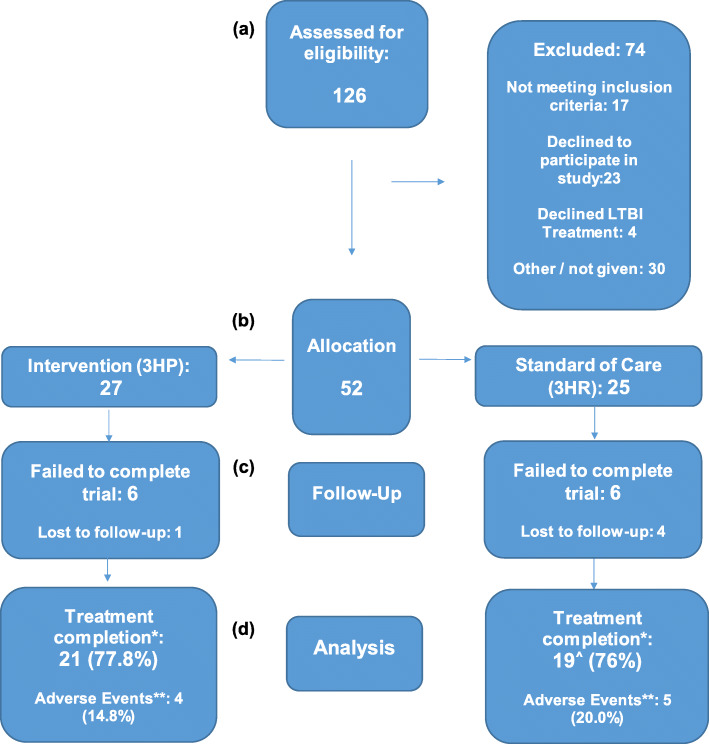
Fifty-two patients were successfully enrolled. In the intervention arm 21 of 27 patients completed treatment (77.8, 95% confidence interval [CI] 57.7-91.4), compared with 19 of 25 (76.0%, CI 54.9-90.6) in the standard of care arm. There was a similar adverse effect profile between the two arms.
In this pilot trial, treatment completion was comparable between the weekly rifapentine/isoniazid and the daily rifampicin/isoniazid regimens. Additionally, the adverse event profile was similar between the two arms. We conclude that it is safe and feasible to undertake a fully powered trial to determine whether self-administered weekly treatment is superior/non-inferior compared to current treatment.
The trial was funded by the NIHR, UK and registered with ISRCTN ( 26/02/2013-No.04379941 ).
要终结全球结核病(TB)疫情,就必须注重治疗潜伏性结核感染(LTBI)患者,以预防未来发病。更短疗程方案的试验结果令人鼓舞,表明这些方案在预防结核病方面同样有效,但是有关自我管理治疗完成率的数据却很缺乏。本试验采用每周利福喷丁和异烟肼方案与每日利福平加异烟肼方案,比较这两种方案治疗 LTBI 的完成率、依从性、安全性和在英国自我管理治疗的可行性,前者疗程为 12 周,后者为 12 周,均为自我管理。
这是一项在英国伦敦进行的开放性标签、随机、多中心的试验,于 2015 年 3 月至 2017 年 1 月进行。试验纳入了两家结核病诊所中符合 LTBI 预防性治疗条件且愿意接受治疗的 16-65 岁成年人,将他们按 1:1 比例随机分配至每周利福喷丁和异烟肼联合用药组(干预组)或每日利福平加异烟肼联合用药组(标准组),两种方案疗程均为 12 周;两组均为自我管理治疗。主要结局是治疗完成情况,即自我报告的接受了超过 90%的规定剂量,并用药物计数和尿液检测来核实。记录不良事件。
共成功纳入 52 例患者。在干预组,27 例患者中有 21 例(77.8%,95%置信区间[CI]为 57.7-91.4)完成了治疗,而标准组 25 例患者中有 19 例(76.0%,CI 为 54.9-90.6)。两组的不良事件谱相似。
在本试验中,每周利福喷丁和异烟肼方案与每日利福平加异烟肼方案的治疗完成率相似。此外,两组的不良事件谱相似。我们得出的结论是,开展一项充分的试验来确定自我管理的每周治疗是否优于/不劣于当前治疗是安全且可行的。
该试验由英国国家健康研究所(NIHR)资助,在 ISRCTN 注册( 26/02/2013-No.04379941 )。