Clinic for Diagnostic and Interventional Radiology, Saarland University Medical Center, Kirrberger Str. 1, 66421, Homburg, Saar, Germany.
Department of Radiotherapy and Radiation Oncology, Saarland University Medical Center, Kirrberger Str. Geb. 6.5, 66421, Homburg, Saar, Germany.
Cancer Imaging. 2021 Jan 21;21(1):15. doi: 10.1186/s40644-021-00384-9.
Computed tomography (CT) is the standard procedure for follow-up of non-small-cell lung cancer (NSCLC) after radiochemotherapy. CT has difficulties differentiating between tumor, atelectasis and radiation induced lung toxicity (RILT). Diffusion-weighted imaging (DWI) may enable a more accurate detection of vital tumor tissue. The aim of this study was to determine the diagnostic value of MRI versus CT in the follow-up of NSCLC.
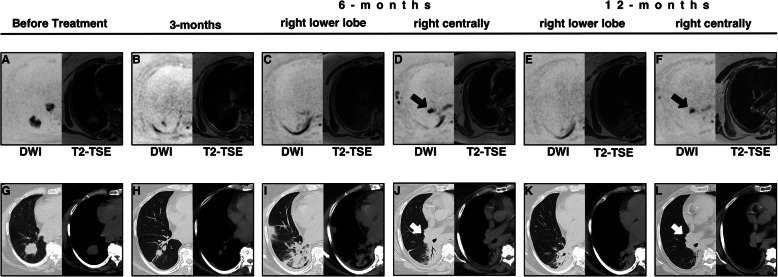
Twelve patients with NSCLC stages I-III scheduled for radiochemotherapy were enrolled in this prospective study. CT with i.v. contrast agent and non enhanced MRI were performed before and 3, 6 and 12 months after treatment. Standardized ROIs were used to determine the apparent diffusion weighted coefficient (ADC) within the tumor. Tumor size was assessed by the longest longitudinal diameter (LD) and tumor volume on DWI and CT. RILT was assessed on a 4-point-score in breath-triggered T2-TSE and CT.
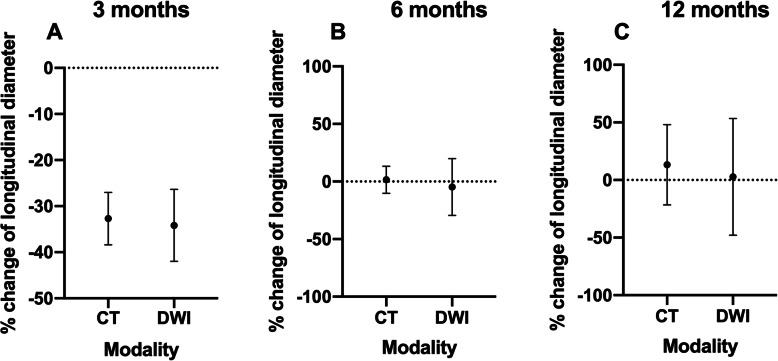
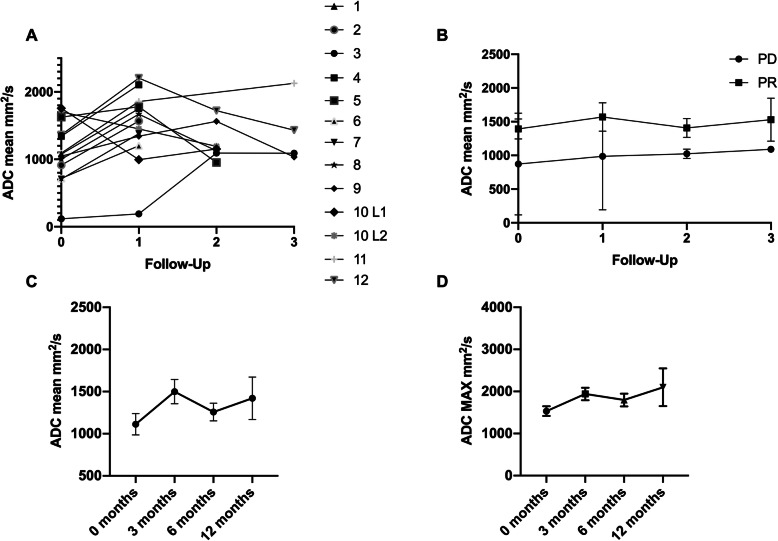
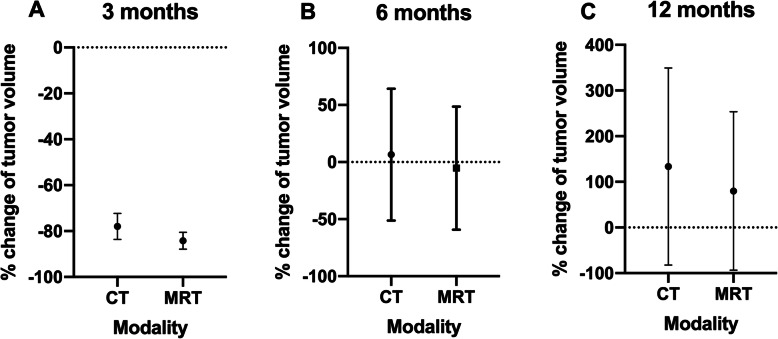
There was no significant difference regarding LD and tumor volume between MRI and CT (p ≥ 0.6221, respectively p ≥ 0.25). Evaluation of RILT showed a very high correlation between MRI and CT at 3 (r = 0.8750) and 12 months (r = 0.903). Assessment of the ADC values suggested that patients with a good tumor response have higher ADC values than non-responders.
DWI is equivalent to CT for tumor volume determination in patients with NSCLC during follow up. The extent of RILT can be reliably determined by MRI. DWI could become a beneficial method to assess tumor response more accurately. ADC values may be useful as a prognostic marker.
计算机断层扫描(CT)是放射化学治疗后非小细胞肺癌(NSCLC)随访的标准程序。CT 难以区分肿瘤、肺不张和放射性肺毒性(RILT)。扩散加权成像(DWI)可能使肿瘤组织的检测更加准确。本研究旨在确定 MRI 与 CT 在 NSCLC 随访中的诊断价值。
本前瞻性研究纳入了 12 例计划接受放射化学治疗的 NSCLC Ⅰ-Ⅲ期患者。治疗前、治疗后 3、6 和 12 个月进行 CT 增强扫描和 MRI 平扫。在肿瘤内使用标准化 ROI 确定表观扩散系数(ADC)。通过最长纵向直径(LD)和 DWI 和 CT 上的肿瘤体积评估肿瘤大小。在呼吸触发 T2-TSE 和 CT 上进行 4 分制评分评估 RILT。
MRI 和 CT 之间的 LD 和肿瘤体积无显著差异(分别为 p≥0.6221 和 p≥0.25)。RILT 的评估显示 MRI 和 CT 在 3 个月(r=0.8750)和 12 个月(r=0.903)时具有非常高的相关性。ADC 值评估表明,肿瘤反应良好的患者 ADC 值高于无反应者。
在 NSCLC 患者随访期间,DWI 与 CT 相比,在肿瘤体积确定方面具有等效性。RILT 的程度可以通过 MRI 可靠地确定。DWI 可能成为一种评估肿瘤反应更准确的有益方法。ADC 值可能作为一种预后标志物。