Institute of Anatomy, University of Zurich, Zurich, Switzerland.
Center for Microscopy and Image Analysis, University of Zurich, Zurich, Switzerland.
J Am Soc Nephrol. 2021 Feb;32(2):342-356. doi: 10.1681/ASN.2020071003. Epub 2021 Jan 21.
The kidney plays an important role in maintaining normal blood pH. Metabolic acidosis (MA) upregulates the pathway that mitochondria in the proximal tubule (PT) use to produce ammonia and bicarbonate from glutamine, and is associated with AKI. However, the extent to which MA causes AKI, and thus whether treating MA would be beneficial, is unclear.
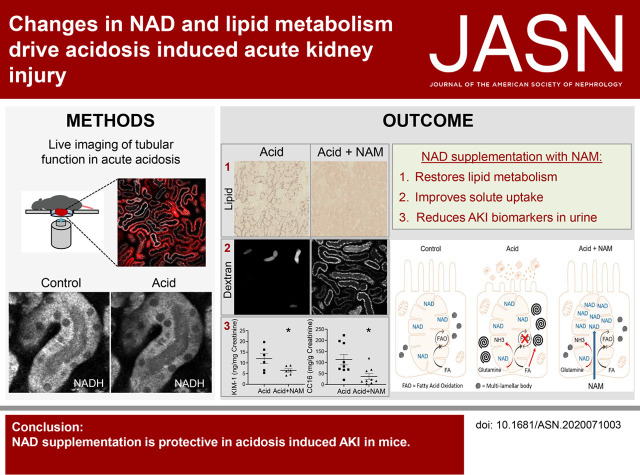
Gavage with ammonium chloride induced acute MA. Multiphoton imaging of mitochondria (NADH/membrane potential) and transport function (dextran/albumin uptake), oxygen consumption rate (OCR) measurements in isolated tubules, histologic analysis, and electron microscopy in fixed tissue, and urinary biomarkers (KIM-1/clara cell 16) assessed tubular cell structure and function in mouse kidney cortex.
MA induces an acute change in NAD redox state (toward oxidation) in PT mitochondria, without changing the mitochondrial energization state. This change is associated with a switch toward complex I activity and decreased maximal OCR, and a major alteration in normal lipid metabolism, resulting in marked lipid accumulation in PTs and the formation of large multilamellar bodies. These changes, in turn, lead to acute tubular damage and a severe defect in solute uptake. Increasing blood pH with intravenous bicarbonate substantially improves tubular function, whereas preinjection with the NAD precursor nicotinamide (NAM) is highly protective.
MA induces AKI changes in PT NAD and lipid metabolism, which can be reversed or prevented by treatment strategies that are viable in humans. These findings might also help to explain why MA accelerates decline in function in CKD.
肾脏在维持正常血液 pH 值方面发挥着重要作用。代谢性酸中毒(MA)会上调近端肾小管(PT)中用于从谷氨酰胺产生氨和碳酸氢盐的线粒体途径,与急性肾损伤(AKI)有关。然而,MA 导致 AKI 的程度,以及因此治疗 MA 是否有益,尚不清楚。
用氯化铵灌胃诱导急性 MA。用多光子成像技术对线粒体(NADH/膜电位)和转运功能(葡聚糖/白蛋白摄取)进行成像,对分离的肾小管进行耗氧率(OCR)测量,对固定组织进行组织学分析和电子显微镜检查,以及尿生物标志物(KIM-1/克拉拉细胞 16)评估小鼠肾皮质中的肾小管细胞结构和功能。
MA 诱导 PT 线粒体中 NAD 氧化还原状态(向氧化方向)发生急性变化,而不改变线粒体的供能状态。这种变化与向复合物 I 活性的转变以及最大 OCR 的降低有关,同时正常脂质代谢发生重大改变,导致 PT 中明显的脂质积累和大的多层体形成。这些变化反过来又导致急性肾小管损伤和溶质摄取的严重缺陷。静脉内给予碳酸氢盐以增加血液 pH 值可显著改善肾小管功能,而预先注射 NAD 前体烟酰胺(NAM)则具有高度保护作用。
MA 诱导 PT NAD 和脂质代谢的 AKI 变化,这些变化可以通过在人类中可行的治疗策略来逆转或预防。这些发现也可能有助于解释为什么 MA 会加速 CKD 功能的下降。