Division of Gastroenterology, Department of Medicine, Samsung Medical Center, Sungkyunkwan University School of Medicine, 81 Irwon-ro, Gangnam-gu, Seoul, 06351, Korea.
Statistics and Data Center, Samsung Medical Center, Sungkyunkwan University School of Medicine, Seoul, Korea.
Sci Rep. 2021 Jan 21;11(1):2025. doi: 10.1038/s41598-021-81657-y.
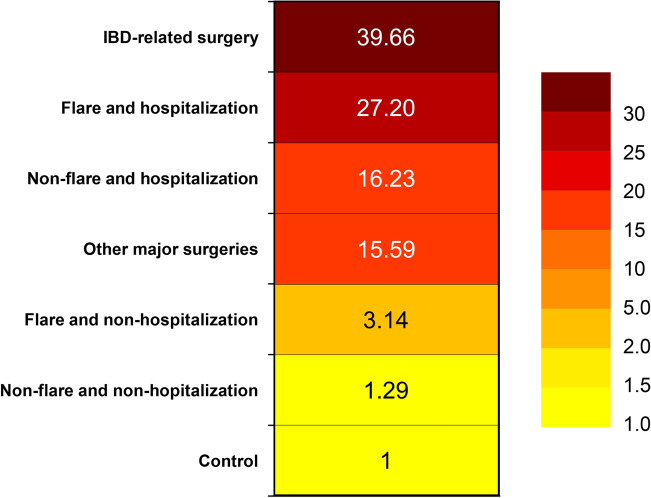
Routine prophylaxis for venous thromboembolism (VTE) in Asian IBD patients has been controversial. We aimed to estimate the risk of VTE of Asian patients at different phases of IBD by incorporating patient-specific risk factors. In this cohort study, we analyzed the National Health Insurance claims data between 2012 and 2016 for the entire Korean population. We calculated incidence rates and hazard ratios for VTE. The overall VTE risk was higher in patients with IBD [adjusted hazard ratio (aHR), 2.06; 95% confidence interval (CI), 1.66-2.55], than in controls. When we compare the risk of VTE by different disease phases, the risk of VTE was the highest during post-operation period after IBD-related bowel surgery (aHR, 39.7; 95% CI 9.87-159.3), followed by during hospitalized periods with flare (aHR, 27.2; 95% CI 14.9-49.65) and during hospitalized periods with non-flare (aHR, 16.23; 95% CI 10.71-24.58). The incidence rate (per 1000 person-years) was 15.26 during hospitalized periods with a flare and 9.83 during hospitalized periods with non-flare. According to age groups, the incidence rate (per 1000 person-years) during hospitalized periods with flare was 14.53 in young patients (20-39 years) and 34.58 in older patients (60-80 years). During hospitalized periods with non-flare, the incidence rate was 3.55 in young patients and 23.61 in older patients. The prophylaxis of VTE for Asian patients with IBD should be recommended in older patients admitted to hospital and be considered in young patients who are hospitalized with a flare.
亚洲炎症性肠病患者常规进行静脉血栓栓塞症(VTE)预防存在争议。我们旨在纳入患者特定的危险因素,以评估不同疾病阶段亚洲患者的 VTE 风险。在这项队列研究中,我们分析了 2012 年至 2016 年期间韩国全民健康保险索赔数据。我们计算了 VTE 的发病率和风险比。与对照组相比,炎症性肠病患者的总体 VTE 风险更高[校正风险比(aHR),2.06;95%置信区间(CI),1.66-2.55]。当我们比较不同疾病阶段的 VTE 风险时,IBD 相关肠道手术后的术后时期 VTE 风险最高(aHR,39.7;95%CI 9.87-159.3),其次是住院缓解期(aHR,27.2;95%CI 14.9-49.65)和住院非缓解期(aHR,16.23;95%CI 10.71-24.58)。有缓解症状的住院期间的发病率(每 1000 人年)为 15.26,无缓解症状的住院期间的发病率为 9.83。按年龄组划分,有缓解症状的住院期间的发病率(每 1000 人年)在年轻患者(20-39 岁)中为 14.53,在老年患者(60-80 岁)中为 34.58。在无缓解症状的住院期间,年轻患者的发病率为 3.55,老年患者为 23.61。应建议对住院的老年亚洲炎症性肠病患者进行 VTE 预防,并考虑对有缓解症状住院的年轻患者进行预防。