Institut du Cerveau, ICM, Inserm U 1127, CNRS UMR 7225, Sorbonne Université, 47 bd de l'Hôpital, 75013, Paris, France.
Assistance Publique-Hôpitaux de Paris, DMU IMPACT, Département Médical-Universitaire de Psychiatrie et d'Addictologie, Hôpitaux Universitaires Henri Mondor-Albert Chenevier, Université Paris-Est Créteil, 40 rue de Mesly, 94000, Créteil, France.
Commun Biol. 2021 Jan 21;4(1):96. doi: 10.1038/s42003-020-01611-y.
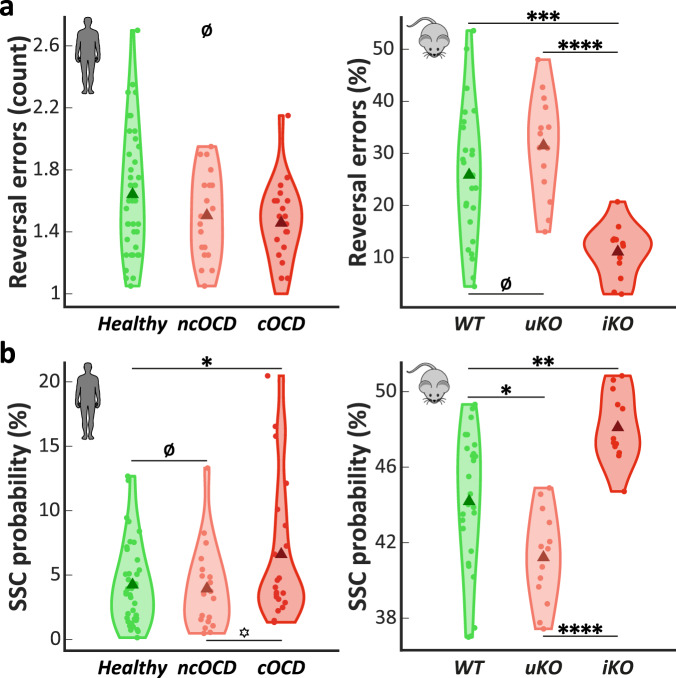
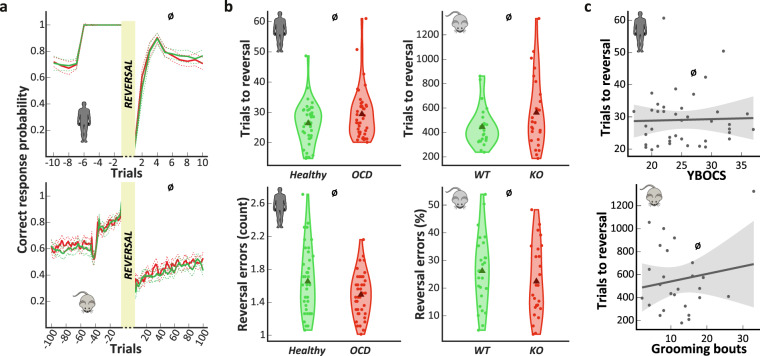
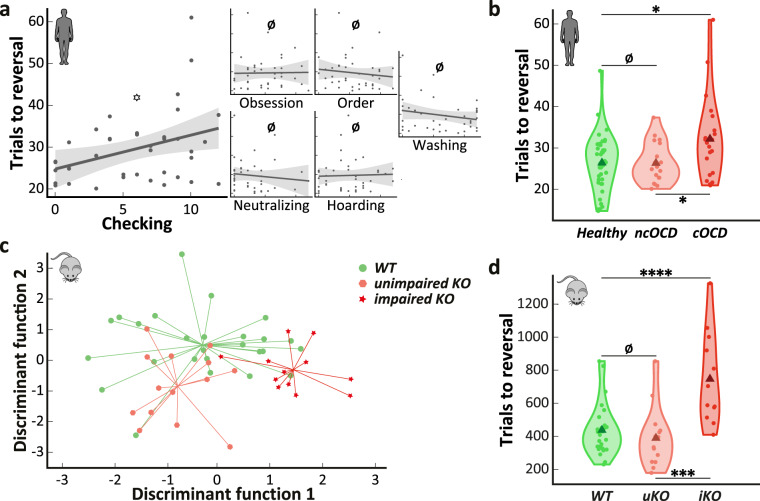
Lack of behavioral flexibility has been proposed as one underlying cause of compulsions, defined as repetitive behaviors performed through rigid rituals. However, experimental evidence has proven inconsistent across human and animal models of compulsive-like behavior. In the present study, applying a similarly-designed reversal learning task in two different species, which share a common symptom of compulsivity (human OCD patients and Sapap3 KO mice), we found no consistent link between compulsive behaviors and lack of behavioral flexibility. However, we showed that a distinct subgroup of compulsive individuals of both species exhibit a behavioral flexibility deficit in reversal learning. This deficit was not due to perseverative, rigid behaviors as commonly hypothesized, but rather due to an increase in response lability. These cross-species results highlight the necessity to consider the heterogeneity of cognitive deficits in compulsive disorders and call for reconsidering the role of behavioral flexibility in the aetiology of compulsive behaviors.
缺乏行为灵活性被认为是强迫行为的一个潜在原因,强迫行为被定义为通过刻板仪式进行的重复行为。然而,强迫样行为的人类和动物模型的实验证据并不一致。在本研究中,我们在两种不同的物种中应用了类似设计的反转学习任务,这两种物种都有强迫的共同症状(人类 OCD 患者和 Sapap3 KO 小鼠),我们发现强迫行为和行为灵活性缺乏之间没有一致的联系。然而,我们发现这两种物种的强迫个体中有一个特定的亚组在反转学习中存在行为灵活性缺陷。这种缺陷不是由于通常假设的坚持性、刻板行为,而是由于反应不稳定增加所致。这些跨物种的结果强调了在强迫症中考虑认知缺陷异质性的必要性,并呼吁重新考虑行为灵活性在强迫行为发病机制中的作用。