Department of Zoology, Peter Medawar Building for Pathogen Research, University of Oxford, Oxford, UK.
Meningococcal Reference Unit, Public Health England, Manchester Public Health Laboratory, Manchester Royal Infirmary, Manchester, UK.
Lancet Infect Dis. 2021 May;21(5):677-687. doi: 10.1016/S1473-3099(20)30842-2. Epub 2021 Jan 19.
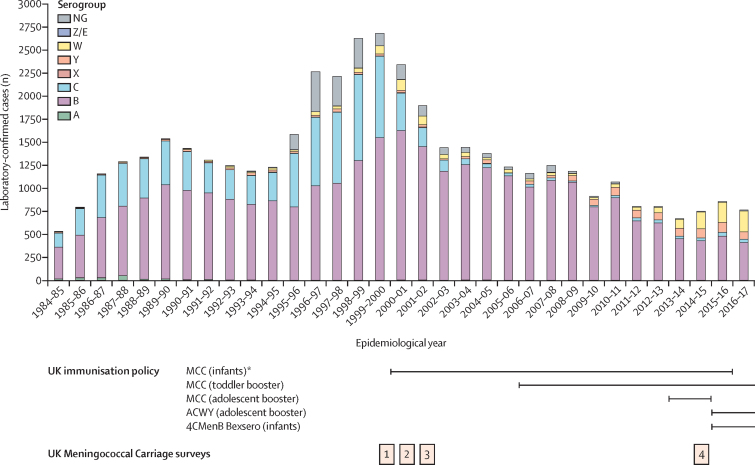
The incidence of invasive meningococcal disease in the UK decreased by approximately four times from 1999 to 2014, with reductions in serogroup C and serogroup B disease. Lower serogroup C invasive meningococcal disease incidence was attributable to implementation of the meningococcal serogroup C conjugate vaccine in 1999, through direct and indirect protection, but no vaccine was implemented against serogroup B disease. UK Meningococcal Carriage surveys 1-3 (UKMenCar1-3), conducted in 1999, 2000, and 2001, were essential for understanding the impact of vaccination. To investigate the decline in invasive meningococcal disease incidence, we did a large oropharyngeal carriage survey in 2014-15, immediately before the changes to meningococcal vaccines in the UK national immunisation schedule.
UKMenCar4 was a cross-sectional survey in adolescents aged 15-19 years who were enrolled from schools and colleges geographically local to one of 11 UK sampling centres between Sept 1, 2014, and March 30, 2015. Participants provided an oropharyngeal swab sample and completed a questionnaire on risk factors for carriage, including social behaviours. Samples were cultured for putative Neisseria spp, which were characterised with serogrouping and whole-genome sequencing. Data from this study were compared with the results from the UKMenCar1-3 surveys (1999-2001).
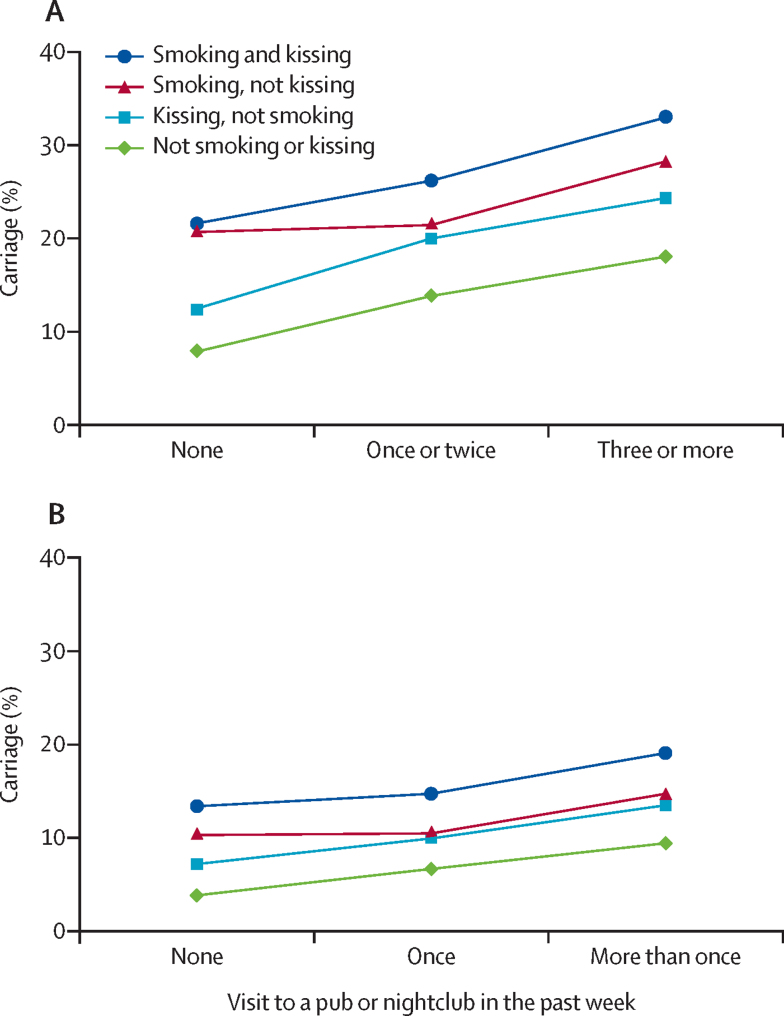
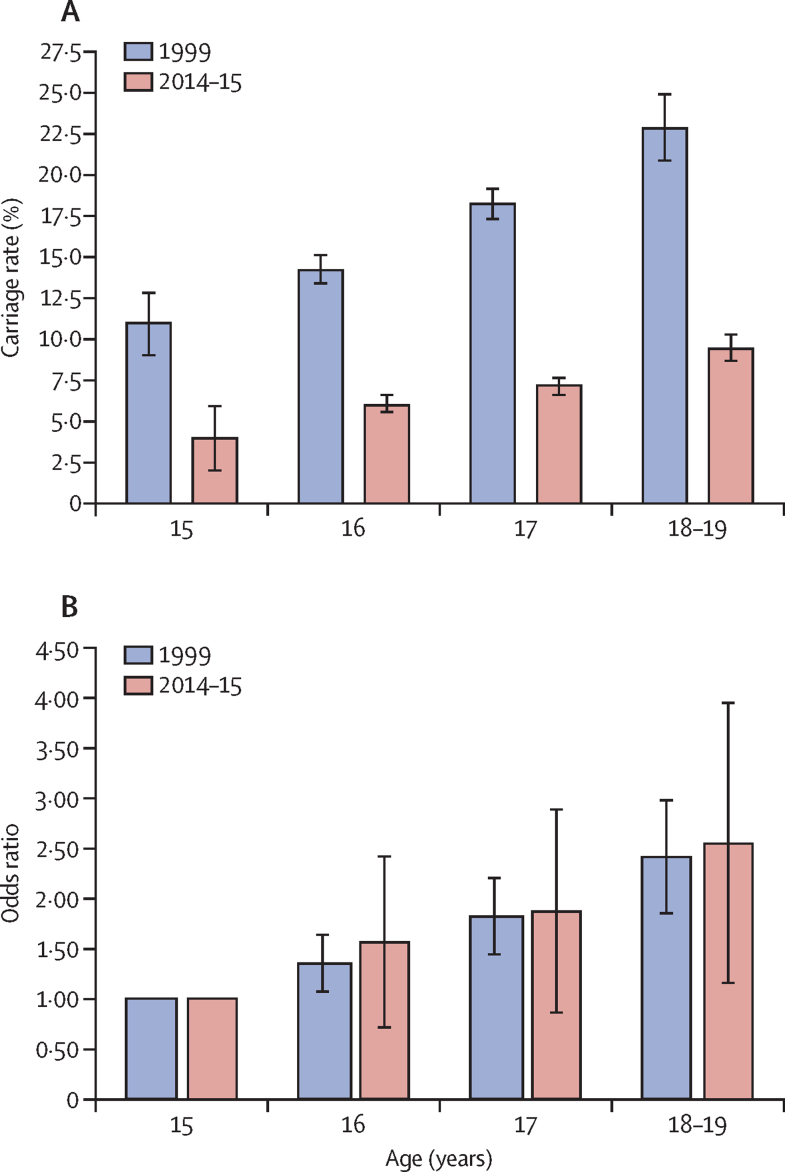
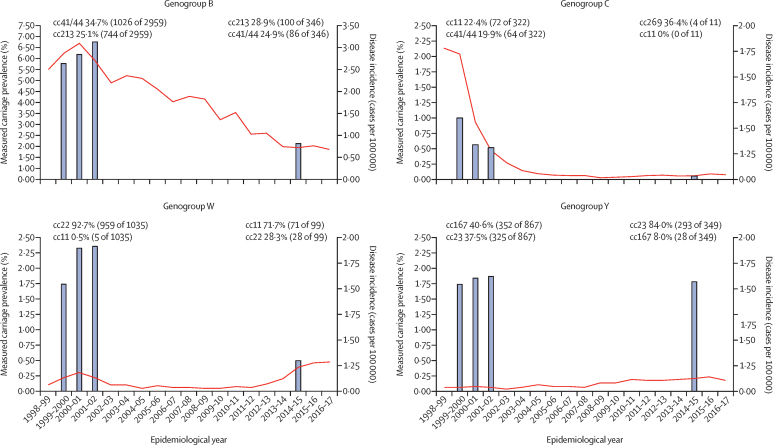
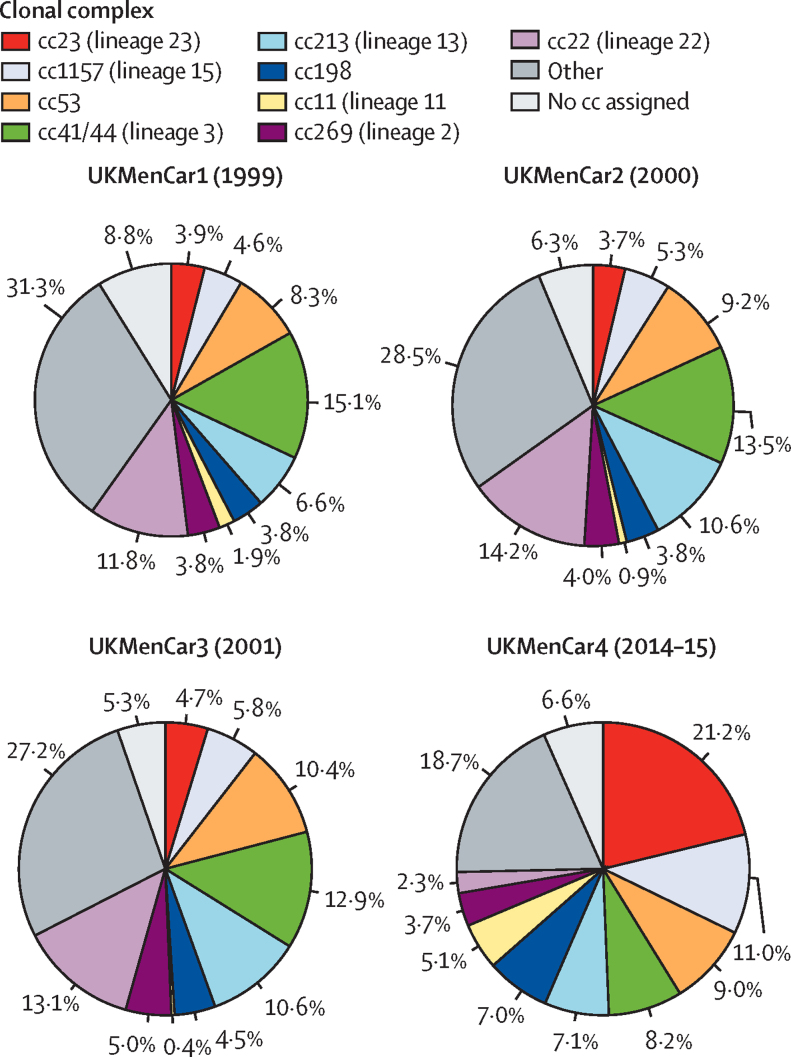
From the 19 641 participants (11 332 female, 8242 male, 67 not stated) in UKMenCar4 with culturable swabs and completed risk-factor questionnaires, 1420 meningococci were isolated, with a carriage prevalence of 7·23% (95% CI 6·88-7·60). Carriage prevalence was substantially lower in UKMenCar4 than in the previous surveys: carriage prevalence was 16·6% (95% CI 15·89-17·22; 2306/13 901) in UKMenCar1 (1999), 17·6% (17·05-18·22; 2873/16 295) in UKMenCar2 (2000), and 18·7% (18·12-19·27; 3283/17 569) in UKMenCar3 (2001). Carriage prevalence was lower for all serogroups in UKMenCar4 than in UKMenCar1-3, except for serogroup Y, which was unchanged. The prevalence of carriage-promoting social behaviours decreased from 1999 to 2014-15, with individuals reporting regular cigarette smoking decreasing from 2932 (21·5%) of 13 650 to 2202 (11·2%) of 19 641, kissing in the past week from 6127 (44·8%) of 13 679 to 7320 (37·3%) of 19 641, and attendance at pubs and nightclubs in the past week from 8436 (62·1%) of 13 594 to 7662 (39·0%) of 19 641 (all p<0·0001).
We show that meningococcal carriage prevalence in adolescents sampled nationally during a low incidence period (2014-15) was less than half of that in an equivalent population during a high incidence period (1999-2001). Disease and carriage caused by serogroup C was well controlled by ongoing vaccination. The prevalence of behaviours associated with carriage declined, suggesting that public health policies aimed at influencing behaviour might have further reduced disease.
Wellcome Trust, UK Department of Health, and National Institute for Health Research.
自 1999 年至 2014 年,英国侵袭性脑膜炎球菌病的发病率降低了约四倍,其中 C 群和 B 群疾病的发病率降低。C 群侵袭性脑膜炎球菌病发病率降低归因于 1999 年实施了脑膜炎球菌 C 群结合疫苗,通过直接和间接保护,但没有针对 B 群疾病实施疫苗。英国脑膜炎球菌带菌调查 1-3 项(UKMenCar1-3)于 1999 年、2000 年和 2001 年进行,对于了解疫苗接种的影响至关重要。为了调查侵袭性脑膜炎球菌病发病率的下降,我们在 2014-15 年进行了一项大规模的口咽带菌调查,这是在英国国家免疫计划改变脑膜炎球菌疫苗之前进行的。
UKMenCar4 是一项在年龄在 15-19 岁的青少年中进行的横断面调查,这些青少年从 11 个英国采样中心之一所在地区的学校和学院招募。参与者提供口咽拭子样本,并完成了一份关于带菌风险因素的问卷,包括社交行为。对样本进行了可能的奈瑟氏菌属的培养,并用血清群分型和全基因组测序进行了特征分析。本研究的数据与 UKMenCar1-3 调查(1999-2001 年)的结果进行了比较。
在 UKMenCar4 中,有 19641 名有可培养拭子和完成风险因素问卷的参与者(11332 名女性,8242 名男性,67 名未说明),分离出 1420 株脑膜炎球菌,带菌率为 7.23%(95%CI 6.88-7.60)。带菌率明显低于之前的调查:UKMenCar1(1999 年)中带菌率为 16.6%(95%CI 15.89-17.22;13901/13650),UKMenCar2(2000 年)中带菌率为 17.6%(17.05-18.22;16295/16295),UKMenCar3(2001 年)中带菌率为 18.7%(18.12-19.27;17569/17649)。除 Y 群外,UKMenCar4 中所有血清群的带菌率均低于 UKMenCar1-3,Y 群的带菌率不变。促进带菌的社交行为的流行率从 1999 年到 2014-15 年下降,报告定期吸烟的个体从 13650 人中的 2932 人(21.5%)下降到 19641 人中的 2202 人(11.2%),过去一周亲吻的人数从 13679 人中的 6127 人(44.8%)下降到 19641 人中的 7320 人(37.3%),过去一周参加酒吧和夜总会的人数从 13594 人中的 8436 人(62.1%)下降到 19641 人中的 7662 人(39.0%)(均 p<0.0001)。
我们表明,在低发病率期间(2014-15 年)全国范围内抽样的青少年中,脑膜炎球菌带菌率不到高发病率期间(1999-2001 年)的一半。血清群 C 引起的疾病和带菌得到了持续疫苗接种的很好控制。与带菌相关的行为的流行率下降,表明旨在影响行为的公共卫生政策可能进一步降低了疾病的发病率。
威康信托基金会、英国卫生部和英国国家卫生研究院。