Department of Mechanical and Industrial Engineering, University of Toronto, Toronto, ON, Canada.
Department of Emergency Medicine, Queen's University, Kingston, ON, Canada.
Resuscitation. 2021 May;162:329-333. doi: 10.1016/j.resuscitation.2021.01.008. Epub 2021 Jan 19.
The COVID-19 pandemic has led to closures of non-essential businesses and buildings. The impact of such closures on automated external defibrillator (AED) accessibility compared to changes in foot traffic levels is unknown.
We identified all publicly available online AED registries in Canada last updated May 1, 2019 or later. We mapped AED locations to location types and classified each location type as completely inaccessible, partially inaccessible, or unaffected based on government-issued closure orders as of May 1, 2020. Using location and mobility data from Google's COVID-19 Community Mobility Reports, we identified the change in foot traffic levels between February 15-May 1, 2020 (excluding April 10-12) compared to the baseline of January 3-February 1, 2020, and determined the discrepancy between foot traffic levels and AED accessibility.
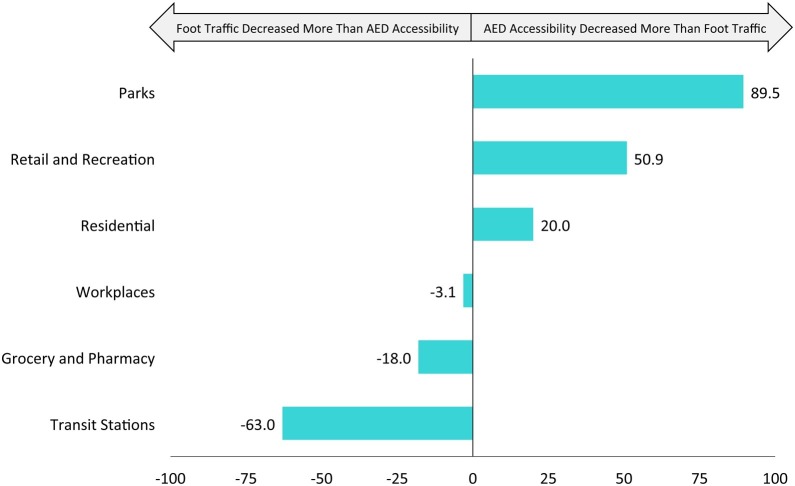
We identified four provincial and two municipal AED registries containing a total of 5848 AEDs. Of those, we estimated that 69.9% were completely inaccessible, 18.8% were partially inaccessible, and 11.3% were unaffected. Parks, retail and recreation locations, and workplaces experienced the greatest reduction in AED accessibility. The greatest discrepancies between foot traffic levels and AED accessibility occurred in parks, retail and recreation locations, and transit stations.
A majority of AEDs became inaccessible during the COVID-19 pandemic due to government-mandated closures. In a substantial number of locations across Canada, the reduction in AED accessibility was far greater than the reduction in foot traffic.
COVID-19 大流行导致非必要企业和建筑物关闭。与行人流量水平变化相比,这些关闭对自动体外除颤器(AED)可及性的影响尚不清楚。
我们确定了截至 2019 年 5 月 1 日或之后更新的所有可公开获取的加拿大在线 AED 注册处。我们将 AED 位置映射到位置类型,并根据截至 2020 年 5 月 1 日发布的政府关闭命令,将每种位置类型分类为完全不可访问、部分不可访问或不受影响。使用谷歌 COVID-19 社区流动性报告中的位置和移动数据,我们确定了 2020 年 2 月 15 日至 5 月 1 日(不包括 4 月 10 日至 12 日)与 2020 年 1 月 3 日至 2 月 1 日基线相比的行人流量水平变化,并确定了行人流量水平与 AED 可及性之间的差异。
我们确定了四个省级和两个市级 AED 注册处,其中共包含 5848 个 AED。其中,我们估计有 69.9%的 AED 完全不可用,18.8%的 AED 部分不可用,11.3%的 AED 不受影响。公园、零售和娱乐场所以及工作场所的 AED 可及性降低最大。行人流量水平和 AED 可及性之间的差异最大的是公园、零售和娱乐场所以及地铁站。
由于政府强制关闭,在 COVID-19 大流行期间,大多数 AED 变得无法使用。在加拿大的许多地点,AED 可及性的减少远远超过行人流量的减少。