Department of Cell Biology, Physiology and Immunology, Institute of Neuroscience, Universitat Autònoma de Barcelona, 08193, Bellaterra, Barcelona, Spain.
Department of Cell Biology, Physiology and Immunology, Universitat de Barcelona, 08028, Barcelona, Spain.
J Neuroinflammation. 2021 Jan 22;18(1):31. doi: 10.1186/s12974-020-02063-1.
When the homeostasis of the central nervous system (CNS) is altered, microglial cells become activated displaying a wide range of phenotypes that depend on the specific site, the nature of the activator, and particularly the microenvironment generated by the lesion. Cytokines are important signals involved in the modulation of the molecular microenvironment and hence play a pivotal role in orchestrating microglial activation. Among them, interleukin-6 (IL-6) is a pleiotropic cytokine described in a wide range of pathological conditions as a potent inducer and modulator of microglial activation, but with contradictory results regarding its detrimental or beneficial functions. The objective of the present study was to evaluate the effects of chronic IL-6 production on the immune response associated with CNS-axonal anterograde degeneration.
The perforant pathway transection (PPT) paradigm was used in transgenic mice with astrocyte-targeted IL6-production (GFAP-IL6Tg). At 2, 3, 7, 14, and 21 days post-lesion, the hippocampal areas were processed for immunohistochemistry, flow cytometry, and protein microarray.
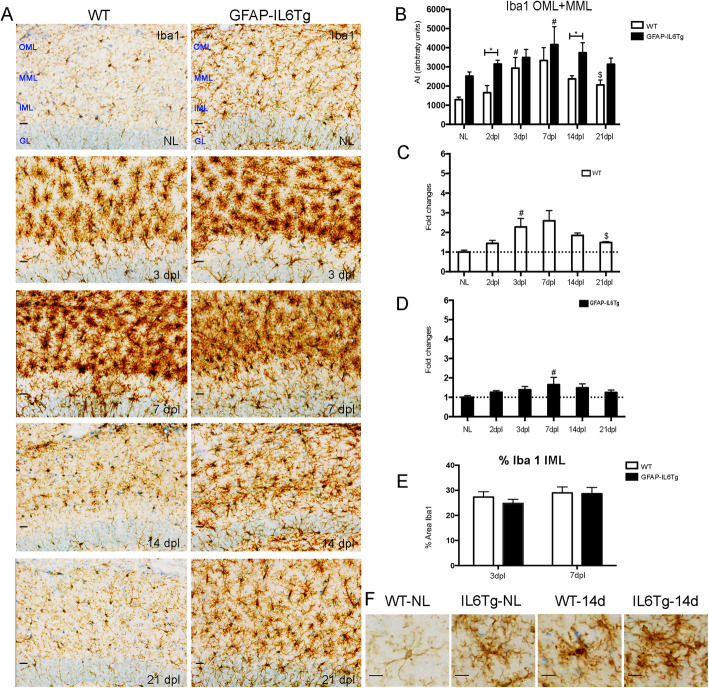
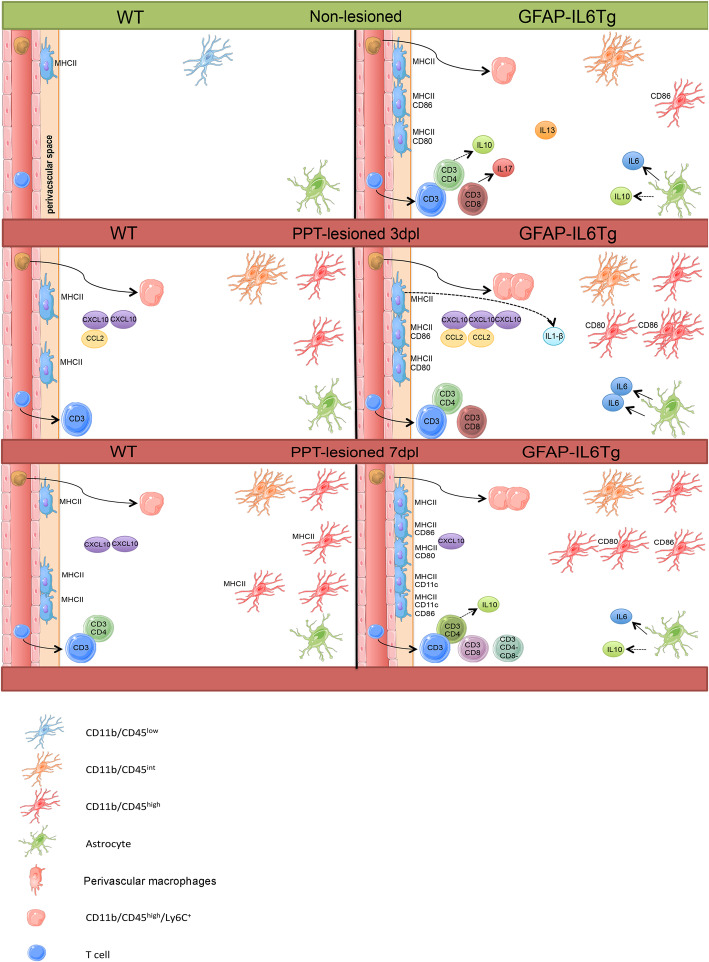
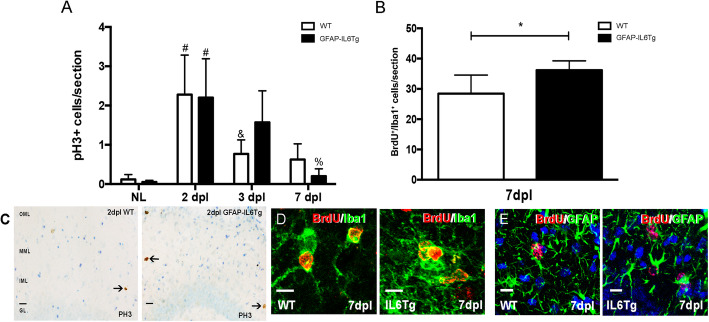
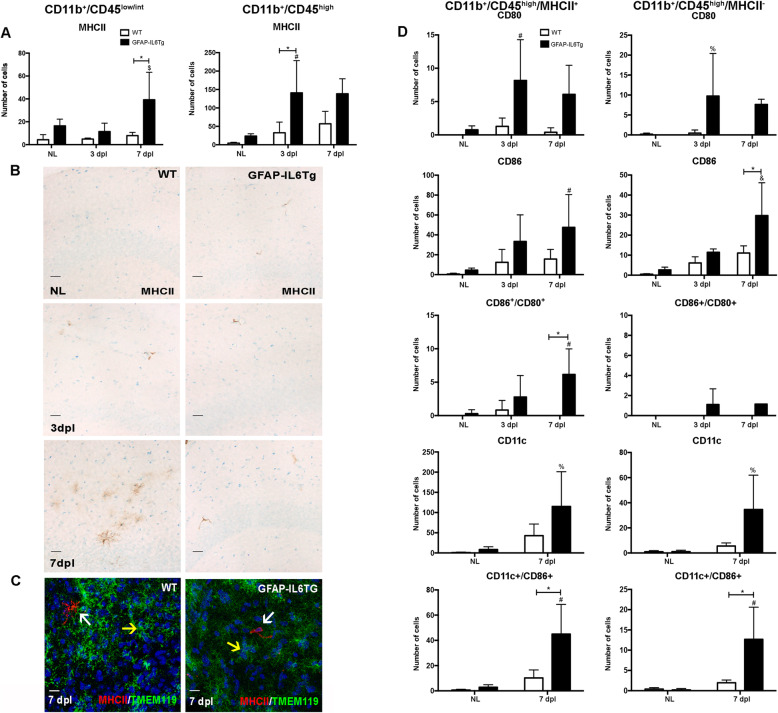
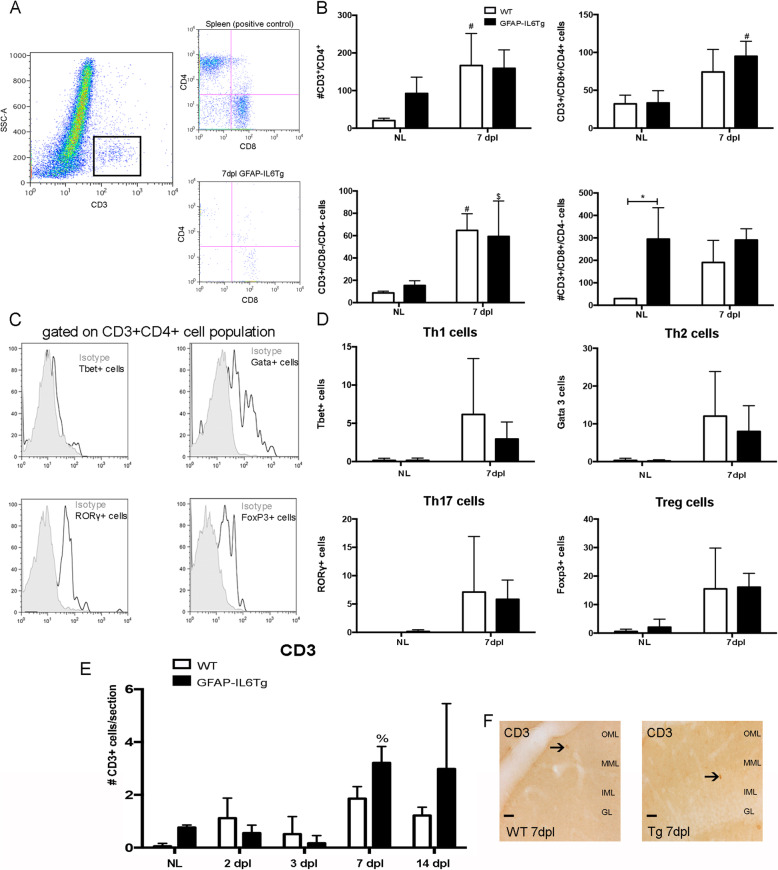
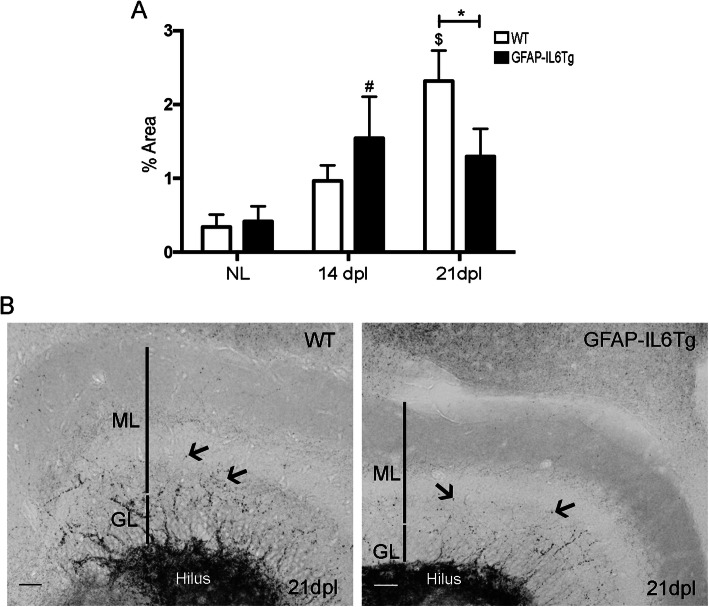
An increase in the microglia/macrophage density was observed in GFAP-IL6Tg animals in non-lesion conditions and at later time-points after PPT, associated with higher microglial proliferation and a major monocyte/macrophage cell infiltration. Besides, in homeostasis, GFAP-IL6Tg showed an environment usually linked with an innate immune response, with more perivascular CD11b/CD45/MHCII/CD86 macrophages, higher T cell infiltration, and higher IL-10, IL-13, IL-17, and IL-6 production. After PPT, WT animals show a change in microglia phenotype expressing MHCII and co-stimulatory molecules, whereas transgenic mice lack this shift. This lack of response in the GFAP-IL6Tg was associated with lower axonal sprouting.
Chronic exposure to IL-6 induces a desensitized phenotype of the microglia.
当中枢神经系统(CNS)的内稳态发生改变时,小胶质细胞被激活,表现出多种表型,这些表型取决于特定的部位、激活剂的性质,特别是病变产生的微环境。细胞因子是参与调节分子微环境的重要信号,因此在协调小胶质细胞激活方面发挥着关键作用。其中,白细胞介素-6(IL-6)是一种多效细胞因子,在广泛的病理条件下被描述为小胶质细胞激活的强有力诱导剂和调节剂,但关于其有害或有益功能的结果存在矛盾。本研究的目的是评估慢性 IL-6 产生对与 CNS 轴突顺行变性相关的免疫反应的影响。
使用具有星形胶质细胞靶向 IL6 产生(GFAP-IL6Tg)的转基因小鼠进行穿通纤维束横断(PPT)范式。在损伤后 2、3、7、14 和 21 天,对海马区进行免疫组织化学、流式细胞术和蛋白质微阵列分析。
在非损伤条件下和 PPT 后较晚时间点,GFAP-IL6Tg 动物的小胶质细胞/巨噬细胞密度增加,与小胶质细胞增殖增加和单核细胞/巨噬细胞细胞浸润增多有关。此外,在静息状态下,GFAP-IL6Tg 显示出与固有免疫反应相关的环境,具有更多的血管周围 CD11b/CD45/MHCII/CD86 巨噬细胞、更高的 T 细胞浸润和更高的 IL-10、IL-13、IL-17 和 IL-6 产生。在 PPT 后,WT 动物的小胶质细胞表型发生变化,表达 MHCII 和共刺激分子,而转基因小鼠则缺乏这种变化。GFAP-IL6Tg 中缺乏这种反应与轴突发芽减少有关。
慢性暴露于 IL-6 会诱导小胶质细胞产生脱敏表型。