Max Planck Institute for Evolutionary Anthropology, 04103, Leipzig, Germany.
Taï Chimpanzee Project, CSRS, 01 BP 1303, Abidjan, Ivory Coast.
Nat Commun. 2021 Jan 22;12(1):539. doi: 10.1038/s41467-020-20709-9.
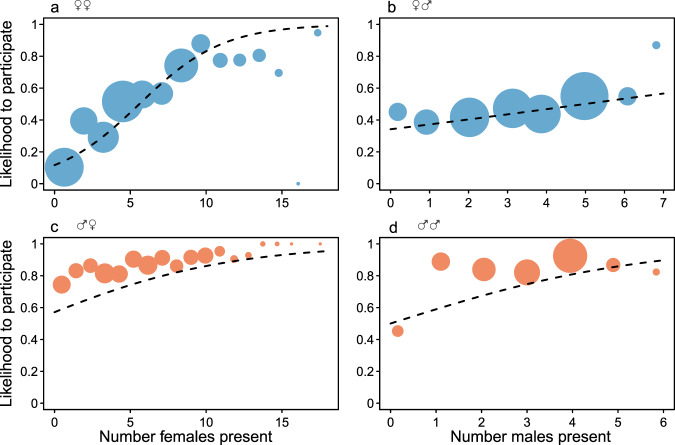
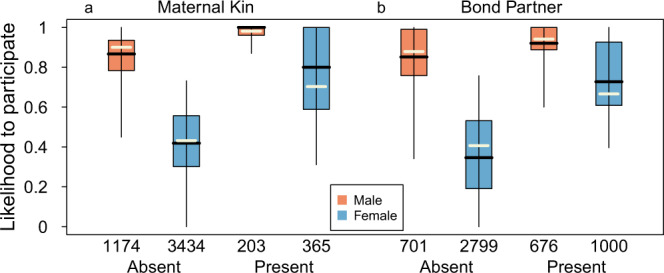
Humans maintain extensive social ties of varying preferences, providing a range of opportunities for beneficial cooperative exchange that may promote collective action and our unique capacity for large-scale cooperation. Similarly, non-human animals maintain differentiated social relationships that promote dyadic cooperative exchange, but their link to cooperative collective action is little known. Here, we investigate the influence of social relationship properties on male and female chimpanzee participations in a costly form of group action, intergroup encounters. We find that intergroup encounter participation increases with a greater number of other participants as well as when participants are maternal kin or social bond partners, and that these effects are independent from one another and from the likelihood to associate with certain partners. Together, strong social relationships between kin and non-kin facilitate group-level cooperation in one of our closest living relatives, suggesting that social bonds may be integral to the evolution of cooperation in our own species.
人类维持着广泛的社会关系,这些关系具有不同的偏好,为有益的合作交流提供了多种机会,这可能促进了集体行动和我们进行大规模合作的独特能力。同样,非人类动物也维持着差异化的社会关系,促进了对偶合作交流,但它们与合作集体行动的联系却鲜为人知。在这里,我们研究了社会关系属性对雄性和雌性黑猩猩参与一种代价高昂的群体行动——群体间遭遇的影响。我们发现,随着其他参与者数量的增加,以及参与者是母系亲属或社会纽带伙伴时,群体间遭遇的参与度会增加,而且这些影响彼此独立,与与某些伙伴结盟的可能性无关。总之,亲缘关系和非亲缘关系之间的牢固社会关系促进了我们最亲近的现存亲属之一的群体层面的合作,这表明社会关系可能是我们自身物种合作进化的重要组成部分。