Weill Institute for Neurosciences, University of California San Francisco, San Francisco, CA, 94158, USA.
Department of Psychiatry and Behavioral Sciences, Johns Hopkins School of Medicine, Baltimore, MD, 21287, USA.
Mol Psychiatry. 2021 Sep;26(9):5239-5250. doi: 10.1038/s41380-020-01006-9. Epub 2021 Jan 22.
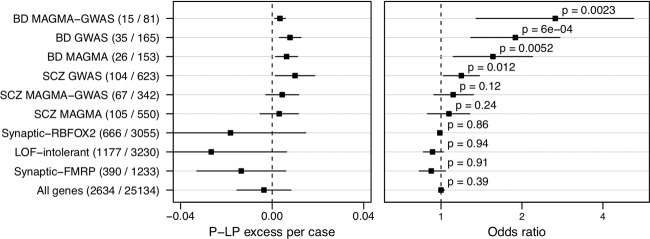
Bipolar disorder (BD) is a serious mental illness with substantial common variant heritability. However, the role of rare coding variation in BD is not well established. We examined the protein-coding (exonic) sequences of 3,987 unrelated individuals with BD and 5,322 controls of predominantly European ancestry across four cohorts from the Bipolar Sequencing Consortium (BSC). We assessed the burden of rare, protein-altering, single nucleotide variants classified as pathogenic or likely pathogenic (P-LP) both exome-wide and within several groups of genes with phenotypic or biologic plausibility in BD. While we observed an increased burden of rare coding P-LP variants within 165 genes identified as BD GWAS regions in 3,987 BD cases (meta-analysis OR = 1.9, 95% CI = 1.3-2.8, one-sided p = 6.0 × 10), this enrichment did not replicate in an additional 9,929 BD cases and 14,018 controls (OR = 0.9, one-side p = 0.70). Although BD shares common variant heritability with schizophrenia, in the BSC sample we did not observe a significant enrichment of P-LP variants in SCZ GWAS genes, in two classes of neuronal synaptic genes (RBFOX2 and FMRP) associated with SCZ or in loss-of-function intolerant genes. In this study, the largest analysis of exonic variation in BD, individuals with BD do not carry a replicable enrichment of rare P-LP variants across the exome or in any of several groups of genes with biologic plausibility. Moreover, despite a strong shared susceptibility between BD and SCZ through common genetic variation, we do not observe an association between BD risk and rare P-LP coding variants in genes known to modulate risk for SCZ.
双相情感障碍(BD)是一种严重的精神疾病,具有大量常见的变异遗传率。然而,罕见编码变异在 BD 中的作用尚未得到充分证实。我们检查了 3987 名无关联的 BD 患者和 5322 名主要来自欧洲血统的对照者的蛋白质编码(外显子)序列,这些个体来自 Bipolar Sequencing Consortium(BSC)的四个队列。我们评估了罕见的、导致蛋白质改变的、单核苷酸变异的负担,这些变异被分类为致病性或可能致病性(P-LP),无论是在外显子组范围内还是在几个具有 BD 表型或生物学合理性的基因组内。虽然我们在 3987 例 BD 病例中发现了 165 个被确定为 BD GWAS 区域的基因中存在罕见编码 P-LP 变异的负担增加(meta 分析 OR=1.9,95%CI=1.3-2.8,单侧 p=6.0×10),但这种富集在另外 9929 例 BD 病例和 14018 例对照中并未复制(OR=0.9,单侧 p=0.70)。尽管 BD 与精神分裂症共享常见变异遗传率,但在 BSC 样本中,我们没有观察到 P-LP 变异在 SCZ GWAS 基因、与 SCZ 相关的两个神经元突触基因(RBFOX2 和 FMRP)或功能丧失不耐受基因中存在显著富集。在这项研究中,这是对 BD 外显子变异的最大分析,BD 患者在外显子组或任何具有生物学合理性的几个基因组中没有可重复的罕见 P-LP 变异富集。此外,尽管 BD 和 SCZ 通过常见的遗传变异具有强烈的共同易感性,但我们没有观察到 BD 风险与已知调节 SCZ 风险的基因中的罕见 P-LP 编码变异之间存在关联。