Department of Structural Biochemistry, Max-Planck-Institute of Molecular Physiology, Otto-Hahn-Strasse 11, 44227, Dortmund, Germany.
Department of Chemical Engineering and Biotechnology, University of Applied Sciences Darmstadt, Stephanstrasse 7, 64295, Darmstadt, Germany.
Curr Genet. 2021 Jun;67(3):399-406. doi: 10.1007/s00294-020-01144-1. Epub 2021 Jan 23.
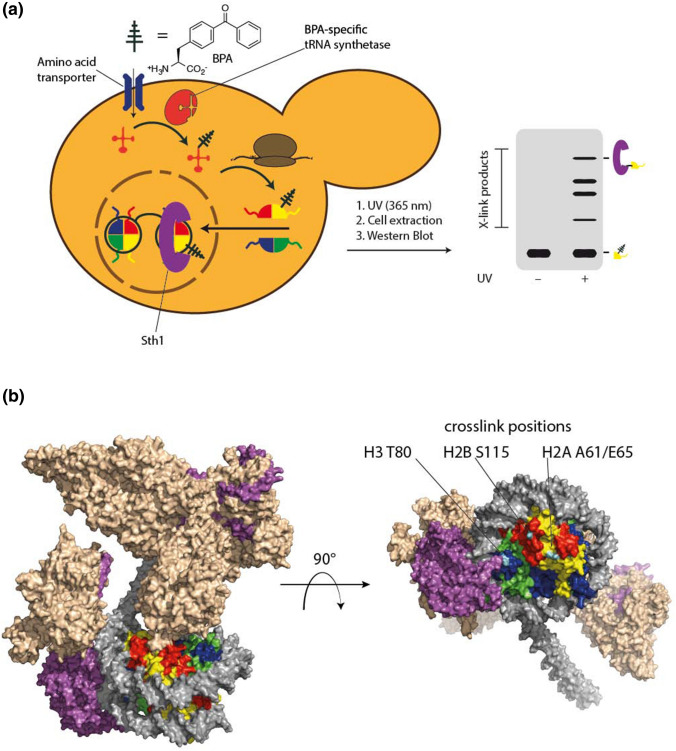
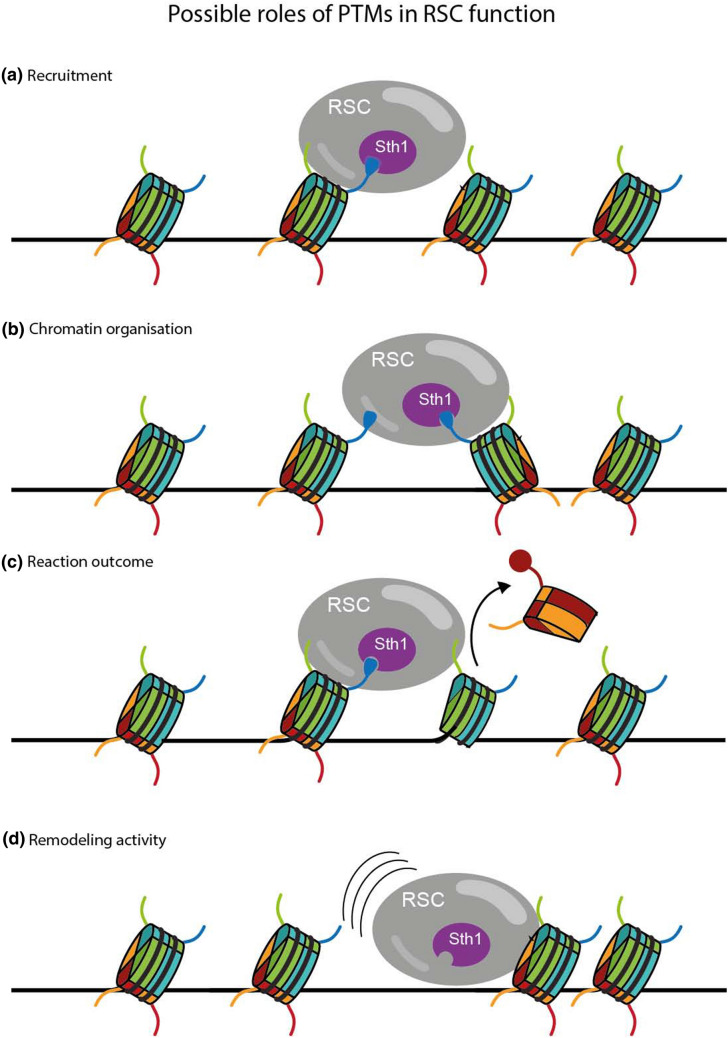
Multiple reports over the past 2 years have provided the first complete structural analyses for the essential yeast chromatin remodeler, RSC, providing elaborate molecular details for its engagement with the nucleosome. However, there still remain gaps in resolution, particularly within the many RSC subunits that harbor histone binding domains.Solving contacts at these interfaces is crucial because they are regulated by posttranslational modifications that control remodeler binding modes and function. Modifications are dynamic in nature often corresponding to transcriptional activation states and cell cycle stage, highlighting not only a need for enriched spatial resolution but also temporal understanding of remodeler engagement with the nucleosome. Our recent work sheds light on some of those gaps by exploring the binding interface between the RSC catalytic motor protein, Sth1, and the nucleosome, in the living nucleus. Using genetically encoded photo-activatable amino acids incorporated into histones of living yeast we are able to monitor the nucleosomal binding of RSC, emphasizing the regulatory roles of histone modifications in a spatiotemporal manner. We observe that RSC prefers to bind H2B SUMOylated nucleosomes in vivo and interacts with neighboring nucleosomes via H3K14ac. Additionally, we establish that RSC is constitutively bound to the nucleosome and is not ejected during mitotic chromatin compaction but alters its binding mode as it progresses through the cell cycle. Our data offer a renewed perspective on RSC mechanics under true physiological conditions.
过去 2 年的多篇报道首次为基本的酵母染色质重塑因子 RSC 提供了完整的结构分析,详细阐述了其与核小体的结合的分子细节。然而,分辨率仍然存在差距,特别是在许多含有组蛋白结合域的 RSC 亚基中。解决这些界面的接触问题至关重要,因为它们受到翻译后修饰的调控,这些修饰控制着重塑因子的结合模式和功能。修饰具有动态性质,通常与转录激活状态和细胞周期阶段相对应,这不仅突出了对富含空间分辨率的需求,也突出了对重塑因子与核小体结合的时间理解的需求。我们最近的工作通过在活核中探索 RSC 的催化马达蛋白 Sth1 与核小体之间的结合界面,揭示了其中的一些差距。我们使用遗传编码的光激活氨基酸整合到活酵母的组蛋白中,能够监测 RSC 与核小体的结合,强调了组蛋白修饰在时空上的调控作用。我们观察到,RSC 更喜欢在体内结合 SUMO 化的 H2B 核小体,并通过 H3K14ac 与相邻的核小体相互作用。此外,我们还确定 RSC 持续结合在核小体上,在有丝分裂染色质紧缩过程中不会被逐出,但随着细胞周期的进展,它会改变其结合模式。我们的数据为真正的生理条件下 RSC 的力学提供了新的视角。