Parnell Timothy J, Schlichter Alisha, Wilson Boris G, Cairns Bradley R
Department of Oncological Sciences, Howard Hughes Medical Institute, University of Utah School of Medicine, Salt Lake City, United States.
Elife. 2015 Mar 30;4:e06073. doi: 10.7554/eLife.06073.
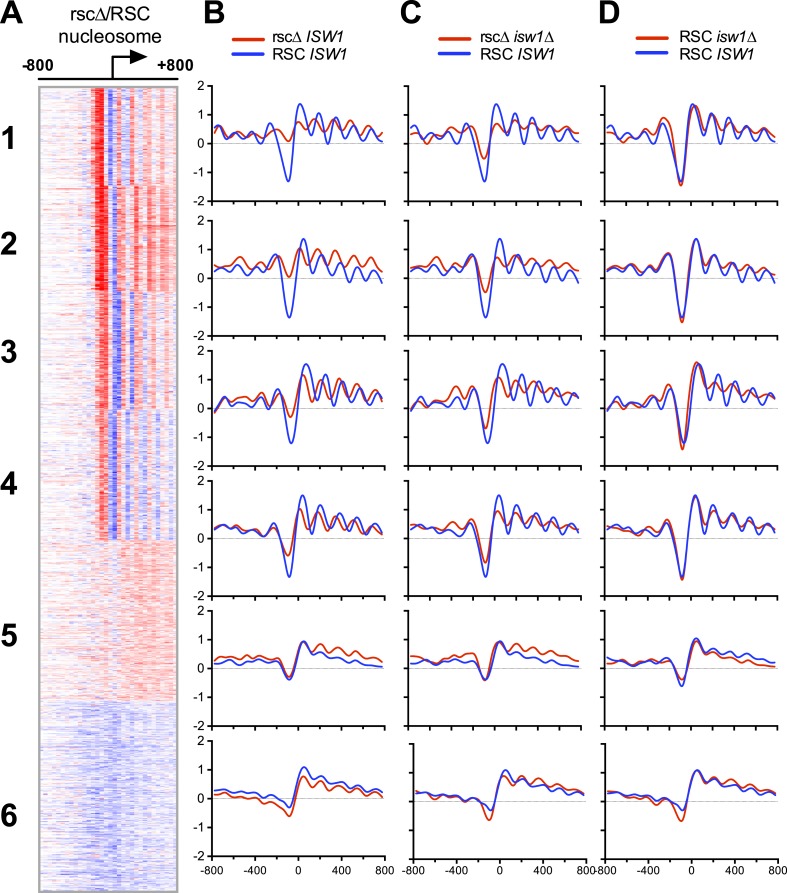
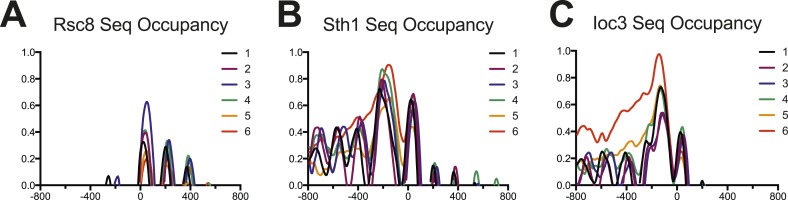
ISWI family chromatin remodelers typically organize nucleosome arrays, while SWI/SNF family remodelers (RSC) typically disorganize and eject nucleosomes, implying an antagonism that is largely unexplored in vivo. Here, we describe two independent genetic screens for rsc suppressors that yielded mutations in the promoter-focused ISW1a complex or mutations in the 'basic patch' of histone H4 (an epitope that regulates ISWI activity), strongly supporting RSC-ISW1a antagonism in vivo. RSC and ISW1a largely co-localize, and genomic nucleosome studies using rsc isw1 mutant combinations revealed opposing functions: promoters classified with a nucleosome-deficient region (NDR) gain nucleosome occupancy in rsc mutants, but this gain is attenuated in rsc isw1 double mutants. Furthermore, promoters lacking NDRs have the highest occupancy of both remodelers, consistent with regulation by nucleosome occupancy, and decreased transcription in rsc mutants. Taken together, we provide the first genetic and genomic evidence for RSC-ISW1a antagonism and reveal different mechanisms at two different promoter architectures.
ISWI家族染色质重塑因子通常会组织核小体阵列,而SWI/SNF家族重塑因子(RSC)通常会破坏并排出核小体,这意味着在体内存在一种很大程度上未被探索的拮抗作用。在这里,我们描述了针对rsc抑制因子的两项独立遗传筛选,结果在以启动子为重点的ISW1a复合物中产生了突变,或者在组蛋白H4的“碱性区域”(一个调节ISWI活性的表位)中产生了突变,这有力地支持了体内RSC-ISW1a的拮抗作用。RSC和ISW1a在很大程度上共定位,使用rsc isw1突变体组合进行的基因组核小体研究揭示了相反的功能:被归类为具有核小体缺陷区域(NDR)的启动子在rsc突变体中核小体占有率增加,但在rsc isw1双突变体中这种增加减弱。此外,缺乏NDR的启动子在两种重塑因子中占有率最高,这与核小体占有率的调节一致,并且在rsc突变体中转录减少。综上所述,我们提供了RSC-ISW1a拮抗作用的首个遗传和基因组证据,并揭示了两种不同启动子结构的不同机制。