Tran Dat T, Palfrey Dan, Welsh Robert
Institute of Health Economics, #1200-10405 Jasper Avenue, Edmonton, AB, T5J 3N4, Canada.
Faculty of Pharmacy and Pharmaceutical Sciences, University of Alberta, Edmonton, AB, Canada.
Pharmacoecon Open. 2021 Sep;5(3):425-435. doi: 10.1007/s41669-021-00257-8. Epub 2021 Jan 23.
We calculated the short- and long-term care resource use and costs in adults with high-risk conditions for cardiovascular disease (HRCVD) as defined by the Canadian Cardiovascular Society dyslipidemia guidelines.
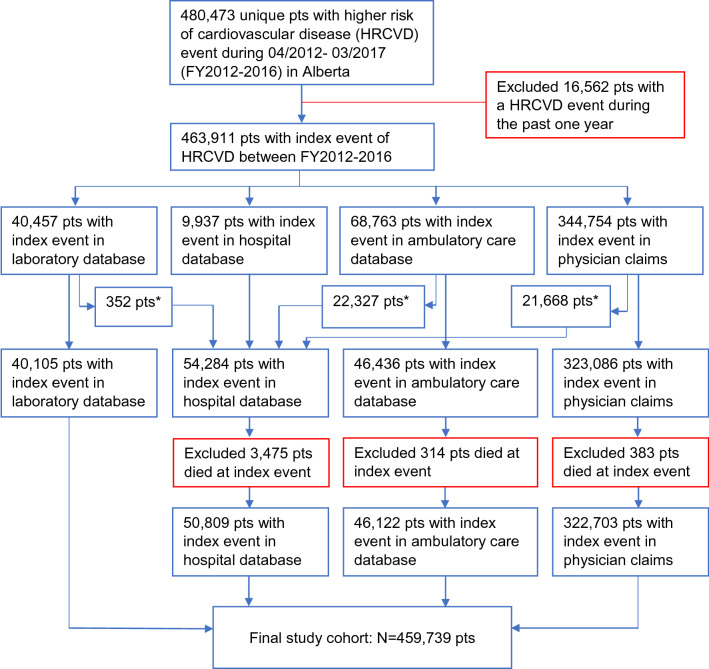
We linked Alberta health databases to identify patients aged ≥ 18 years with HRCVD between fiscal year (FY) 2012 and FY2016. The first HRCVD event was the index event. Patients were categorized into (1) primary prevention patients and (2) secondary prevention patients at the index event and were followed until death, they moved out of the province, or they were censored at March 2018. We calculated the resource use and costs for each of the 5 years after the index event.
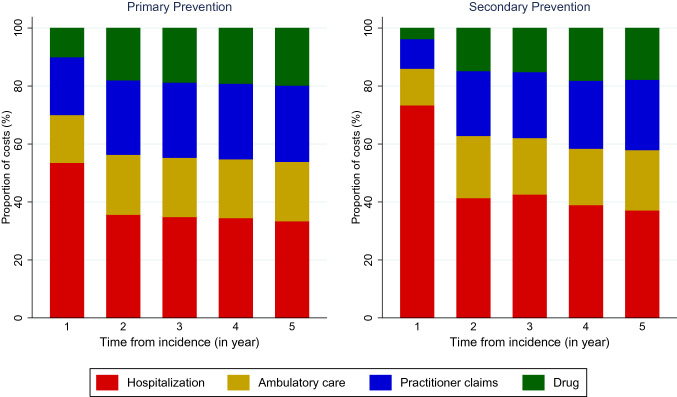
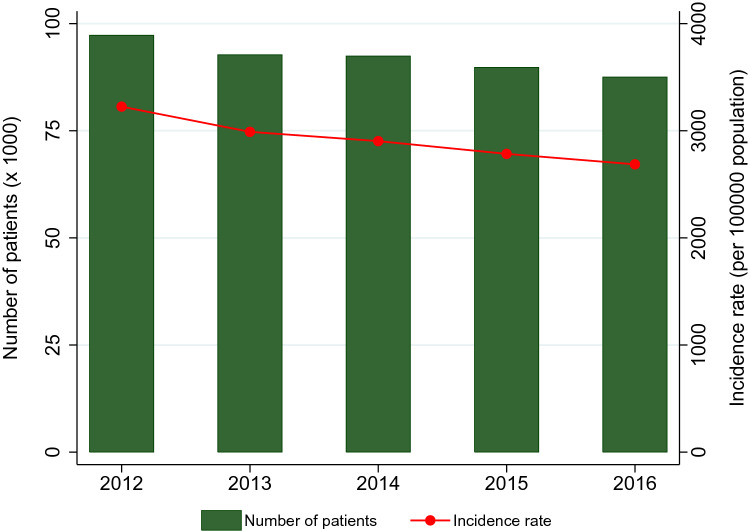
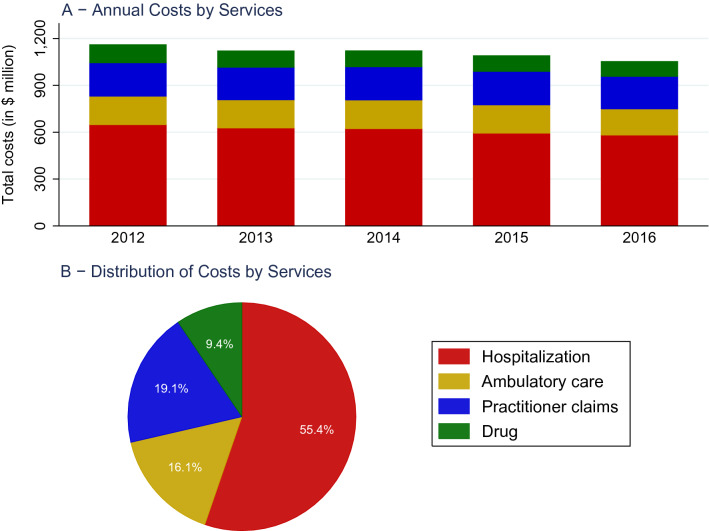
The study included 459,739 HRCVD patients (13,947 [3%] were secondary prevention patients). The secondary prevention patients were older (median age 61 years vs. 55 years; p < 0.001), and there were fewer females in this group (30.4% vs. 51.3%; p < 0.001). The total healthcare costs in the first year decreased over time (FY2012: 1.16 billion Canadian dollars (CA$); FY2016: CA$1.05 billion; p < 0.001). An HRCVD patient incurred CA$12,068, CA$5626, and CA$4655 during the first, second, and fifth year, respectively (p for trend < 0.001). During the first year, healthcare costs per secondary prevention patient (CA$36,641) were triple that for a primary prevention patient (CA$11,299; p < 0.001), primarily due to higher hospitalization costs in secondary prevention patients (CA$26,896 vs. CA$6051; p < 0.001).
The healthcare costs for HRCVD patients were substantial but decreased over time. The costs were highest in the year following the index event and decreased thereafter. Secondary prevention patients incurred higher costs than the primary prevention patients.
我们计算了根据加拿大心血管学会血脂异常指南定义的心血管疾病高危成人(HRCVD)的短期和长期护理资源使用及成本。
我们将艾伯塔省的健康数据库相链接,以识别2012财年至2016财年期间年龄≥18岁的HRCVD患者。首次HRCVD事件为索引事件。患者在索引事件时被分为(1)一级预防患者和(2)二级预防患者,并随访至死亡、迁出该省或在2018年3月被截尾。我们计算了索引事件后5年中每一年的资源使用和成本。
该研究纳入了459,739例HRCVD患者(13,947例[3%]为二级预防患者)。二级预防患者年龄更大(中位年龄61岁对55岁;p<0.001),且该组女性更少(30.4%对51.3%;p<0.001)。第一年的总医疗费用随时间下降(2012财年:11.6亿加元;2016财年:10.5亿加元;p<0.001)。一名HRCVD患者在第一年、第二年和第五年分别产生12,068加元、5626加元和4655加元的费用(趋势p<0.001)。在第一年,每例二级预防患者的医疗费用(36,641加元)是一级预防患者(11,299加元)的三倍(p<0.001),主要是因为二级预防患者的住院费用更高(26,896加元对6051加元;p<0.001)。
HRCVD患者的医疗费用很高,但随时间下降。费用在索引事件后的第一年最高,此后下降。二级预防患者产生的费用高于一级预防患者。