Song Ci, Xu Yan, Ding Yuqing, Zhang Yanfang, Liu Na, Li Lin, Li Zhun, Du Jiangbo, You Hua, Ma Hongxia, Jin Guangfu, Wang Xudong, Shen Hongbing, Lin Yuan, Jiang Xiaoqing, Hu Zhibin
State Key Laboratory of Reproductive Medicine, Nanjing Medical University, Nanjing, 211166, China.
Department of Epidemiology, School of Public Health, Nanjing Medical University, Nanjing, 211166, China.
BMC Med. 2021 Jan 25;19(1):14. doi: 10.1186/s12916-020-01890-6.
The World Health Organization (WHO) in 2015 stated that every effort should be made to provide cesarean delivery (CD) for women in need. In China, the two-child policy largely prompts the number of advanced age childbirth, which raises the possibility of an increasing number of women who need a c-section. The aim of this study was to assess the trends in the overall and medical indication-classified CD rates in the era of the two-child policy in Jiangsu, China.
A retrospective cross-sectional study of 291,448 women who delivered in 11 hospitals in Jiangsu province between 2012 and 2019 was conducted. Medical cesarean indication for each woman was ascertained by manually reviewing the medical records. The 291,448 women were divided into two subgroups according to the presence of the indications: the indicated group (7.80%) and the non-indicated group (92.20%). We then fitted joinpoint regression and log-binomial regression models to estimate trends in the CD rates across the study period.
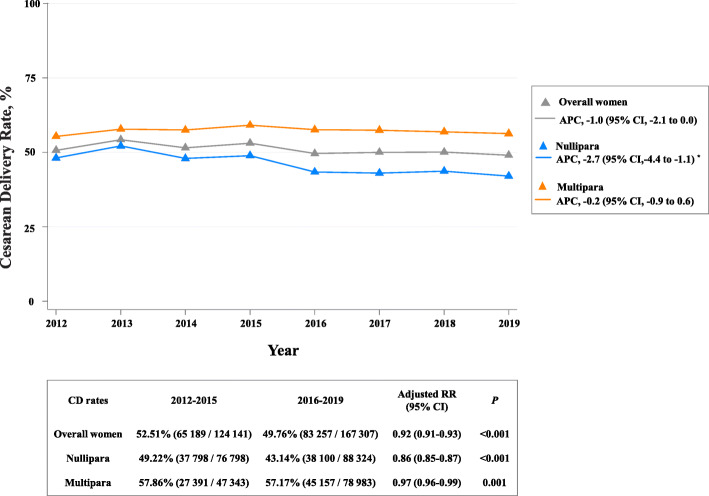
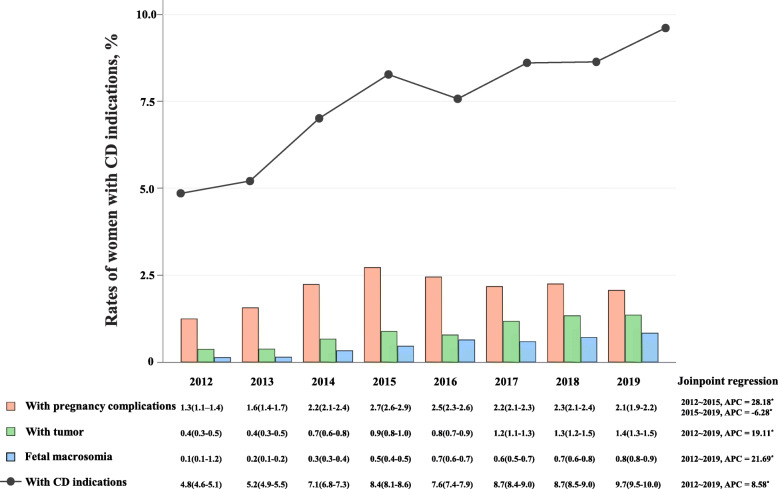
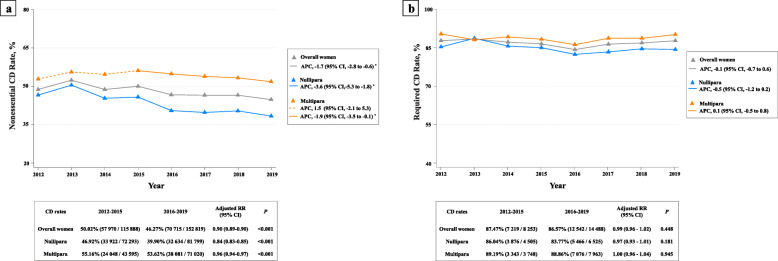
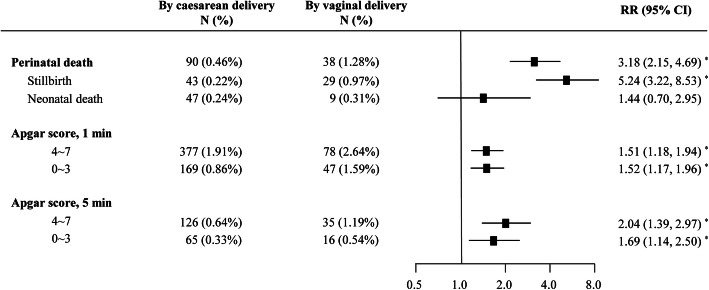
The overall CD rate was observed with a declining trend from 52.51% in 2012-2015 to 49.76% in 2016-2019 (adjusted RR, 0.92; 95% CI, 0.91-0.93; P < 0.001), along with an annual percentage change (APC) to be - 1.0 (95% CI, - 2.1 to 0.0) across the period. The participants were then divided into two subgroups according to the presence of medical CD indications: the indicated group (7.80%) and the non-indicated group (92.20%).We found the declining trend was most pronounced in the non-indicated group, with the CD rates decreased from 50.02% in 2012-2015 to 46.27% in 2016-2019 (adjusted RR, 0.90; 95% CI, 0.89-0.90; P < 0.001). By contrast, we observed a steady trend in the CD rate of the indicated group, which maintained from 87.47% in 2012-2015 to 86.57% in 2016-2019 (P = 0.448). In the indicated group, a higher risk of adverse pregnancy outcomes was revealed for those women who delivered vaginally as compared with those who received c-section. We further investigated that women with following specific indications had a higher proportion of vaginal delivery, i.e., pregnancy complications, fetal macrosomia, and pregnancy complicated with tumor (34.70%, 10.84%, and 16.34%, respectively). Women with the above 3 indications were observed with a higher risk of adverse pregnancy outcomes if delivered vaginally. The incidence rates of the medical indications among the general population increased considerably over the 8-year period (P < 0.001).
Although the overall CD rate apparently decreased in the recent years, along with the decline of the unnecessary CD rate, a considerable proportion of indicated women were not provided with CD service in Jiangsu, China. Instead of targeting the overall CD rate, we need to take actions to reduce unnecessary CD rate and provide adequate c-section service for women with indications, particularly for those with underlying diseases and suspected fetal macrosomia.
世界卫生组织(WHO)在2015年指出,应尽一切努力为有需要的妇女提供剖宫产(CD)。在中国,二孩政策在很大程度上促使高龄分娩数量增加,这增加了需要剖宫产的妇女数量上升的可能性。本研究的目的是评估中国江苏省二孩政策时代总体剖宫产率和按医学指征分类的剖宫产率的趋势。
对2012年至2019年在江苏省11家医院分娩的291448名妇女进行回顾性横断面研究。通过人工查阅病历确定每名妇女的医学剖宫产指征。根据指征的有无将291448名妇女分为两个亚组:有指征组(7.80%)和无指征组(92.20%)。然后我们拟合连接点回归模型和对数二项回归模型来估计整个研究期间剖宫产率的趋势。
总体剖宫产率呈下降趋势,从2012 - 2015年的52.51%降至2016 - 2019年的49.76%(调整风险比,0.92;95%置信区间,0.91 - 0.93;P < 0.001),在此期间年变化百分比(APC)为 - 1.0(95%置信区间, - 2.1至0.0)。然后根据医学剖宫产指征的有无将参与者分为两个亚组:有指征组(7.80%)和无指征组(92.20%)。我们发现无指征组的下降趋势最为明显,剖宫产率从2012 - 2015年的50.02%降至2016 - 2019年的46.27%(调整风险比,0.90;95%置信区间,0.89 - 0.90;P < 0.001)。相比之下,我们观察到有指征组的剖宫产率呈稳定趋势,从2012 - 2015年的87.47%维持到2016 - 2019年的86.57%(P = 0.448)。在有指征组中,与接受剖宫产的妇女相比,阴道分娩的妇女出现不良妊娠结局的风险更高。我们进一步调查发现,有以下特定指征的妇女阴道分娩的比例较高,即妊娠并发症、巨大胎儿和妊娠合并肿瘤(分别为34.70%、10.84%和16.34%)。上述3种指征的妇女若阴道分娩,出现不良妊娠结局的风险更高。在这8年期间,普通人群中这些医学指征的发生率显著增加(P < 0.001)。
尽管近年来总体剖宫产率明显下降,同时不必要剖宫产率也有所下降,但在中国江苏省,仍有相当一部分有指征的妇女未获得剖宫产服务。我们需要采取行动降低不必要剖宫产率,而不是针对总体剖宫产率,并为有指征的妇女,特别是患有基础疾病和疑似巨大胎儿的妇女提供适当的剖宫产服务。