
黑热病后皮肤利什曼病的分子诊断进展
Advancement in Molecular Diagnosis of Post Kala-Azar Dermal Leishmaniasis.
作者信息
Dixit Keerti Kaumudee, Singh Ruchi, Salotra Poonam
机构信息
ICMR- National Institute of Pathology (NIP), New Delhi, India.
出版信息
Indian J Dermatol. 2020 Nov-Dec;65(6):465-472. doi: 10.4103/ijd.IJD_311_19.
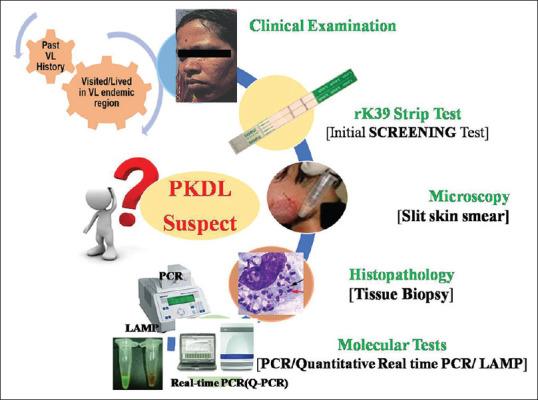
Post kala-azar dermal leishmaniasis (PKDL), a clinical sequela of visceral leishmaniasis (VL), plays a critical role in the anthroponotic transmission of VL, particularly in the Indian subcontinent (ISC). The early, accurate, and feasible diagnosis of PKDL is essential for the attainment and sustenance of VL elimination goal in ISC. PKDL poses a stumbling block for this goal, considering the heterogeneity presented with regard to time after cure of VL and onset of PKDL, chronicity, and clinical variations. In most of the endemic regions the diagnosis is based on clinical examination, previous history of VL, by ruling out other disorders, and by the response to treatment. The conventional microscopic examination involving the demonstration of Leishman-Donovan bodies (LDB) in macrophages is pathognomonic, however, the method faces constraints in terms of being invasive, less sensitive, technically demanding, and difficult to be applied in field conditions. Serological evidences are of limited use because antileishmanial antibodies remain positive for years after VL treatment. Molecular tools such as PCR, nested-PCR, Q-PCR overcome these constraints and have become increasingly popular due to their high sensitivity and specificity along with their applicability in diverse clinical samples. Molecular methods not only play a key role in early detection but also provide quantification and monitoring of treatment effectiveness. NCBI PubMed search tool was used for locating, selecting, and extracting research articles pertinent for this review article by using various related terminologies on the molecular diagnosis of leishmaniasis.
黑热病后皮肤利什曼病(PKDL)是内脏利什曼病(VL)的一种临床后遗症,在VL的人传人传播中起着关键作用,尤其是在印度次大陆(ISC)。PKDL的早期、准确和可行诊断对于在ISC实现和维持VL消除目标至关重要。考虑到VL治愈后至PKDL发病的时间、慢性病程以及临床变异的异质性,PKDL成为实现这一目标的绊脚石。在大多数流行地区,诊断基于临床检查、既往VL病史、排除其他疾病以及治疗反应。传统的显微镜检查通过在巨噬细胞中显示利杜体(LDB)具有诊断特异性,然而,该方法存在侵入性、敏感性较低、技术要求高以及难以在现场条件下应用等局限性。血清学证据的用途有限,因为抗利什曼抗体在VL治疗后数年仍呈阳性。诸如PCR、巢式PCR、定量PCR等分子工具克服了这些局限性,由于其高敏感性、特异性以及在各种临床样本中的适用性而越来越受欢迎。分子方法不仅在早期检测中起关键作用,还能提供治疗效果的定量和监测。通过使用利什曼病分子诊断的各种相关术语,利用NCBI PubMed搜索工具来定位、选择和提取与本综述文章相关的研究文章。
 Zotero 插件