Centre of Experimental Medicine and Surgery, Institute of Medical Sciences, Banaras Hindu University, Varanasi, India.
Department of Medicine, Institute of Medical Sciences, Banaras Hindu University, Varanasi, India.
Front Immunol. 2023 Aug 11;14:1236952. doi: 10.3389/fimmu.2023.1236952. eCollection 2023.
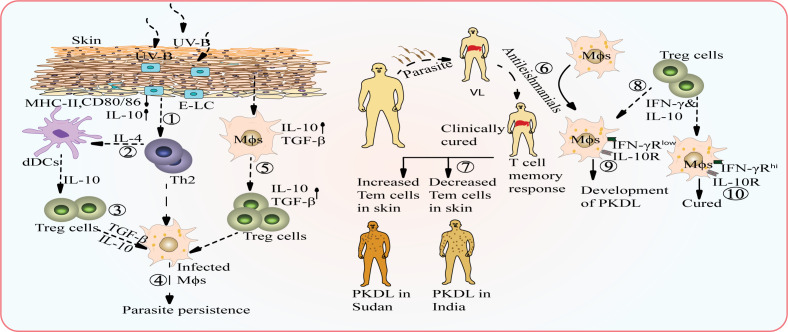
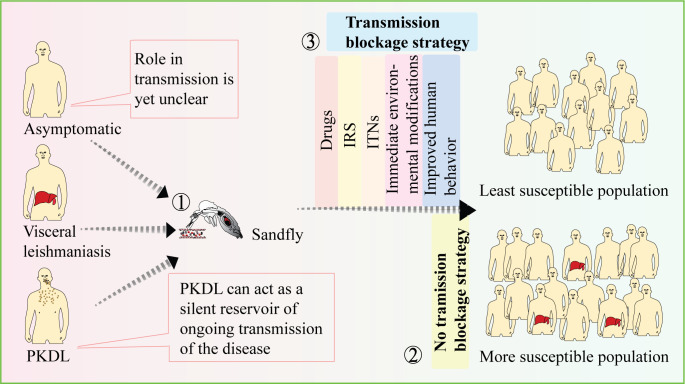
Visceral leishmaniasis (VL) is a severe and often fatal form of leishmaniasis caused by in the Indian sub-continent. Post Kala-azar Dermal Leishmaniasis (PKDL) is a late cutaneous manifestation of VL, typically occurring after apparent cure of VL, but sometimes even without a prior history of VL in India. PKDL serves as a significant yet neglected reservoir of infection and plays a crucial role in the transmission of the disease, posing a serious threat to the VL elimination program in the Indian sub-continent. Therefore, the eradication of PKDL should be a priority within the current VL elimination program aimed at achieving a goal of less than 1 case per 10,000 in the population at the district or sub-district levels of VL endemic areas. To accomplish this, a comprehensive understanding of the pathogenesis of PKDL is essential, as well as developing strategies for disease management. This review provides an overview of the current status of diagnosis and treatment options for PKDL, highlighting our current knowledge of the immune responses underlying disease development and progression. Additionally, the review discusses the impact of PKDL on elimination programs and propose strategies to overcome this challenge and achieve the goal of elimination. By addressing the diagnostic and therapeutic gaps, optimizing surveillance and control measures, and implementing effective intervention strategies, it is possible to mitigate the burden of PKDL and facilitate the successful elimination of VL in the Indian sub-continent.
内脏利什曼病(VL)是一种严重且常致命的利什曼病,由 在印度次大陆引起。卡拉-阿扎尔皮肤利什曼病(PKDL)是 VL 的一种晚期皮肤表现,通常发生在 VL 明显治愈后,但有时甚至在印度没有 VL 的既往病史。PKDL 是一个重要但被忽视的感染源,在疾病传播中起着关键作用,对印度次大陆的 VL 消除计划构成严重威胁。因此,在当前旨在实现 VL 流行地区每 10000 人口中少于 1 例的目标的 VL 消除计划中,消除 PKDL 应成为优先事项。要实现这一目标,必须全面了解 PKDL 的发病机制,并制定疾病管理策略。这篇综述概述了 PKDL 的当前诊断和治疗选择,强调了我们对疾病发展和进展所涉及的免疫反应的现有知识。此外,该综述还讨论了 PKDL 对消除计划的影响,并提出了克服这一挑战并实现消除 VL 目标的策略。通过解决诊断和治疗差距、优化监测和控制措施以及实施有效的干预策略,可以减轻 PKDL 的负担,并促进印度次大陆 VL 的成功消除。