• 文献检索
  • 文档翻译
  • 深度研究
  • 学术资讯
  • Suppr Zotero 插件Zotero 插件
  • 邀请有礼
  • 套餐&价格
  • 历史记录
应用&插件
Suppr Zotero 插件Zotero 插件浏览器插件Mac 客户端Windows 客户端微信小程序
定价
高级版会员购买积分包购买API积分包
服务
文献检索文档翻译深度研究API 文档MCP 服务
关于我们
关于 Suppr公司介绍联系我们用户协议隐私条款
关注我们

Suppr 超能文献

核心技术专利:CN118964589B侵权必究
粤ICP备2023148730 号-1Suppr @ 2026

文献检索

告别复杂PubMed语法,用中文像聊天一样搜索,搜遍4000万医学文献。AI智能推荐,让科研检索更轻松。

立即免费搜索

文件翻译

保留排版,准确专业,支持PDF/Word/PPT等文件格式,支持 12+语言互译。

免费翻译文档

深度研究

AI帮你快速写综述,25分钟生成高质量综述,智能提取关键信息,辅助科研写作。

立即免费体验

二硅酸锂局部修复体的边缘及内部适合性:一项系统评价与荟萃分析。

Marginal and internal adaptation of lithium disilicate partial restorations: A systematic review and meta-analysis.

作者信息

Bastos Natália Almeida, Bitencourt Sandro Basso, Carneiro Renan Figueiredo, Ferrairo Brunna Mota, Strelhow Samira Sandy Ferreira, Dos Santos Daniela Micheline, Bombonatti Juliana Fraga Soares

机构信息

Department of Operative Dentistry, Endodontics and Dental Materials, Bauru School of Dentistry, University of Sao Paulo, Bauru, Brazil.

Department of Dental Materials and Prosthodontics, Sao Paulo State University (UNESP), School of Dentistry, Araçatuba, Sao Paulo, Brazil.

出版信息

J Indian Prosthodont Soc. 2020 Oct-Dec;20(4):338-344. doi: 10.4103/jips.jips_112_20. Epub 2020 Oct 8.

DOI:10.4103/jips.jips_112_20
PMID:33487960
原文链接:https://pmc.ncbi.nlm.nih.gov/articles/PMC7814692/
Abstract

AIM

The aim of this meta analysis was to evaluate the influence of the processing method on the marginal and internal gaps of lithium disilicate inlays/onlays.

SETTINGS AND DESIGN

A systematic literature review was conducted using the PubMed/Medline, Embase, Scopus, and Cochrane Library databases. This review was registered on the PROSPERO platform.

MATERIALS AND METHODS

The studies were selected according to the marginal and internal gaps of two different fabrication methods for lithium disilicate (milled and pressed).

STATISTICAL ANALYSIS USED

The meta analysis was performed based on the Mantel-Haenszel and inverse variance methods, using the random effects model and a 95% confidence interval.

RESULTS

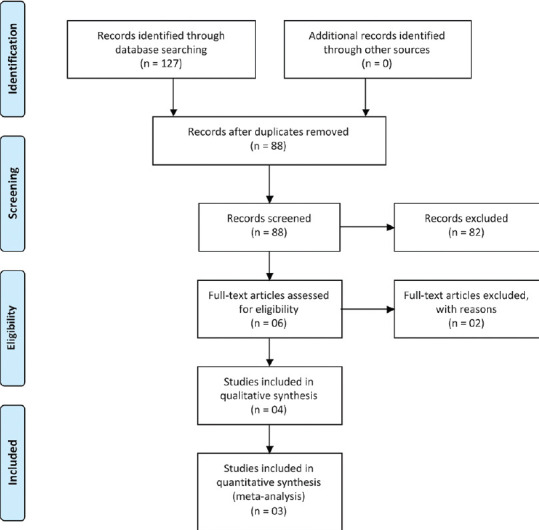
From all databases, 127 studies were identified. Four in vitro studies were included in the qualitative analysis and three in the meta analysis. Moreover, 197 restorations were evaluated (103 pressed and 94 milled). During the evaluation of only the internal gap, there was a statistically significant difference favoring the pressed technique ( = 0.002). There was no statistically significant difference in the analyses of the marginal gap ( = 0.530) and the total gap ( = 0.450).

CONCLUSION

Both the techniques provided acceptable marginal and total gaps, although the pressed technique revealed a more favorable internal adaptation than the milled onlays/inlays.

摘要

目的

本荟萃分析的目的是评估加工方法对二硅酸锂嵌体/高嵌体边缘及内部间隙的影响。

设置与设计

使用PubMed/Medline、Embase、Scopus和Cochrane图书馆数据库进行系统的文献综述。该综述已在PROSPERO平台注册。

材料与方法

根据两种不同的二硅酸锂制作方法(铣削和压制)的边缘及内部间隙来选择研究。

所用统计分析方法

基于Mantel-Haenszel法和逆方差法进行荟萃分析,采用随机效应模型和95%置信区间。

结果

从所有数据库中识别出127项研究。4项体外研究纳入定性分析,3项纳入荟萃分析。此外,共评估了197个修复体(103个压制的和94个铣削的)。仅在评估内部间隙时,压制技术具有统计学显著优势(P = 0.002)。在边缘间隙(P = 0.530)和总间隙(P = 0.450)分析中无统计学显著差异。

结论

两种技术均能提供可接受的边缘和总间隙,尽管压制技术在内部适应性方面比铣削嵌体/高嵌体更具优势。
https://cdn.ncbi.nlm.nih.gov/pmc/blobs/d6f3/7814692/0e1b3a7551d6/JIPS-20-338-g004.jpg
https://cdn.ncbi.nlm.nih.gov/pmc/blobs/d6f3/7814692/4014e5c15da8/JIPS-20-338-g001.jpg
https://cdn.ncbi.nlm.nih.gov/pmc/blobs/d6f3/7814692/cc460906be4a/JIPS-20-338-g002.jpg
https://cdn.ncbi.nlm.nih.gov/pmc/blobs/d6f3/7814692/c2e9fc7b5ccc/JIPS-20-338-g003.jpg
https://cdn.ncbi.nlm.nih.gov/pmc/blobs/d6f3/7814692/0e1b3a7551d6/JIPS-20-338-g004.jpg
https://cdn.ncbi.nlm.nih.gov/pmc/blobs/d6f3/7814692/4014e5c15da8/JIPS-20-338-g001.jpg
https://cdn.ncbi.nlm.nih.gov/pmc/blobs/d6f3/7814692/cc460906be4a/JIPS-20-338-g002.jpg
https://cdn.ncbi.nlm.nih.gov/pmc/blobs/d6f3/7814692/c2e9fc7b5ccc/JIPS-20-338-g003.jpg
https://cdn.ncbi.nlm.nih.gov/pmc/blobs/d6f3/7814692/0e1b3a7551d6/JIPS-20-338-g004.jpg

相似文献

1
Marginal and internal adaptation of lithium disilicate partial restorations: A systematic review and meta-analysis.二硅酸锂局部修复体的边缘及内部适合性:一项系统评价与荟萃分析。
J Indian Prosthodont Soc. 2020 Oct-Dec;20(4):338-344. doi: 10.4103/jips.jips_112_20. Epub 2020 Oct 8.
2
Marginal and Internal Gap of Handmade, Milled and 3D Printed Additive Manufactured Patterns for Pressed Lithium Disilicate Onlay Restorations.用于压制二硅酸锂嵌体修复体的手工制作、铣削和3D打印增材制造修复体的边缘和内部间隙
Eur J Prosthodont Restor Dent. 2018 Mar 1;26(1):31-38. doi: 10.1922/EJPRD_01733RevillaLeon08.
3
The Effect of Different Wax Pattern Fabrication Techniques on the Marginal Fit of Customized Lithium Disilicate Implant Abutments.不同蜡型制作技术对定制氧化锆基全瓷桥修复体边缘适合性的影响。
J Prosthodont. 2019 Dec;28(9):1018-1023. doi: 10.1111/jopr.13112. Epub 2019 Oct 11.
4
Marginal and internal fit of pressed lithium disilicate inlays fabricated with milling, 3D printing, and conventional technologies.研磨、3D 打印和传统技术制作的加压二硅酸锂嵌体的边缘和内部适合性。
J Prosthet Dent. 2018 May;119(5):783-790. doi: 10.1016/j.prosdent.2017.07.025. Epub 2017 Sep 29.
5
Fit Accuracy of Pressed and Milled Lithium Disilicate Inlays Fabricated From Conventional Impressions or a Laboratory-Based Digital Workflow.基于传统印模或实验室数字化工作流程制作的压制和铣削二硅酸锂嵌体的适合度准确性
Eur J Prosthodont Restor Dent. 2019 Feb 22;27(1):18-25. doi: 10.1922/EJPRD_01828Homsy08.
6
Marginal and internal fit of pressed ceramic crowns made from conventional and computer-aided design and computer-aided manufacturing wax patterns: An in vitro comparison.传统蜡型与计算机辅助设计及计算机辅助制造蜡型制作的压铸陶瓷全冠的边缘适合性和内部适合性:一项体外比较研究。
J Prosthet Dent. 2016 Aug;116(2):242-8. doi: 10.1016/j.prosdent.2015.12.005. Epub 2016 Mar 3.
7
Microstructure, topography, surface roughness, fractal dimension, internal and marginal adaptation of pressed and milled lithium-disilicate monolithic restorations.压制和铣削锂硅玻璃陶瓷单片修复体的微观结构、形貌、表面粗糙度、分形维数、内部和边缘适应性。
J Prosthodont Res. 2020 Jan;64(1):12-19. doi: 10.1016/j.jpor.2019.05.004. Epub 2019 Jun 15.
8
Comparison of fit accuracy of pressed lithium disilicate inlays fabricated from wax or resin patterns with conventional and CAD-CAM technologies.比较使用蜡或树脂模型以及传统和 CAD/CAM 技术制作的加压硅酸二锂嵌体的拟合精度。
J Prosthet Dent. 2018 Oct;120(4):530-536. doi: 10.1016/j.prosdent.2018.04.006. Epub 2018 Jun 29.
9
Evaluation of the Marginal Fit and Internal Adaptation of Zirconia and Lithium Disilicate Single Crowns: Micro-CT Comparison Between Different Manufacturing Procedures.氧化锆和二硅酸锂单冠的边缘适合性和内部适应性评估:不同制造工艺的显微CT比较
Open Dent J. 2018 Feb 22;12:160-172. doi: 10.2174/1874210601812010160. eCollection 2018.
10
Evaluation of the marginal fit of lithium disilicate single crowns fabricated with the conventional (IPS e.max Press) and CAD/CAM (IPS e.max CAD) methods: a systematic review and meta-analysis.采用传统方法(义获嘉e.max压铸)和CAD/CAM方法(义获嘉e.max CAD)制作的二硅酸锂单冠边缘适合性的评价:一项系统评价和Meta分析。
Int J Comput Dent. 2024 Dec 9;27(4):365-377. doi: 10.3290/j.ijcd.b4224643.

引用本文的文献

1
The internal and marginal adaptation of lithium disilicate endocrowns fabricated using intra and extraoral scanners: An in-vitro study.采用口内和口外扫描仪制作的二硅酸锂全瓷嵌体的内部和边缘适合性:一项体外研究。
PLoS One. 2024 Apr 16;19(4):e0301361. doi: 10.1371/journal.pone.0301361. eCollection 2024.
2
Assessment Methods for Marginal and Internal Fit of Partial Crown Restorations: A Systematic Review.部分冠修复体边缘与内部适合性的评估方法:一项系统评价
J Clin Med. 2023 Jul 31;12(15):5048. doi: 10.3390/jcm12155048.
3
Photodynamic Therapy (PDT) in Prosthodontics: Disinfection of Human Teeth Exposed to and the Effect on the Adhesion of Full Ceramic Veneers, Crowns, and Inlays: An In Vitro Study.

本文引用的文献

1
Evaluation of the Marginal Fit and Internal Adaptation of Zirconia and Lithium Disilicate Single Crowns: Micro-CT Comparison Between Different Manufacturing Procedures.氧化锆和二硅酸锂单冠的边缘适合性和内部适应性评估:不同制造工艺的显微CT比较
Open Dent J. 2018 Feb 22;12:160-172. doi: 10.2174/1874210601812010160. eCollection 2018.
2
Comparison of marginal and internal adaptation of copings fabricated from three different fabrication techniques: An study.三种不同制作技术制作的修复体边缘与内部适合性的比较:一项研究。
J Indian Prosthodont Soc. 2018 Apr-Jun;18(2):102-107. doi: 10.4103/jips.jips_327_17.
3
The marginal fit of lithium disilicate crowns: Press vs. CAD/CAM.
口腔修复学中的光动力疗法(PDT):对暴露于……的人牙进行消毒及其对全瓷贴面、牙冠和嵌体粘结的影响:一项体外研究
Biomedicines. 2022 Jan 10;10(1):144. doi: 10.3390/biomedicines10010144.
二硅酸锂全冠的边缘适合性:压制法与计算机辅助设计/计算机辅助制造法的比较
Braz Oral Res. 2018;32:e001. doi: 10.1590/1807-3107/2018.vol32.0001. Epub 2018 Jan 22.
4
Marginal and internal fit of pressed lithium disilicate inlays fabricated with milling, 3D printing, and conventional technologies.研磨、3D 打印和传统技术制作的加压二硅酸锂嵌体的边缘和内部适合性。
J Prosthet Dent. 2018 May;119(5):783-790. doi: 10.1016/j.prosdent.2017.07.025. Epub 2017 Sep 29.
5
Micro-CT Evaluation of Ceramic Inlays: Comparison of the Marginal and Internal Fit of Five and Three Axis CAM Systems with a Heat Press Technique.微 CT 评价陶瓷嵌体:五轴和三轴 CAD/CAM 系统与热压铸技术的边缘和内部适合性比较。
J Esthet Restor Dent. 2017 Feb;29(1):49-58. doi: 10.1111/jerd.12271. Epub 2016 Sep 29.
6
"Digitally Oriented Materials": Focus on Lithium Disilicate Ceramics.“数字导向材料”:聚焦于二硅酸锂陶瓷。
Int J Dent. 2016;2016:9840594. doi: 10.1155/2016/9840594. Epub 2016 Aug 18.
7
Fit of lithium disilicate crowns fabricated from conventional and digital impressions assessed with micro-CT.使用微型计算机断层扫描评估由传统印模和数字印模制作的二硅酸锂全冠的适合性。
J Prosthet Dent. 2016 Oct;116(4):551-557. doi: 10.1016/j.prosdent.2016.03.028. Epub 2016 Jul 14.
8
Machinability of lithium disilicate glass ceramic in in vitro dental diamond bur adjusting process.二硅酸锂玻璃陶瓷在体外牙科金刚砂车针调磨过程中的可加工性
J Mech Behav Biomed Mater. 2016 Jan;53:78-92. doi: 10.1016/j.jmbbm.2015.08.003. Epub 2015 Aug 12.
9
A new classification system for all-ceramic and ceramic-like restorative materials.一种用于全瓷和类瓷修复材料的新分类系统。
Int J Prosthodont. 2015 May-Jun;28(3):227-35. doi: 10.11607/ijp.4244.
10
Assessment of Chair-side Computer-Aided Design and Computer-Aided Manufacturing Restorations: A Review of the Literature.椅旁计算机辅助设计与计算机辅助制造修复体的评估:文献综述
J Int Oral Health. 2015 Apr;7(4):96-104.

