Zhou Jun, Ma Xiaoqian, Li Chunwang, Liao Aijun, Yang Zihao, Ren Honghong, Tang Jinsong, Li Jinguang, Li Zongchang, He Ying, Chen Xiaogang
Department of Psychiatry, The Second Xiangya Hospital, Central South University, Changsha, China.
National Clinical Research Center for Mental Disorders, Changsha, China.
Front Psychiatry. 2021 Jan 8;11:574819. doi: 10.3389/fpsyt.2020.574819. eCollection 2020.
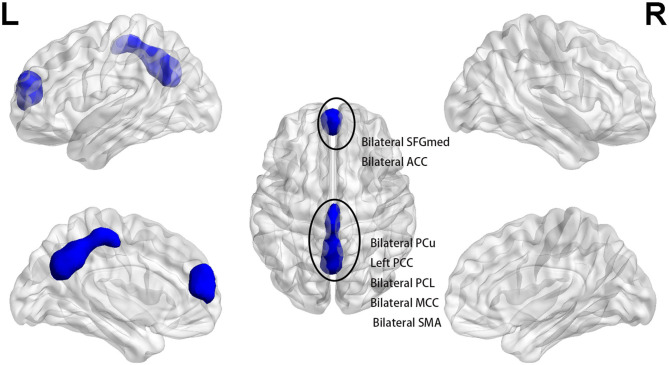
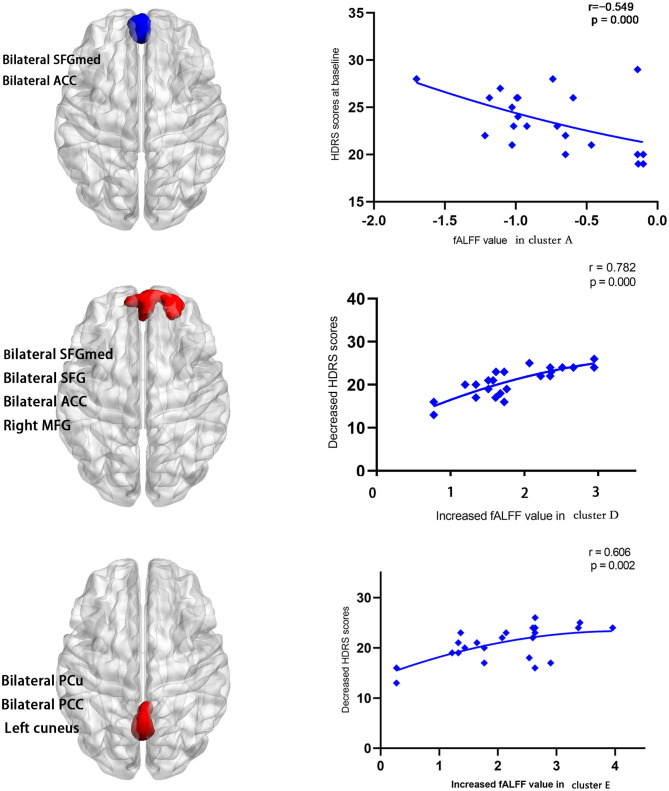
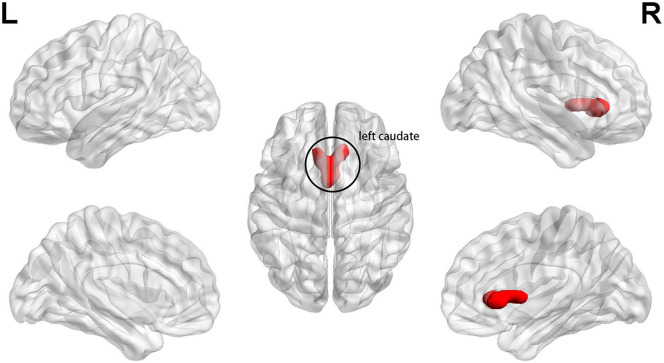
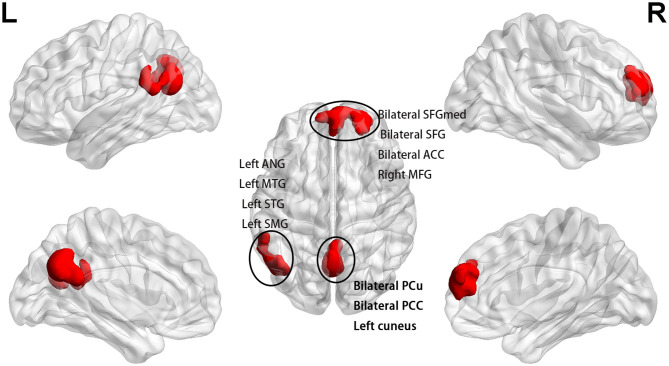
This study aimed to examine the treatment-related changes of the fractional amplitude of low-frequency fluctuations (fALFF) in the default mode network (DMN) across different bands after the medication-free patients with bipolar II depression received a 16-week treatment of escitalopram and lithium. A total of 23 medication-free patients with bipolar II depression and 29 healthy controls (HCs) were recruited. We evaluated the fALFF values of slow 4 (0.027-0.073 Hz) band and slow 5 (0.01-0.027 Hz) band of the patients and compared the results with those of the 29 HCs at baseline. After 16-week treatment of escitalopram with lithium, the slow 4 and slow 5 fALFF values of the patients were assessed and compared with the baselines of patients and HCs. The depressive symptoms of bipolar II depression in patients were assessed with a 17-item Hamilton Depression Rating Scale (HDRS) before and after treatment. Treatment-related effects showed increased slow 5 fALFF in cluster D (bilateral medial superior frontal gyrus, bilateral superior frontal gyrus, right middle frontal gyrus, and bilateral anterior cingulate), cluster E (bilateral precuneus/posterior cingulate, left cuneus), and cluster F (left angular, left middle temporal gyrus, left superior temporal gyrus, and left supramarginal gyrus) in comparison with the baseline of the patients. Moreover, a positive association was found between the increase in slow 5 fALFF values (follow-up value minus the baseline values) in cluster D and the decrease in HDRS scores (baseline HDRS scores minus follow-up HDRS scores) at follow-up, and the same association between the increase in slow 5 fALFF values and the decrease in HDRS scores was found in cluster E. The study reveals that the hypoactivity of slow 5 fALFF in the DMN is related to depression symptoms and might be corrected by the administration of escitalopram with lithium, implying that slow 5 fALFF of the DMN plays a key role in bipolar depression.
本研究旨在探讨双相II型抑郁症未服药患者接受16周艾司西酞普兰和锂盐治疗后,默认模式网络(DMN)中不同频段低频振幅分数(fALFF)与治疗相关的变化。共招募了23例双相II型抑郁症未服药患者和29名健康对照者(HCs)。我们评估了患者慢4(0.027 - 0.073Hz)频段和慢5(0.01 - 0.027Hz)频段的fALFF值,并在基线时将结果与29名HCs的结果进行比较。在接受16周艾司西酞普兰与锂盐联合治疗后,评估患者的慢4和慢5 fALFF值,并与患者及HCs的基线进行比较。治疗前后采用17项汉密尔顿抑郁量表(HDRS)评估患者双相II型抑郁症的抑郁症状。与患者基线相比,治疗相关效应显示,D簇(双侧内侧额上回、双侧额上回、右侧额中回和双侧前扣带回)、E簇(双侧楔前叶/后扣带回、左侧楔叶)和F簇(左侧角回、左侧颞中回、左侧颞上回和左侧缘上回)的慢5 fALFF增加。此外,随访时发现D簇慢5 fALFF值的增加(随访值减去基线值)与HDRS评分的降低(基线HDRS评分减去随访HDRS评分)呈正相关,E簇慢5 fALFF值的增加与HDRS评分的降低也呈同样的相关性。该研究表明,DMN中慢5 fALFF的低活性与抑郁症状相关,可能通过艾司西酞普兰与锂盐联合给药得到纠正,这意味着DMN的慢5 fALFF在双相抑郁症中起关键作用。