Zhou Binhui, Yang Wenyi, Li Wushan, He Le, Lu Liaoxun, Zhang Lichen, Liu Zhuangzhuang, Wang Ying, Chao Tianzhu, Huang Rong, Gu Yanrong, Jia Tingting, Liu Qiaoli, Tian Shuanghua, Pierre Philippe, Maeda Takahiro, Liang Yinming, Kong Eryan
Laboratory of Mouse Genetics, Institute of Psychiatry and Neuroscience, Xinxiang Medical University, Henan, China.
Laboratory of Genetic Regulators in the Immune System, Henan Collaborative Innovation Center of Molecular Diagnosis and Laboratory Medicine, Xinxiang Medical University, Henan, China.
Front Immunol. 2021 Jan 8;11:607442. doi: 10.3389/fimmu.2020.607442. eCollection 2020.
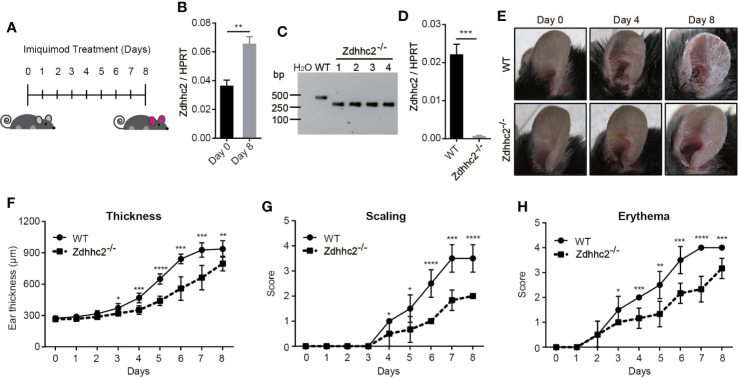
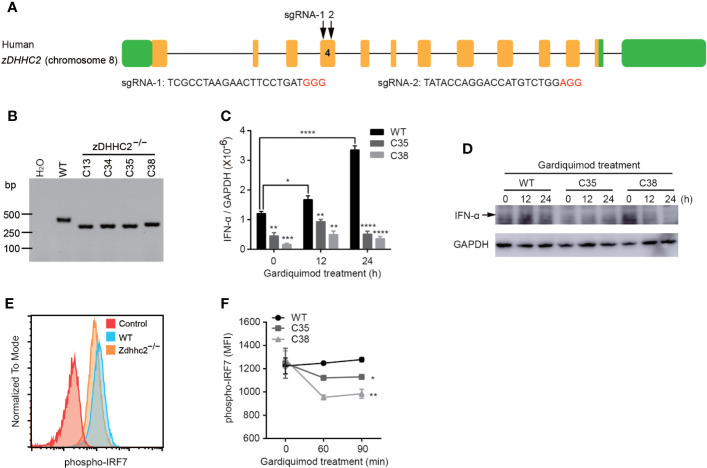
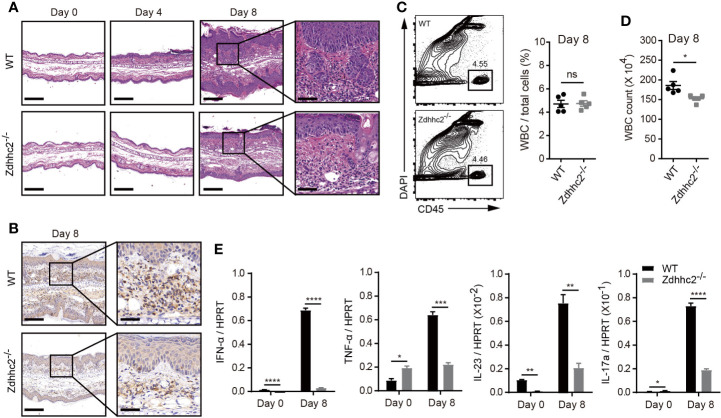
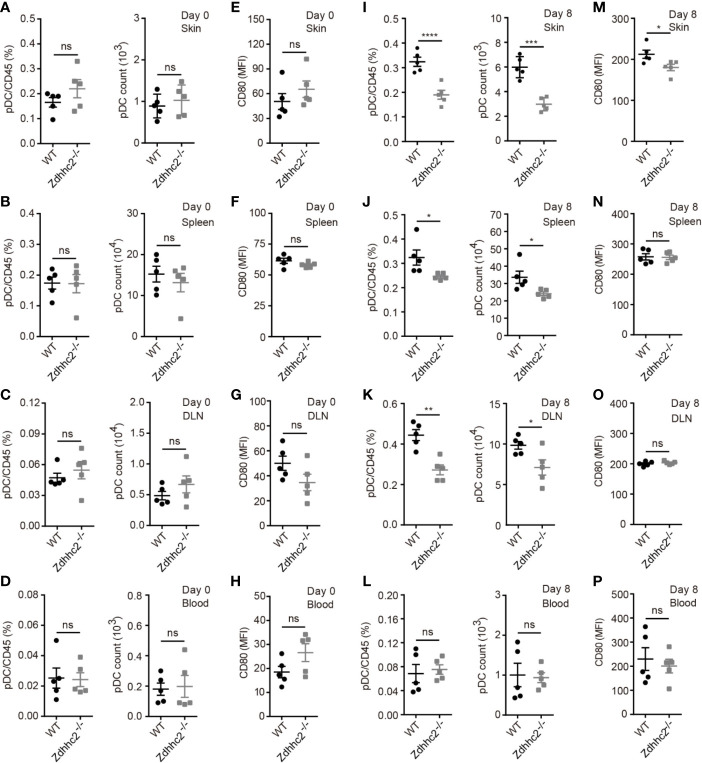
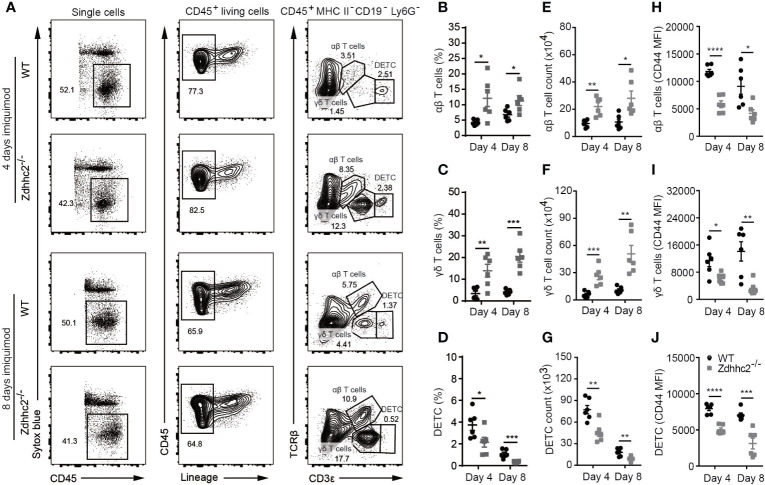
Zdhhc family genes are composed of 24 members that regulate palmitoylation, a post-translational modification process for proteins. Mutations in genes that alter palmitoylation or de-palmitoylation could result in neurodegenerative diseases and inflammatory disorders. In this study, we found that Zdhhc2 was robustly induced in psoriatic skin and loss of Zdhhc2 in mice by CRISPR/Cas9 dramatically inhibited pathology of the ear skin following imiquimod treatment. As psoriasis is an inflammatory disorder, we analyzed tissue infiltrating immune cells and cytokine production. Strikingly we found that a master psoriatic cytokine interferon-α (IFN-α) in the lesioned skin of wildtype (WT) mice was 23-fold higher than that in Zdhhc2 deficient counterparts. In addition, we found that CD45 white blood cells (WBC) infiltrating in the skin of Zdhhc2 deficient mice were also significantly reduced. Amelioration in psoriasis and dramatically reduced inflammation of Zdhhc2 deficient mice led us to analyze the cellular components that were affected by loss of Zdhhc2. We found that imiquimod induced plasmacytoid dendritic cell (pDC) accumulation in psoriatic skin, spleen, and draining lymph nodes (DLN) were drastically decreased in Zdhhc2 deficient mice, and the expression of pDC activation marker CD80 also exhibited significantly inhibited in psoriatic skin. In further experiments, we confirmed the cell intrinsic effect of Zdhhc2 on pDCs as we found that loss of zDHHC2 in human CAL-1 pDC dampened both interferon regulatory factor 7 (IRF7) phosphorylation and IFN-α production. Therefore, we identified novel function of Zdhhc2 in controlling inflammatory response in psoriasis in mice and we also confirmed that crucial role of Zdhhc2 in pDCs by regulating IRF7 activity and production of the critical cytokine. Our results finding the dependence of IFN-α production on Zdhhc2 in inflamed murine skin and in human pDCs provide rationale for targeting this new molecule in treatment of inflammation.
Zdhhc家族基因由24个成员组成,这些成员调节棕榈酰化,这是一种蛋白质的翻译后修饰过程。改变棕榈酰化或去棕榈酰化的基因突变可能导致神经退行性疾病和炎症性疾病。在本研究中,我们发现Zdhhc2在银屑病皮肤中强烈诱导表达,并且通过CRISPR/Cas9技术使小鼠体内Zdhhc2缺失,显著抑制了咪喹莫特治疗后耳部皮肤的病变。由于银屑病是一种炎症性疾病,我们分析了组织浸润免疫细胞和细胞因子的产生。令人惊讶的是,我们发现野生型(WT)小鼠病变皮肤中主要的银屑病细胞因子干扰素-α(IFN-α)比Zdhhc2缺陷小鼠的高23倍。此外,我们发现Zdhhc2缺陷小鼠皮肤中浸润的CD45白细胞(WBC)也显著减少。Zdhhc2缺陷小鼠银屑病的改善和炎症的显著减轻促使我们分析受Zdhhc2缺失影响的细胞成分。我们发现,咪喹莫特诱导的银屑病皮肤、脾脏和引流淋巴结(DLN)中浆细胞样树突状细胞(pDC)的积累在Zdhhc2缺陷小鼠中显著减少,并且银屑病皮肤中pDC活化标志物CD80的表达也显著受到抑制。在进一步的实验中,我们证实了Zdhhc2对pDC的细胞内在作用,因为我们发现人CAL-1 pDC中zDHHC2的缺失抑制了干扰素调节因子7(IRF7)的磷酸化和IFN-α的产生。因此,我们确定了Zdhhc2在控制小鼠银屑病炎症反应中的新功能,并且我们还通过调节IRF7活性和关键细胞因子的产生证实了Zdhhc2在pDC中的关键作用。我们的结果发现炎症小鼠皮肤和人pDC中IFN-α的产生依赖于Zdhhc2这一发现为将这个新分子作为炎症治疗靶点提供了理论依据。