• 文献检索
  • 文档翻译
  • 深度研究
  • 学术资讯
  • Suppr Zotero 插件Zotero 插件
  • 邀请有礼
  • 套餐&价格
  • 历史记录
应用&插件
Suppr Zotero 插件Zotero 插件浏览器插件Mac 客户端Windows 客户端微信小程序
定价
高级版会员购买积分包购买API积分包
服务
文献检索文档翻译深度研究API 文档MCP 服务
关于我们
关于 Suppr公司介绍联系我们用户协议隐私条款
关注我们

Suppr 超能文献

核心技术专利:CN118964589B侵权必究
粤ICP备2023148730 号-1Suppr @ 2026

文献检索

告别复杂PubMed语法,用中文像聊天一样搜索,搜遍4000万医学文献。AI智能推荐,让科研检索更轻松。

立即免费搜索

文件翻译

保留排版,准确专业,支持PDF/Word/PPT等文件格式,支持 12+语言互译。

免费翻译文档

深度研究

AI帮你快速写综述,25分钟生成高质量综述,智能提取关键信息,辅助科研写作。

立即免费体验

一种基于实验室指标的预测模型在新型冠状病毒肺炎患者风险分层中的应用

Application of a prediction model with laboratory indexes in the risk stratification of patients with COVID-19.

作者信息

Ye Jiru, Zhang Xiaoqing, Zhu Feng, Tang Yao

机构信息

Department of Respiratory and Critical Care Medicine, The Third Affiliated Hospital of Soochow University, Changzhou, Jiangsu 213003, P.R. China.

Department of Respiratory and Critical Care Medicine, Wuxi Fifth People's Hospital, Wuxi, Jiangsu 214000, P.R. China.

出版信息

Exp Ther Med. 2021 Mar;21(3):182. doi: 10.3892/etm.2021.9613. Epub 2021 Jan 5.

DOI:10.3892/etm.2021.9613
PMID:33488791
原文链接:https://pmc.ncbi.nlm.nih.gov/articles/PMC7812582/
Abstract

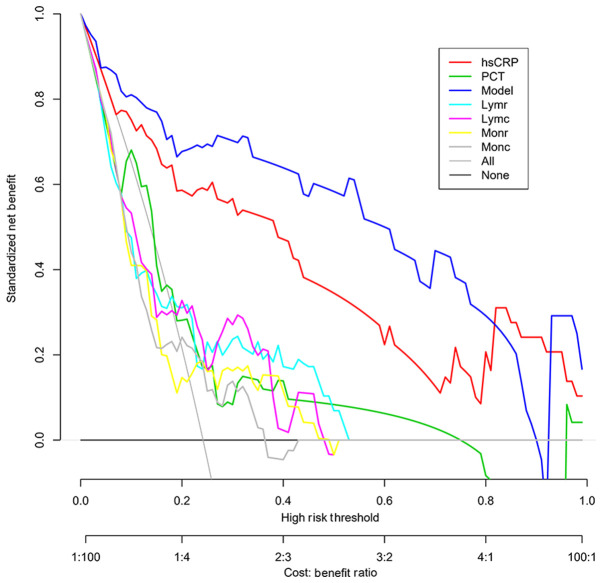
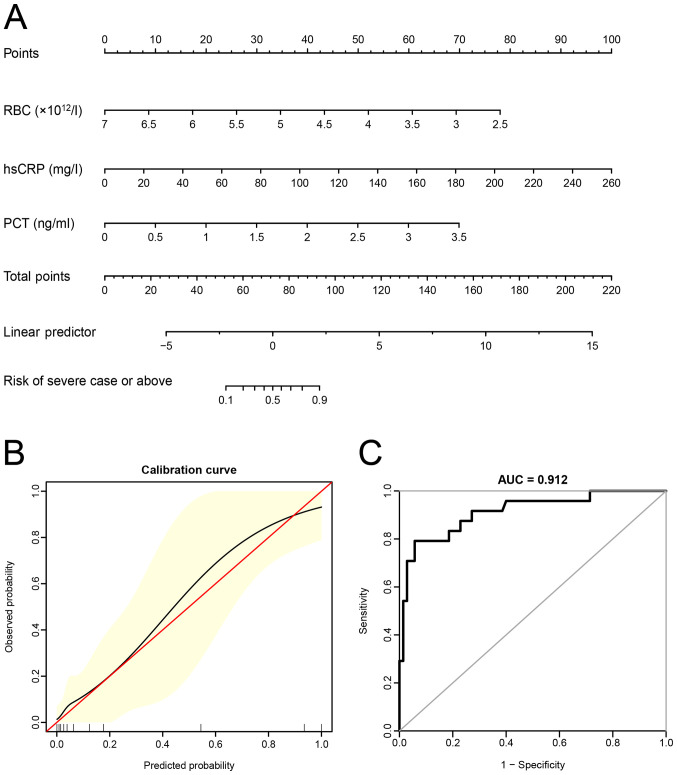
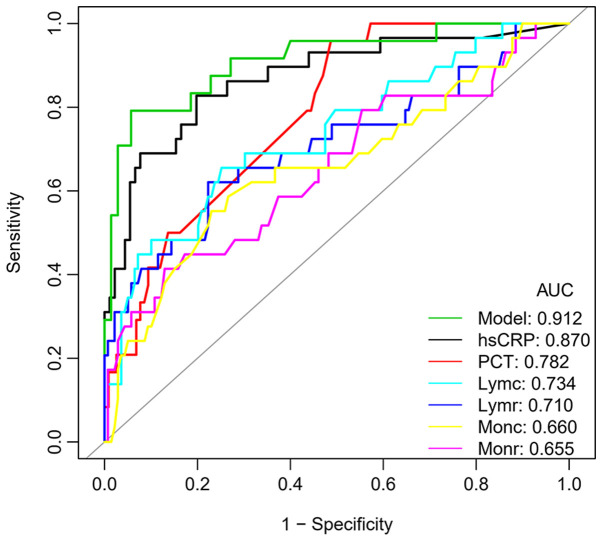
In the present study, a prediction model with combined laboratory indexes in risk stratification of patients with COVID-19 was established and tested. The data of 170 patients with COVID-19 who were divided into an asymptomatic-moderate group (141 cases) and severe or above group (29 cases) were retrospectively analyzed. The clinical characteristics and laboratory indexes of the two groups were compared. Multivariate logistic regression analysis was performed to construct the prediction model based on laboratory indexes. A receiver operating characteristic (ROC) curve analysis was used to compare the diagnostic efficacy of different indexes. Decision curve analysis (DCA) was performed to quantify and compare the clinical validity of the prediction models. There were significant differences in blood cell count, high-sensitivity C-reactive protein (hsCRP) and procalcitonin (PCT) levels between the severe or above group and the asymptomatic-moderate group (all P<0.05). Among all individual indexes, hsCRP had the highest diagnostic efficacy (area under the curve=0.870), with a sensitivity and specificity of 0.828 and 0.802, respectively. The red blood cell count, hsCRP and PCT were used to construct the prediction model. The AUC of the prediction model was higher than that of hsCRP (0.912 vs. 0.870) but the difference was not significant (P=0.307). DCA suggested that the net benefit of the prediction model was higher than that of hsCRP in most cases and significantly higher than that of PCT, lymphocytes and monocytes. The prediction model with combined laboratory indexes was able to more effectively predict the clinical classification of patients with COVID-19 and may be used as a tool for risk stratification of patients.

摘要

在本研究中,建立并测试了一个用于新型冠状病毒肺炎(COVID-19)患者风险分层的联合实验室指标预测模型。对170例COVID-19患者的数据进行回顾性分析,这些患者被分为无症状-中度组(141例)和重度及以上组(29例)。比较了两组的临床特征和实验室指标。基于实验室指标进行多因素逻辑回归分析以构建预测模型。采用受试者工作特征(ROC)曲线分析比较不同指标的诊断效能。进行决策曲线分析(DCA)以量化和比较预测模型的临床有效性。重度及以上组与无症状-中度组之间的血细胞计数、高敏C反应蛋白(hsCRP)和降钙素原(PCT)水平存在显著差异(均P<0.05)。在所有单项指标中,hsCRP的诊断效能最高(曲线下面积=0.870),敏感性和特异性分别为0.828和0.802。采用红细胞计数、hsCRP和PCT构建预测模型。预测模型的AUC高于hsCRP(0.912对0.870),但差异无统计学意义(P=0.307)。DCA表明,在大多数情况下,预测模型的净效益高于hsCRP,且显著高于PCT、淋巴细胞和单核细胞。联合实验室指标的预测模型能够更有效地预测COVID-19患者的临床分类,可作为患者风险分层的工具。
https://cdn.ncbi.nlm.nih.gov/pmc/blobs/c013/7812582/ba0a9e6370f7/etm-21-03-09613-g02.jpg
https://cdn.ncbi.nlm.nih.gov/pmc/blobs/c013/7812582/f42a7e30244b/etm-21-03-09613-g00.jpg
https://cdn.ncbi.nlm.nih.gov/pmc/blobs/c013/7812582/1256aba73f83/etm-21-03-09613-g01.jpg
https://cdn.ncbi.nlm.nih.gov/pmc/blobs/c013/7812582/ba0a9e6370f7/etm-21-03-09613-g02.jpg
https://cdn.ncbi.nlm.nih.gov/pmc/blobs/c013/7812582/f42a7e30244b/etm-21-03-09613-g00.jpg
https://cdn.ncbi.nlm.nih.gov/pmc/blobs/c013/7812582/1256aba73f83/etm-21-03-09613-g01.jpg
https://cdn.ncbi.nlm.nih.gov/pmc/blobs/c013/7812582/ba0a9e6370f7/etm-21-03-09613-g02.jpg

相似文献

1
Application of a prediction model with laboratory indexes in the risk stratification of patients with COVID-19.一种基于实验室指标的预测模型在新型冠状病毒肺炎患者风险分层中的应用
Exp Ther Med. 2021 Mar;21(3):182. doi: 10.3892/etm.2021.9613. Epub 2021 Jan 5.
2
[Establishment and validation of a risk prediction model for disseminated intravascular coagulation patients with electrical burns].[电烧伤并发弥散性血管内凝血患者风险预测模型的建立与验证]
Zhonghua Shao Shang Yu Chuang Mian Xiu Fu Za Zhi. 2023 Aug 20;39(8):738-745. doi: 10.3760/cma.j.cn501225-20230419-00132.
3
Machine Learning Algorithms are Superior to Conventional Regression Models in Predicting Risk Stratification of COVID-19 Patients.机器学习算法在预测COVID-19患者的风险分层方面优于传统回归模型。
Risk Manag Healthc Policy. 2021 Jul 29;14:3159-3166. doi: 10.2147/RMHP.S318265. eCollection 2021.
4
[Clinical and laboratory characteristics of 215 cases of coronavirus disease 2019 with different prognosis].215例不同预后的2019冠状病毒病患者的临床和实验室特征
Zhonghua Wei Zhong Bing Ji Jiu Yi Xue. 2020 Dec;32(12):1428-1433. doi: 10.3760/cma.j.cn121430-20200824-00590.
5
[Diagnosis value of serum infection index for early infection of patients undergoing posterior cervical expansive open-door laminoplasty].[血清感染指标对颈椎后路单开门椎管扩大成形术患者早期感染的诊断价值]
Zhongguo Gu Shang. 2019 Oct 25;32(10):892-897. doi: 10.3969/j.issn.1003-0034.2019.10.004.
6
[Correlation between blood pressure indexes and prognosis in sepsis patients: a cohort study based on MIMIC-III database].[脓毒症患者血压指标与预后的相关性:一项基于MIMIC-III数据库的队列研究]
Zhonghua Wei Zhong Bing Ji Jiu Yi Xue. 2023 Jun;35(6):578-585. doi: 10.3760/cma.j.cn121430-20220830-00799.
7
[Analysis of evaluation indexes for prognosis of severe burn patients with sepsis].[严重烧伤合并脓毒症患者预后评估指标分析]
Zhonghua Wei Zhong Bing Ji Jiu Yi Xue. 2017 Apr;29(4):327-331. doi: 10.3760/cma.j.issn.2095-4352.2017.04.008.
8
[A study on treatment timing selection and short-term efficacy prediction with changes in cytokine levels before and after non-biological artificial liver treatment in acute-on-chronic liver failure].[慢性肝衰竭急性发作非生物人工肝治疗前后细胞因子水平变化对治疗时机选择及短期疗效预测的研究]
Zhonghua Gan Zang Bing Za Zhi. 2022 Nov 20;30(11):1218-1224. doi: 10.3760/cma.j.cn501113-20220524-00278.
9
[Combined predictive value of the risk factors influencing the short-term prognosis of sepsis].[影响脓毒症短期预后的危险因素的联合预测价值]
Zhonghua Wei Zhong Bing Ji Jiu Yi Xue. 2020 Mar;32(3):307-312. doi: 10.3760/cma.j.cn121430-20200306-00218.
10
[Combined prognostic value of serum lactic acid, procalcitonin and severity score for short-term prognosis of septic shock patients].[血清乳酸、降钙素原及严重程度评分对脓毒症休克患者短期预后的联合预测价值]
Zhonghua Wei Zhong Bing Ji Jiu Yi Xue. 2021 Mar;33(3):281-285. doi: 10.3760/cma.j.cn121430-20201113-00715.

引用本文的文献

1
Procalcitonin as a predictive marker in COVID-19: A systematic review and meta-analysis.降钙素原作为 COVID-19 的预测标志物:系统评价和荟萃分析。
PLoS One. 2022 Sep 9;17(9):e0272840. doi: 10.1371/journal.pone.0272840. eCollection 2022.
2
Clinical, laboratory data and inflammatory biomarkers at baseline as early discharge predictors in hospitalized SARS-CoV-2 infected patients.住院的 SARS-CoV-2 感染患者出院预测指标:基线时的临床、实验室数据和炎症生物标志物。
PLoS One. 2022 Jul 14;17(7):e0269875. doi: 10.1371/journal.pone.0269875. eCollection 2022.
3
The COVID-19 pandemic in Brazilian pregnant and postpartum women: results from the REBRACO prospective cohort study.

本文引用的文献

1
Evidence of Structural Protein Damage and Membrane Lipid Remodeling in Red Blood Cells from COVID-19 Patients.新型冠状病毒肺炎患者红细胞结构蛋白损伤和膜脂重塑的证据。
J Proteome Res. 2020 Nov 6;19(11):4455-4469. doi: 10.1021/acs.jproteome.0c00606. Epub 2020 Oct 26.
2
Pathophysiology, Transmission, Diagnosis, and Treatment of Coronavirus Disease 2019 (COVID-19): A Review.新型冠状病毒病 2019(COVID-19)的病理生理学、传播、诊断和治疗:综述。
JAMA. 2020 Aug 25;324(8):782-793. doi: 10.1001/jama.2020.12839.
3
A predictive model and scoring system combining clinical and CT characteristics for the diagnosis of COVID-19.
巴西孕妇和产后妇女的 COVID-19 大流行:REBRACO 前瞻性队列研究结果。
Sci Rep. 2022 Jul 11;12(1):11758. doi: 10.1038/s41598-022-15647-z.
4
Optimal Triage for COVID-19 Patients Under Limited Health Care Resources With a Parsimonious Machine Learning Prediction Model and Threshold Optimization Using Discrete-Event Simulation: Development Study.利用简约机器学习预测模型及基于离散事件模拟的阈值优化,在有限医疗资源下对新冠患者进行优化分诊:一项开发研究
JMIR Med Inform. 2021 Nov 2;9(11):e32726. doi: 10.2196/32726.
5
Machine Learning Algorithms are Superior to Conventional Regression Models in Predicting Risk Stratification of COVID-19 Patients.机器学习算法在预测COVID-19患者的风险分层方面优于传统回归模型。
Risk Manag Healthc Policy. 2021 Jul 29;14:3159-3166. doi: 10.2147/RMHP.S318265. eCollection 2021.
一种结合临床和 CT 特征的 COVID-19 诊断预测模型和评分系统。
Eur Radiol. 2020 Dec;30(12):6797-6807. doi: 10.1007/s00330-020-07022-1. Epub 2020 Jul 1.
4
Laboratory findings and a combined multifactorial approach to predict death in critically ill patients with COVID-19: a retrospective study.实验室检测结果与综合多因素方法预测 COVID-19 危重症患者死亡:一项回顾性研究。
Epidemiol Infect. 2020 Jun 30;148:e129. doi: 10.1017/S0950268820001442.
5
Myocardial injury determination improves risk stratification and predicts mortality in COVID-19 patients.心肌损伤的确定可改善 COVID-19 患者的风险分层并预测其死亡率。
Cardiol J. 2020;27(5):489-496. doi: 10.5603/CJ.a2020.0089. Epub 2020 Jun 26.
6
Crucial laboratory parameters in COVID-19 diagnosis and prognosis: An updated meta-analysis.新冠病毒诊断和预后的关键实验室参数:一项更新的荟萃分析。
Med Clin (Barc). 2020 Aug 28;155(4):143-151. doi: 10.1016/j.medcli.2020.05.017. Epub 2020 Jun 5.
7
Clinical prediction model for mortality of adult diabetes inpatients with COVID-19 in Wuhan, China: A retrospective pilot study.中国武汉成人COVID-19糖尿病住院患者死亡率的临床预测模型:一项回顾性试点研究。
J Clin Anesth. 2020 Nov;66:109927. doi: 10.1016/j.jclinane.2020.109927. Epub 2020 May 27.
8
Combined use of the neutrophil-to-lymphocyte ratio and CRP to predict 7-day disease severity in 84 hospitalized patients with COVID-19 pneumonia: a retrospective cohort study.中性粒细胞与淋巴细胞比值和C反应蛋白联合用于预测84例COVID-19肺炎住院患者7天疾病严重程度:一项回顾性队列研究
Ann Transl Med. 2020 May;8(10):635. doi: 10.21037/atm-20-2372.
9
Prompt Predicting of Early Clinical Deterioration of Moderate-to-Severe COVID-19 Patients: Usefulness of a Combined Score Using IL-6 in a Preliminary Study.在一项初步研究中,使用白细胞介素 6(IL-6)联合评分预测中重度 COVID-19 患者的早期临床恶化:有用性。
J Allergy Clin Immunol Pract. 2020 Sep;8(8):2575-2581.e2. doi: 10.1016/j.jaip.2020.06.013. Epub 2020 Jun 19.
10
Procalcitonin levels in COVID-19 patients.COVID-19 患者降钙素原水平。
Int J Antimicrob Agents. 2020 Aug;56(2):106051. doi: 10.1016/j.ijantimicag.2020.106051. Epub 2020 Jun 10.