Mohammed Eman Shawky, El-Beih Nadia M, El-Hussieny Enas Ali, El-Ahwany Eman, Hassan Marwa, Zoheiry Mona
Zoology Department, Faculty of Science, Ain Shams University, Cairo, Egypt.
Immunology Department, Theodor Bilharz Research Institute, Giza, Egypt.
Arch Med Sci. 2020 Mar 17;17(1):218-227. doi: 10.5114/aoms.2020.93739. eCollection 2021.
Curcumin therapeutic applications are constrained by its prominent metabolic instability as well as inadequate absorption and bioavailability. The current study was designed to enhance the curcumin bioavailability by exploiting nanoparticles.
Eleven groups of mice were divided into: normal and nanoparticle control groups, a hepatocellular carcinoma (HCC) group induced by diethylnitrosamine (DEN), 2 groups treated with DEN plus a high dose/low dose of free curcumin, 2 groups treated with a high dose/low dose of free curcumin, 2 groups treated with DEN plus a high dose/low dose of nanoparticulate curcumin, and 2 groups treated with a high dose/low dose of nanoparticulate curcumin.
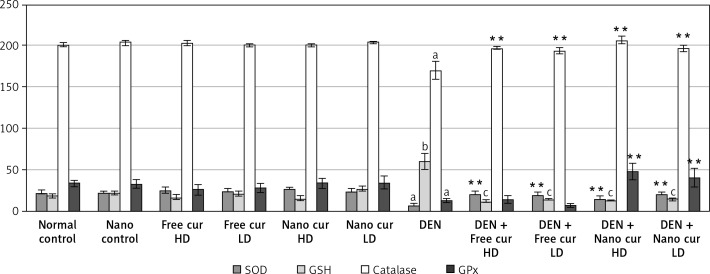
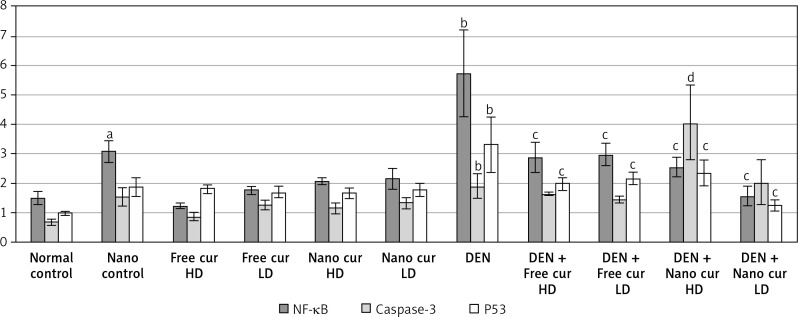
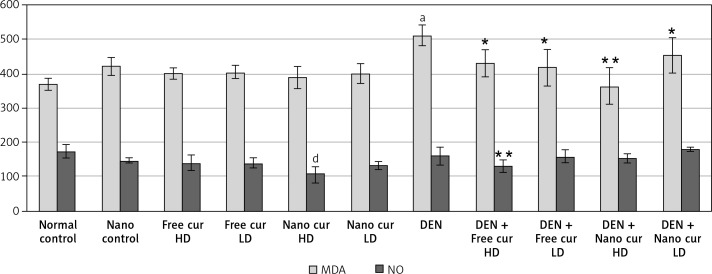
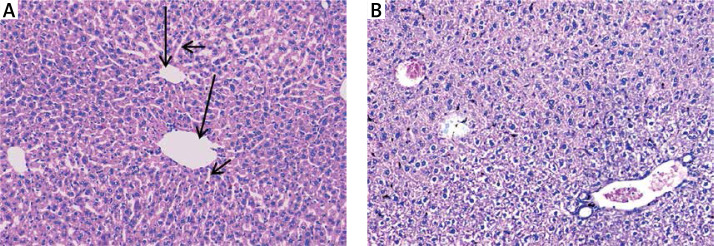
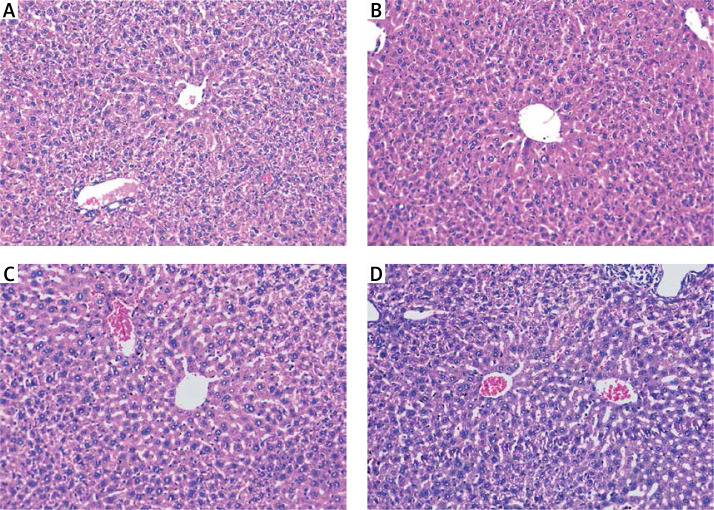
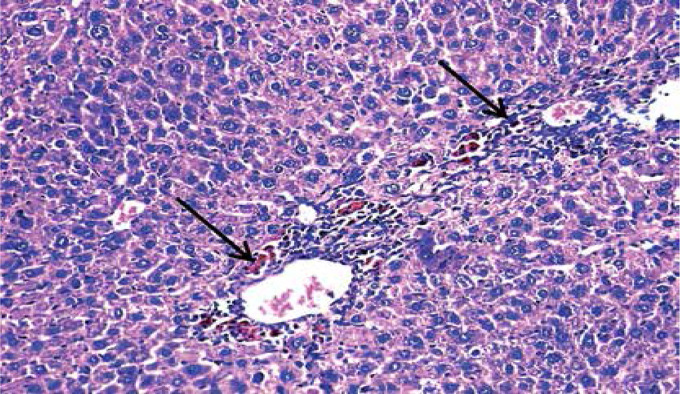
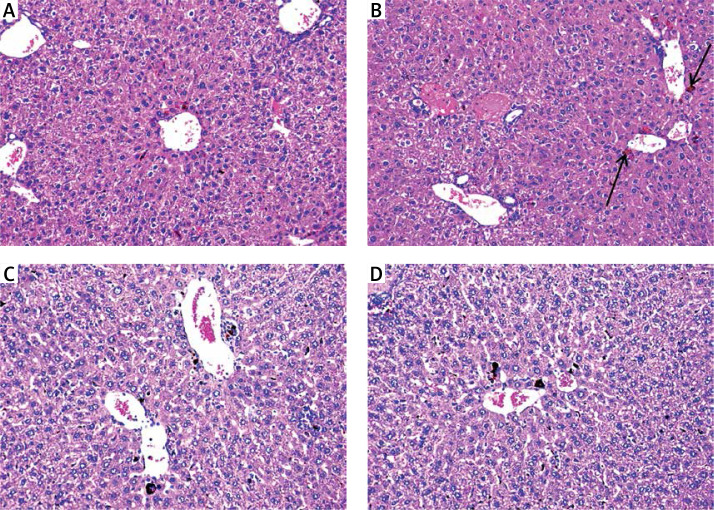
DEN administration significantly increased liver enzymes, vascular endothelial growth factor, tumor necrosis factor-α, α-fetoprotein, malondialdehyde, and nucelar factor-κB. Also, it decreased serum albumin and tissue antioxidant activities and caused severe histological changes in hepatic tissue. Oral treatment of DEN-injected mice with either a high dose of free curcumin or the tested doses of nanoparticulate curcumin resulted in a significant improvement of all the tested parameters.
Although the two tested doses of nanoparticulate curcumin were much lower than free curcumin, both doses were effective in preventing HCC development while the low dose of free curcumin was hardly effective. Hence, we conclude that nanoparticles enhance the bioavailability of curcumin.
姜黄素的治疗应用受到其显著的代谢不稳定性以及吸收和生物利用度不足的限制。本研究旨在通过利用纳米颗粒来提高姜黄素的生物利用度。
将11组小鼠分为:正常组和纳米颗粒对照组、二乙基亚硝胺(DEN)诱导的肝细胞癌(HCC)组、2组用DEN加高剂量/低剂量游离姜黄素治疗的组、2组用高剂量/低剂量游离姜黄素治疗的组、2组用DEN加高铁剂量/低剂量纳米颗粒姜黄素治疗的组,以及2组用高剂量/低剂量纳米颗粒姜黄素治疗的组。
给予DEN显著增加了肝酶、血管内皮生长因子、肿瘤坏死因子-α、甲胎蛋白、丙二醛和核因子-κB。此外,它降低了血清白蛋白和组织抗氧化活性,并导致肝组织出现严重的组织学变化。用高剂量游离姜黄素或测试剂量的纳米颗粒姜黄素口服治疗注射了DEN的小鼠,所有测试参数均有显著改善。
尽管测试的两种剂量的纳米颗粒姜黄素远低于游离姜黄素,但两种剂量均能有效预防HCC的发生,而低剂量的游离姜黄素几乎无效。因此,我们得出结论,纳米颗粒可提高姜黄素的生物利用度。