Zeng Ziqing, Yan Bo, Chen Yulong, Zhang Lianmin, Zhu Jianquan, Yang Fan, Wei Feng, Tam Terence Chi Chun, Kauffmann-Guerrero Diego, Soo Ross Andrew, Ren Xiubao, You Jian
Department of Immunology, Tianjin Medical University Cancer Institute and Hospital, National Clinical Research Center for Cancer, Tianjin, China.
Key Laboratory of Cancer Prevention and Therapy, Tianjin, China.
Transl Lung Cancer Res. 2020 Dec;9(6):2401-2410. doi: 10.21037/tlcr-20-1214.
Adjuvant () tyrosine kinase inhibitors (TKIs) are increasing considered for the tailored management of resectable non-small cell lung cancer (NSCLC). This study aimed to analyze the survival and toxicity profile of patients with mutation-positive NSCLC treated with adjuvant icotinib.
This was a single-center retrospective study of patients with mutation-positive NSCLC who underwent R0 (microscopically margin-negative) resection and received adjuvant icotinib between November 2011 and December 2017. The outcomes included 2-year disease-free survival (DFS) rate, 3-year overall survival (OS) rates, DFS, OS, and adverse events (AEs).
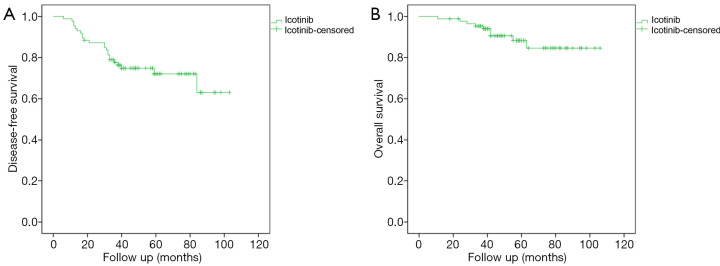
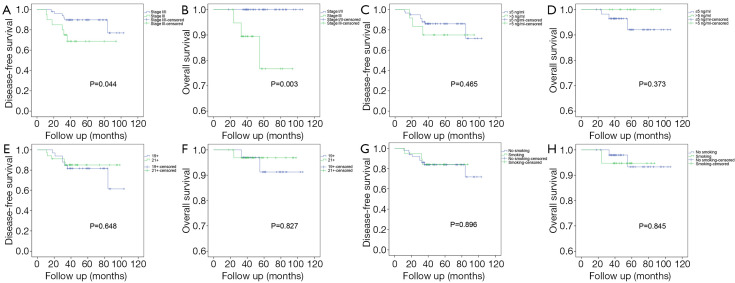
A total of 86 patients receiving adjuvant icotinib were included. Their mean age was 59.7±10.0 years, and 26 (30.2%) patients were male. The 2-year DFS rate was 86.7%, and the 3-year OS rate was 95.3% with adjuvant icotinib. DFS (P=0.044) and OS (P=0.003) are better in stage I/II disease than in stage III disease. There seems no differences in DFS and OS between patients with low or high preoperative CEA levels (cutoff of 5 ng/mL), patients with exon 19 or 21 mutation or patients with or without smoking history. The most common AEs with adjuvant icotinib were rash (83.7%) and diarrhea (19.8%). One (1.2%) patient-reported grade ≥3 AEs. No treatment-related death occurred.
For patients with mutation-positive NSCLC, adjuvant icotinib might be associated with a promising survival benefit, with an acceptable toxicity profile.
辅助性()酪氨酸激酶抑制剂(TKIs)越来越多地被考虑用于可切除非小细胞肺癌(NSCLC)的个体化治疗。本研究旨在分析接受辅助性埃克替尼治疗的表皮生长因子受体(EGFR)突变阳性NSCLC患者的生存情况和毒性特征。
这是一项单中心回顾性研究,研究对象为2011年11月至2017年12月期间接受R0(显微镜下切缘阴性)切除并接受辅助性埃克替尼治疗的EGFR突变阳性NSCLC患者。观察指标包括2年无病生存率(DFS)、3年总生存率(OS)、DFS、OS及不良事件(AE)。
共纳入86例接受辅助性埃克替尼治疗的患者。他们的平均年龄为59.7±10.0岁,26例(30.2%)为男性。接受辅助性埃克替尼治疗的患者2年DFS率为86.7%,3年OS率为95.3%。I/II期疾病患者的DFS(P=0.044)和OS(P=0.003)优于III期疾病患者。术前癌胚抗原(CEA)水平低或高(临界值为5 ng/mL)的患者、外显子19或21 EGFR突变的患者或有或无吸烟史的患者之间,DFS和OS似乎无差异。辅助性埃克替尼治疗最常见的AE为皮疹(83.7%)和腹泻(19.8%)。1例(1.2%)患者报告发生≥3级AE。未发生与治疗相关的死亡。
对于EGFR突变阳性的NSCLC患者,辅助性埃克替尼可能具有良好的生存获益,且毒性特征可接受。