Qiao Yuan, Zhu Shan, Deng Shuanglin, Zou Shan-Shan, Gao Bao, Zang Guoxia, Wu Jing, Jiang Yuxue, Liu Yong-Jun, Chen Jingtao
Institute of Translational Medicine, The First Hospital of Jilin University, Changchun, China.
Department of Neurosurgery, The First Hospital of Jilin University, Changchun, China.
Front Cell Dev Biol. 2021 Jan 8;8:606001. doi: 10.3389/fcell.2020.606001. eCollection 2020.
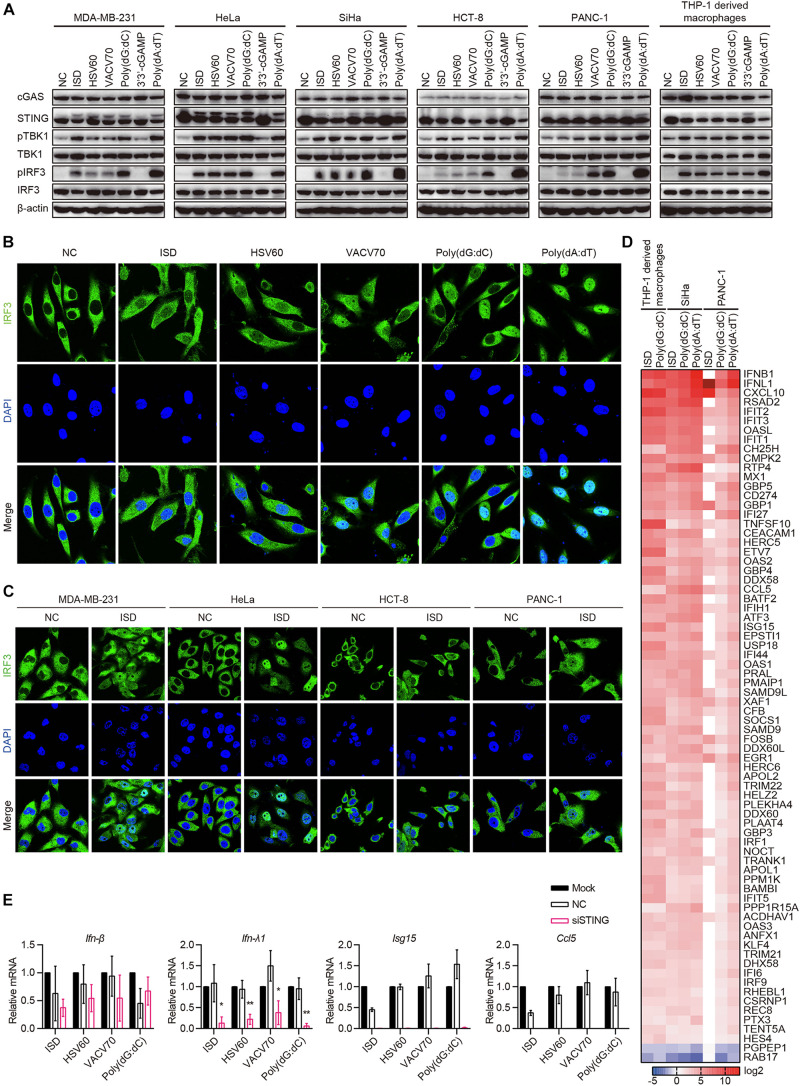
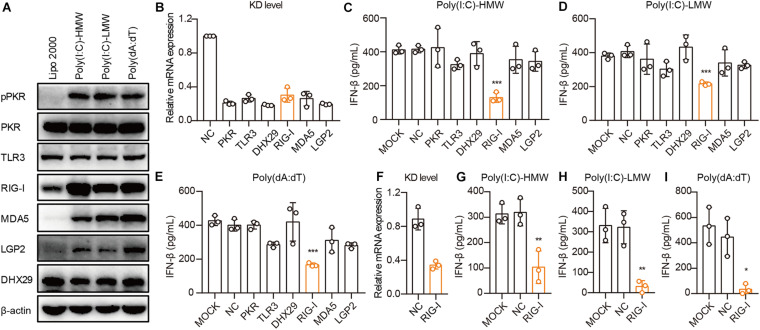
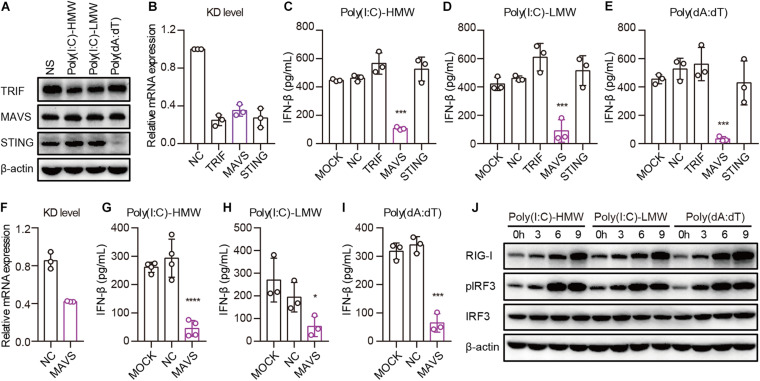
Pattern recognition receptors (PRRs) are germline-encoded host sensors of the innate immune system. Some human cancer cells have been reported to express PRRs. However, nucleic acid sensors in human cancers have not been studied in detail. Therefore, we systematically analyzed the expression, molecular cascade, and functions of TLR3, RIG-I, MDA5, LGP2, cGAS, and STING in human cancer cells. TLR3, TRIF, RIG-I, MDA5, LGP2, and MAVS were expressed in 22 cell lines. The majority of cell lines responded to only RIG-I ligands 5'-ppp-dsRNA, Poly(I:C)-HMW, Poly(I:C)-LMW, and/or Poly(dA:dT), as revealed by IRF3 phosphorylation and IFN-β secretion. IFN-β secretion was inhibited by RIG-I and MAVS knockdown. cGAS and STING were co-expressed in 10 of 22 cell lines, but IFN-β secretion was not induced by STING ligands ISD, HSV60, VACV70, Poly(dG:dC), and 3'3'-cGAMP in cGAS and STING intact cell lines. Further experiments revealed that the cGAS-STING pathway was activated, as revealed by TBK1 and IRF3 phosphorylation and IFN-β and ISG mRNA expression. These results suggest that human epithelial cancer cells respond to cytosolic RNA through the RIG-I-MAVS pathway but only sense cytosolic DNA through the cGAS-STING pathway. These findings are relevant for cancer immunotherapy approaches based on targeting nucleic acid receptors.
模式识别受体(PRRs)是先天免疫系统中由种系编码的宿主传感器。据报道,一些人类癌细胞会表达PRRs。然而,人类癌症中的核酸传感器尚未得到详细研究。因此,我们系统地分析了Toll样受体3(TLR3)、视黄酸诱导基因I(RIG-I)、黑色素瘤分化相关基因5(MDA5)、实验室遗传学和生理学2(LGP2)、环鸟苷酸-腺苷酸合成酶(cGAS)和干扰素基因刺激蛋白(STING)在人类癌细胞中的表达、分子级联反应和功能。TLR3、TIR结构域衔接蛋白(TRIF)、RIG-I、MDA5、LGP2和线粒体抗病毒信号蛋白(MAVS)在22种细胞系中表达。如干扰素调节因子3(IRF3)磷酸化和干扰素-β(IFN-β)分泌所示,大多数细胞系仅对RIG-I配体5'-三磷酸双链RNA(5'-ppp-dsRNA)、高分子量聚肌苷酸胞苷酸(Poly(I:C)-HMW)、低分子量聚肌苷酸胞苷酸(Poly(I:C)-LMW)和/或聚脱氧腺苷酸-脱氧胸苷酸(Poly(dA:dT))有反应。RIG-I和MAVS基因敲低可抑制IFN-β分泌。cGAS和STING在22种细胞系中的10种中共同表达,但在cGAS和STING完整的细胞系中,STING配体双链DNA(ISD)、单纯疱疹病毒60(HSV60)、痘苗病毒70(VACV70)、聚脱氧鸟苷酸-脱氧胞苷酸(Poly(dG:dC))和3'3'-环状二核苷酸(3'3'-cGAMP)未诱导IFN-β分泌。进一步的实验表明,TBK1和IRF3磷酸化以及IFN-β和干扰素刺激基因(ISG)mRNA表达显示cGAS-STING通路被激活。这些结果表明,人类上皮癌细胞通过RIG-I-MAVS通路对细胞质RNA作出反应,但仅通过cGAS-STING通路感知细胞质DNA。这些发现与基于靶向核酸受体的癌症免疫治疗方法相关。