Yoshimura Hajime, Togo Masaya, Ishii Junko, Ishiyama Hiroyuki, Tamura Ryota, Kimura Masamune, Kuroda Takehito, Kusunoki Susumu, Kawamoto Michi, Kohara Nobuo
Department of Neurology, Kobe City Medical Center General Hospital, Japan.
Division of Neurology, Kobe University Graduate School of Medicine, Japan.
Clin Neurophysiol Pract. 2020 Dec 26;6:29-35. doi: 10.1016/j.cnp.2020.11.004. eCollection 2021.
Bickerstaff's brainstem encephalitis (BBE) is a rare post-infectious inflammatory disease, which causes impaired consciousness by the dysfunction of the ascending reticular activating system (ARAS). We aimed to clarify EEG changes possibly caused by the dysfunction of the ARAS in BBE.
We retrospectively investigated 15 EEGs from 5 patients with definite BBE (i.e., the positivity for serum IgG anti-GQ1b antibodies was mandatory for the diagnosis) admitted to our hospital from January 2014 through December 2019, particularly focusing on whether N1 and N2 sleep patterns were maintained.
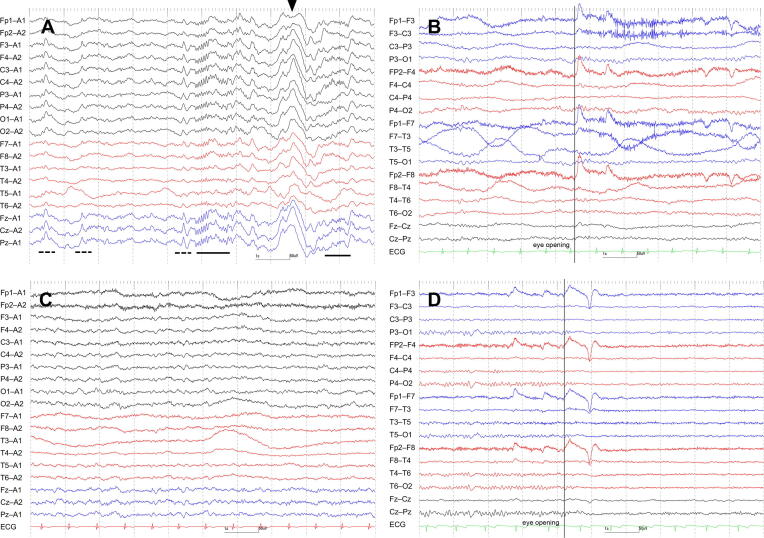
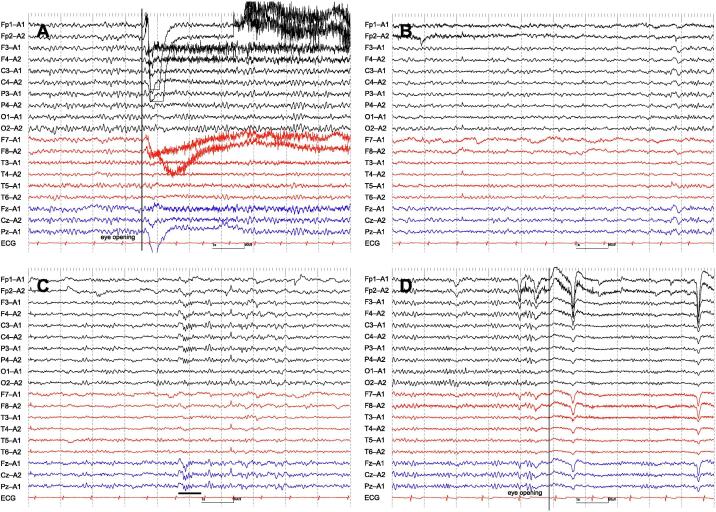
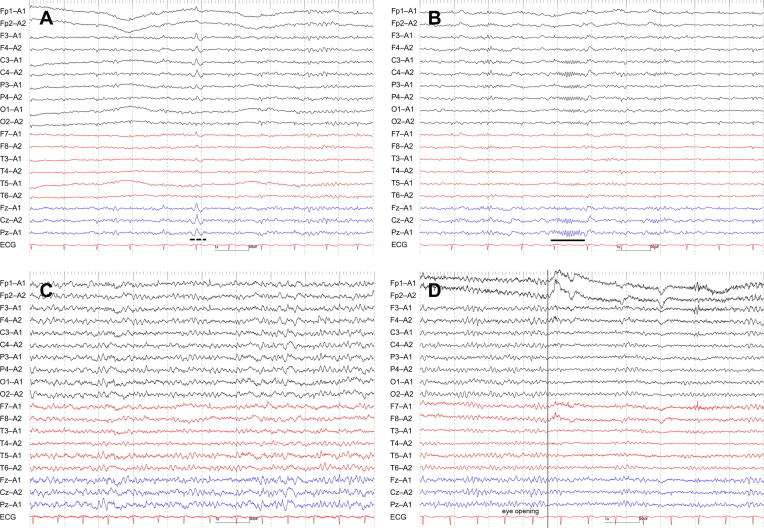
All of the 10 EEGs recorded when patients had consciousness disturbance were abnormal. Stereotypical EEG changes correlating with their level of consciousness were identified: poorly organized posterior dominant rhythms with maintenance of sleep patterns in patients with mild consciousness disturbance (n = 5); predominant N1 and/or N2 sleep patterns even with external stimuli, including spindle coma pattern, in patients with moderate consciousness disturbance ("unarousable sleep-like" EEG) (n = 4); and generalized slow waves without N1 and N2 sleep patterns in patients with severe consciousness disturbance (n = 1). Among 5 patients, 3 (60%) had "unarousable sleep-like" EEG in their clinical course.
Patients with BBE showed stereotypical EEG changes correlating with their level of consciousness, mostly with maintenance of N1 and N2 sleep patterns, and often exhibited characteristic "unarousable sleep-like" EEG.
This study revealed characteristic EEG changes possibly caused by the dysfunction of the ARAS, which can be a diagnostic clue for BBE.
巴洛氏脑干脑炎(BBE)是一种罕见的感染后炎症性疾病,通过上行网状激活系统(ARAS)功能障碍导致意识障碍。我们旨在阐明BBE中ARAS功能障碍可能引起的脑电图变化。
我们回顾性研究了2014年1月至2019年12月期间我院收治的5例确诊BBE患者(即诊断必须血清IgG抗GQ1b抗体阳性)的15份脑电图,特别关注N1和N2睡眠模式是否得以维持。
患者意识障碍时记录的10份脑电图均异常。确定了与意识水平相关的典型脑电图变化:轻度意识障碍患者(n = 5)后头部优势节律紊乱但睡眠模式得以维持;中度意识障碍患者(“不可唤醒睡眠样”脑电图)(n = 4)即使受到外部刺激仍以N1和/或N2睡眠模式为主,包括纺锤波昏迷模式;重度意识障碍患者(n = 1)出现无N1和N2睡眠模式的广泛性慢波。5例患者中,3例(60%)在临床过程中出现“不可唤醒睡眠样”脑电图。
BBE患者表现出与意识水平相关的典型脑电图变化,大多维持N1和N2睡眠模式,且常出现特征性的“不可唤醒睡眠样”脑电图。
本研究揭示了可能由ARAS功能障碍引起的特征性脑电图变化,可为BBE提供诊断线索。