Söderlund Anne, Elvén Maria, Sandborgh Maria, Fritz Johanna
School of Health, Care and Social Welfare, Mälardalen University, Västerås, Sweden.
Pain Rep. 2020 Sep 23;5(5):e844. doi: 10.1097/PR9.0000000000000844. eCollection 2020 Sep-Oct.
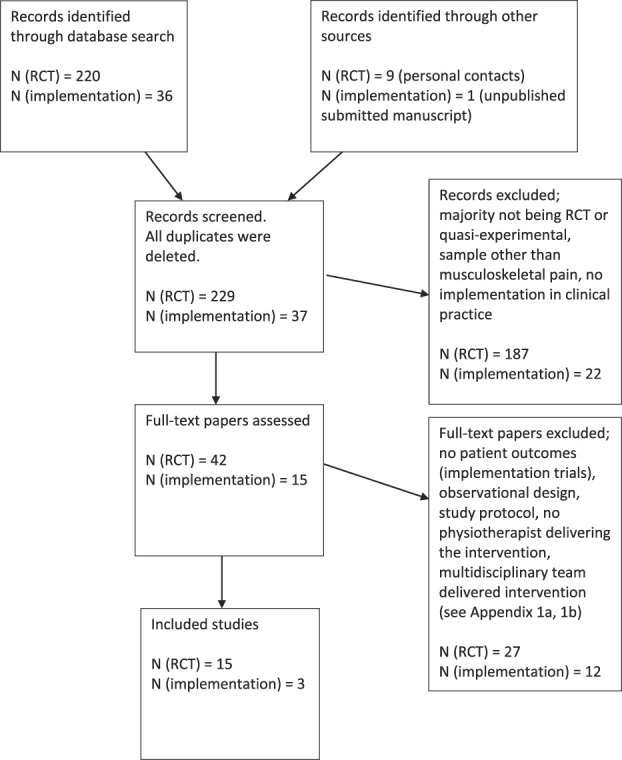
In intervention research on musculoskeletal pain, physiotherapists often study behavioral and cognitive components. Evidence on applying these components has increased during the past decade. However, how to effectively integrate behavioral and cognitive components in the biopsychosocial management of musculoskeletal pain is challenging. The aim was to study the intervention components and patient outcomes of studies integrating behavioral and cognitive components in physiotherapy, to match the interventions with a definition of behavioral medicine in physiotherapy and to categorize the behavior change techniques targeted at patients with musculoskeletal pain in (1) randomized controlled effect trials or (2) implementation in clinical practice trials. A scoping review was used to conduct this study, and the PRISMA-ScR checklist was applied. Relevant studies were identified from the PubMed, MEDLINE, PsycINFO, CINAHL Plus, and Web of Science Core databases separately for the (1) randomized controlled effect trials and (2) implementation in clinical practice trials. Synthesis for the matching of the patient interventions with the existing definition of behavior medicine in physiotherapy showed that the interventions mostly integrated psychosocial, behavioral, and biomedical/physical aspects, and were thus quite consistent with the definition of behavioral medicine in physiotherapy. The reported behavior change techniques were few and were commonly in categories such as "information of natural consequences," "feedback and monitoring," and "goals and planning." The patient outcomes for long-term follow-ups often showed positive effects. The results of this scoping review may inform future research, policies, and practice.
在肌肉骨骼疼痛的干预研究中,物理治疗师经常研究行为和认知成分。在过去十年中,应用这些成分的证据有所增加。然而,如何在肌肉骨骼疼痛的生物心理社会管理中有效整合行为和认知成分具有挑战性。目的是研究在物理治疗中整合行为和认知成分的研究的干预成分和患者结局,使干预措施与物理治疗中行为医学的定义相匹配,并将针对肌肉骨骼疼痛患者的行为改变技术分类为(1)随机对照效果试验或(2)临床实践试验中的实施情况。本研究采用了范围综述,并应用了PRISMA-ScR清单。分别从PubMed、MEDLINE、PsycINFO、CINAHL Plus和Web of Science核心数据库中识别出(1)随机对照效果试验和(2)临床实践试验中的相关研究。对患者干预措施与物理治疗中行为医学现有定义的匹配情况进行综合分析表明,这些干预措施大多整合了心理社会、行为和生物医学/身体方面,因此与物理治疗中行为医学的定义相当一致。报告的行为改变技术很少,通常属于“自然结果信息”、“反馈与监测”以及“目标与计划”等类别。长期随访的患者结局通常显示出积极效果。本范围综述的结果可能为未来的研究、政策和实践提供参考。