National Centre for Epidemiology and Population Health, Research School of Population Health, Australian National University, Acton, ACT, Australia.
Sax Institute, Ultimo, NSW, Australia.
Int J Epidemiol. 2021 Jul 9;50(3):942-954. doi: 10.1093/ije/dyaa274.
Despite generally high smoking prevalences, stemming from colonization, the relationship of smoking to mortality has not been quantified reliably in an Indigenous population. We investigate smoking and mortality among Aboriginal and Torres Strait Islander adults in Australia, where current adult daily smoking prevalence is 40.2%.
A prospective study of 1388 cardiovascular disease- and cancer-free Aboriginal adults aged ≥45 years, of the 267 153 45 and Up Study participants randomly sampled from the New South Wales general population over 2006-09. Questionnaire and mortality data were linked (through the Centre for Health Record Linkage) to mid-2019. Adjusted hazard ratios (called relative risks, RRs) for all-cause mortality-among current- and past- versus never-smokers-were estimated overall, by smoking intensity and by age at cessation. Smoking-attributable fractions and associated deaths were estimated.
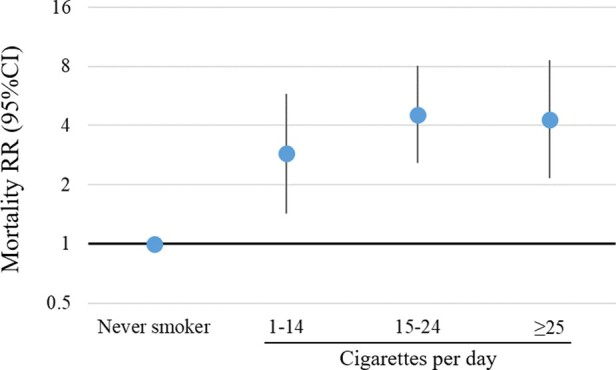
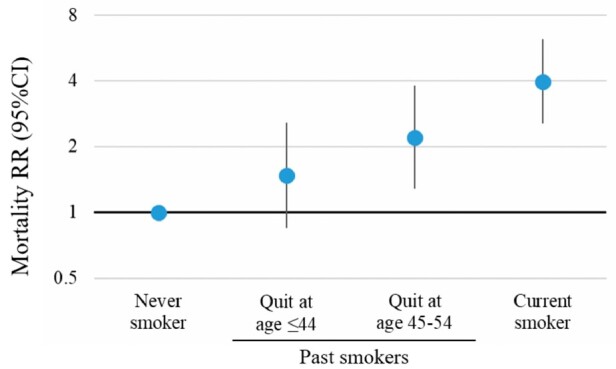
Over 14 586 person-years' follow-up (median 10.6 years), 162 deaths accrued. Mortality RRs [95% confidence interval (CI)] were 3.90 (2.52-6.04) for current- and 1.95 (1.32-2.90) for past- versus never-smokers, with age heterogeneity. RRs increased with smoking intensity, to 4.29 (2.15-8.57) in current-smokers of ≥25 cigarettes/day. Compared with never-smokers, RRs were 1.48 (0.85-2.57) for those quitting at <45 years of age and 2.21 (1.29-3.80) at 45-54 years. Never-smokers lived an average >10 years longer than current-smokers. Around half of deaths among adults aged ≥45 years were attributable to smoking, exceeding 10 000 deaths in the past decade.
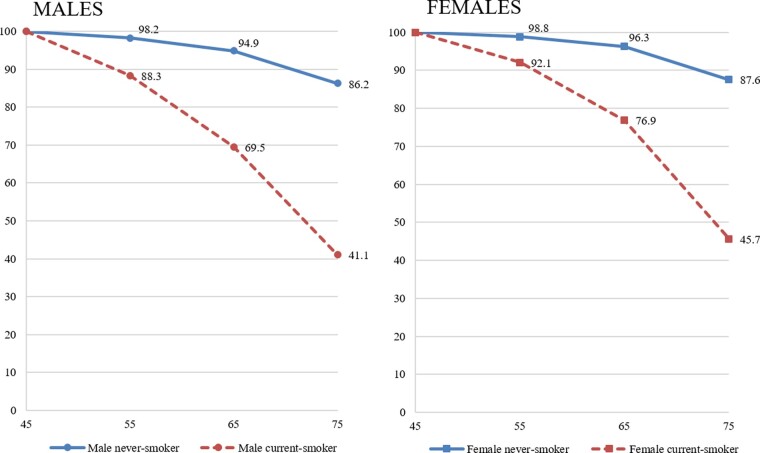
In this population, >80% of never-smokers would survive to 75 years, versus ∼40% of current-smokers. Quitting at all ages examined had substantial benefits versus continuing smoking; those quitting before age 45 years had mortality risks similar to never-smokers. Smoking causes half of deaths in older Aboriginal and Torres Strait Islander adults; Indigenous tobacco control must receive increased priority.
尽管殖民化导致吸烟率普遍较高,但吸烟与死亡率之间的关系在土著人群中尚未得到可靠的量化。我们研究了澳大利亚的原住民和托雷斯海峡岛民成年人的吸烟和死亡率,目前澳大利亚成年人的每日吸烟率为 40.2%。
这是一项针对 1388 名年龄在 45 岁及以上、无心血管疾病和癌症的原住民成年人的前瞻性研究,他们是 2006-09 年从新南威尔士州普通人群中随机抽取的 26715345 名参与者中的一部分。通过中心健康记录链接(Centre for Health Record Linkage)将问卷调查和死亡率数据联系起来,截至 2019 年年中。总体上,通过目前吸烟和过去吸烟与从不吸烟者的调整后的危险比(称为相对风险,RR),以及吸烟强度和戒烟年龄,来估计全因死亡率。还估计了吸烟归因分数和相关死亡人数。
在超过 14586 人年的随访(中位数为 10.6 年)中,有 162 人死亡。RR[95%置信区间(CI)]为当前吸烟者为 3.90(2.52-6.04),过去吸烟者为 1.95(1.32-2.90),有年龄异质性。RR 随着吸烟强度的增加而增加,目前每天吸烟≥25 支的吸烟者为 4.29(2.15-8.57)。与从不吸烟者相比,<45 岁戒烟者的 RR 为 1.48(0.85-2.57),45-54 岁戒烟者的 RR 为 2.21(1.29-3.80)。从不吸烟者的平均预期寿命比当前吸烟者长 10 年以上。过去十年中,≥45 岁成年人中约一半的死亡归因于吸烟,超过 10000 人死亡。
在该人群中,超过 80%的从不吸烟者将活到 75 岁,而目前吸烟者中只有约 40%能活到 75 岁。与继续吸烟相比,所有年龄组戒烟都有显著的益处;<45 岁戒烟者的死亡率风险与从不吸烟者相似。吸烟导致一半的老年原住民和托雷斯海峡岛民成年人死亡;必须优先加强对土著烟草控制的重视。