Department of Neuropsychiatry, Graduate School of Medical Sciences, Kyushu University, Fukuoka, Japan.
Neural Dynamics Laboratory, Research Service, VA Boston Healthcare System, and Department of Psychiatry, Harvard Medical School, Boston, Massachusetts, USA.
Curr Opin Psychiatry. 2021 May 1;34(3):245-252. doi: 10.1097/YCO.0000000000000693.
To provide recent evidence on real-time neurofeedback (NFB) training for auditory verbal hallucinations (AVH) in schizophrenia patients.
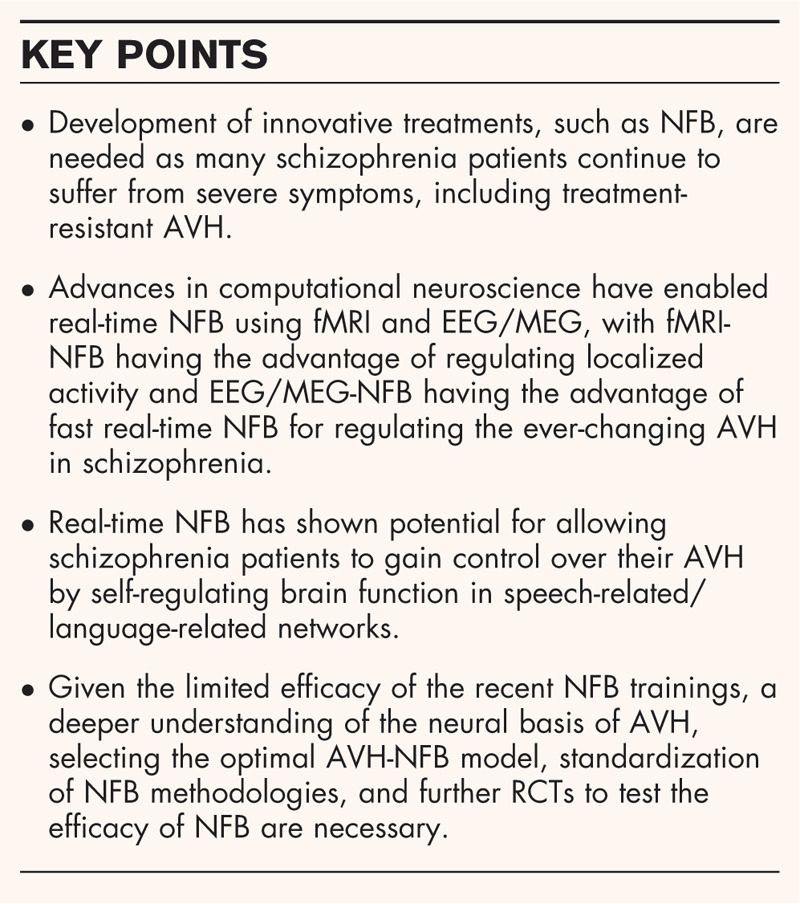
NFB is a promising technique that allows patients to gain control over their AVH by modulating their own speech-related/language-related networks including superior temporal gyrus (STG) and anterior cingulate cortex (ACC) using fMRI, fNIRS and EEG/MEG. A recent limited number of studies showed that while an EEG-based NFB study failed to regulate auditory-evoked potentials and reduce AVH, downregulation of STG hyperactivity and upregulation of ACC activity with fMRI-based NFB appear to alleviate treatment-resistant AVH in schizophrenia patients. A deeper understanding of AVH and development of more effective methodologies are still needed.
Despite recent innovations in antipsychotics, many schizophrenia patients continue to suffer from treatment-resistant AVH and social dysfunctions. Recent studies suggested that real-time NFB shows promise in enabling patients to gain control over AVH by regulating their own speech-related/language-related networks. Although fMRI-NFB is suitable for regulating localized activity, EEG/MEG-NFB are ideal for regulating the ever-changing AVH. Although there are still many challenges including logistic complexity and burden on patients, we hope that such innovative real-time NFB trainings will help patients to alleviate severe symptoms and improve social functioning.
为了提供有关精神分裂症患者听觉言语幻觉(AVH)实时神经反馈(NFB)训练的最新证据。
NFB 是一种很有前途的技术,它可以通过使用 fMRI、fNIRS 和 EEG/MEG 来调节与言语/语言相关的网络,包括颞上回(STG)和前扣带皮层(ACC),从而使患者能够控制自己的 AVH。最近的一些有限的研究表明,虽然基于 EEG 的 NFB 研究未能调节听觉诱发电位并减少 AVH,但基于 fMRI 的 NFB 下调 STG 过度活跃和上调 ACC 活动似乎可以缓解精神分裂症患者的治疗抵抗性 AVH。仍需要更深入地了解 AVH 并开发更有效的方法。
尽管抗精神病药物最近有所创新,但许多精神分裂症患者仍继续遭受治疗抵抗性 AVH 和社交功能障碍的困扰。最近的研究表明,实时 NFB 通过调节与言语/语言相关的网络,有望使患者能够控制自己的 AVH。虽然 fMRI-NFB 适合调节局部活动,但 EEG/MEG-NFB 是调节不断变化的 AVH 的理想选择。尽管仍然存在许多挑战,包括后勤复杂性和患者负担,但我们希望这种创新的实时 NFB 训练将帮助患者缓解严重症状并改善社交功能。