Department of Pediatric Otorhinolaryngology, Faculty of Medicine, Comenius University and National Institute of Children's Diseases, 83101 Bratislava, Slovakia.
Faculty of Medicine, Masaryk University, 62500 Brno, Czech Republic.
Medicina (Kaunas). 2021 Jan 21;57(2):93. doi: 10.3390/medicina57020093.
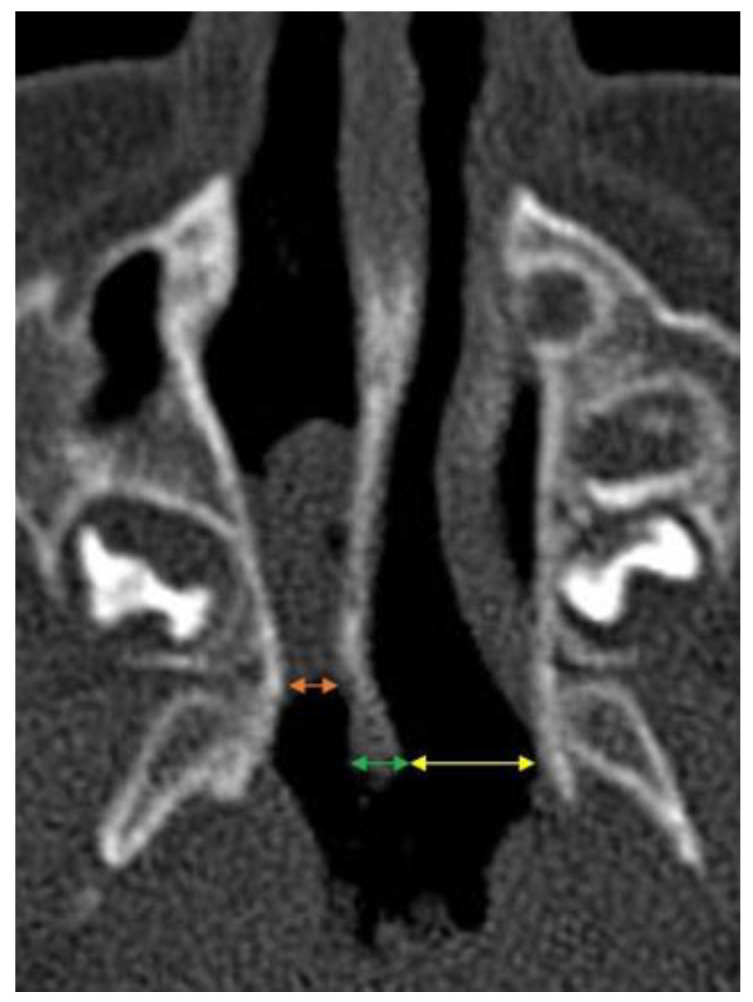
Choanal atresia is the most common congenital malformation of the nose. We have evaluated 24 CT images of children with choanal atresia treated at the Department of Pediatric Otorhinolaryngology FM CU and the NICD Bratislava (Slovakia). In accordance with the methodology used by Slovis et al. (1985), we have measured parameters related to anomalous development in the nasal cavity: vomer width, the width of soft atresia and the width of the air space of unilaterally developed choana. In the group of 24 patients, 11 (46%) were male and 13 (54%) were female. The age of patients at the time of CT imaging varied. Associated syndromes had been manifested in 11 (46%) children, with 7 (29%) patients having CHARGE syndrome. In 13 (54%) cases it was a bone membranous type of atresia, in 8 (33%) cases a membranous type, and in 3 (13%) patients a bone type. Among the group of patients, unilateral disorder was present in 13 (54%) patients and bilateral in 11 (46%). Based on the Pearson's correlation test, we have found in the studied group that the width of the vomer correlates with age, and the vomer is wider in bone atresia than in the membranous ones. Based on determining the average vomer's width within the age groups 0-8 and >8-20, compared to the standard widths, we found that the vomer's widths reached the upper limits of the standard ±2 SD (cm) or even exceeded that limit. The same applies to the width in soft choanal atresia. On the other hand, the width of the developed choana in the case of unilateral atresia is almost standard. The above findings are the basis for selecting the appropriate type of surgery. Currently, the gold standard is the endoscopic fenestration. associated with posterior septotomy.
后鼻孔闭锁是最常见的鼻腔先天性畸形。我们评估了在 FM CU 儿科学耳鼻喉科和 NICD Bratislava(斯洛伐克)治疗的 24 例后鼻孔闭锁患儿的 24 例 CT 图像。根据 Slovis 等人(1985 年)使用的方法,我们测量了与鼻腔异常发育相关的参数:犁骨宽度、软闭锁的宽度和单侧发育的后鼻孔空气空间的宽度。在 24 例患者中,11 例(46%)为男性,13 例(54%)为女性。患者在 CT 成像时的年龄不同。11 例(46%)患儿表现出相关综合征,其中 7 例(29%)患儿为 CHARGE 综合征。13 例(54%)为骨膜性闭锁,8 例(33%)为膜性闭锁,3 例(13%)为骨性闭锁。在患者组中,单侧障碍存在于 13 例(54%)患者中,双侧障碍存在于 11 例(46%)患者中。基于 Pearson 相关检验,我们在研究组中发现犁骨的宽度与年龄相关,并且骨性闭锁的犁骨比膜性闭锁的犁骨更宽。通过在年龄组 0-8 岁和>8-20 岁内确定犁骨的平均宽度,并与标准宽度进行比较,我们发现犁骨的宽度达到了标准宽度±2 SD(cm)的上限,甚至超过了该限制。同样适用于软后鼻孔闭锁的宽度。另一方面,单侧闭锁时发育后的后鼻孔的宽度几乎是标准的。上述发现是选择合适手术类型的基础。目前,金标准是内镜开窗术,联合后鼻中隔切开术。