He Zhong-Hua, Li Ming-De, Liu Chan-Jun, Ma Xiao-Yue
School of Journalism and New Media, Xi'an Jiaotong University, Xi'an, China.
Arch Public Health. 2021 Jan 25;79(1):11. doi: 10.1186/s13690-021-00526-2.
Abdominal fat deposition is a key component of obesity, which is associated with an increased risk for a number of mental disorders. The current study aims to explore the relationship between body image, anxiety, food-specific inhibitory control, and emotional eating in young women with abdominal obesity.
A total of 224 participants were recruited: 168 were non-abdominal obesity and 56 were abdominal obesity. Participants completed the following questionnaires and behavioral tests: the Body Mass Index (BMI) -based Silhouette-Matching Test (SMT), the State-Trait Anxiety Inventory (STAI), Food Stop Signal Task (SST), the Emotional Eating Scale (EES).
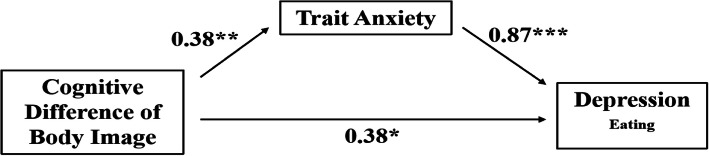
Abdominal obesity women had significantly higher levels of trait anxiety, cognitive difference, expectational difference in body image but lower self-reported emotional eating level compared to the control group. Anxiety mediated the relationship between cognitive difference of body image and depression in young females with abdominal obesity. In addition, only among abdominal obesity individuals, expectational difference of body image were significantly and positively correlated with food-specific inhibitory control and trait/state anxiety.
The findings suggest it is of critical importance to promote a healthy body image recognition and expectation and improve mood regulation for young females with abdominal obesity high in trait anxiety.
腹部脂肪沉积是肥胖的一个关键组成部分,与多种精神障碍风险增加相关。当前研究旨在探讨腹部肥胖年轻女性的身体意象、焦虑、食物特异性抑制控制和情绪化进食之间的关系。
共招募了224名参与者:168名非腹部肥胖者和56名腹部肥胖者。参与者完成了以下问卷和行为测试:基于体重指数(BMI)的轮廓匹配测试(SMT)、状态-特质焦虑量表(STAI)、食物停止信号任务(SST)、情绪化进食量表(EES)。
与对照组相比,腹部肥胖女性的特质焦虑、身体意象的认知差异、期望差异水平显著更高,但自我报告的情绪化进食水平更低。焦虑介导了腹部肥胖年轻女性身体意象认知差异与抑郁之间的关系。此外,仅在腹部肥胖个体中,身体意象的期望差异与食物特异性抑制控制以及特质/状态焦虑显著正相关。
研究结果表明,对于特质焦虑水平高的腹部肥胖年轻女性,促进健康的身体意象认知和期望以及改善情绪调节至关重要。