Ophthalmology, Erasmus MC, Rotterdam, Zuid-Holland, The Netherlands
Orthopics & Optometry, Hogeschool Utrecht, Utrecht, The Netherlands.
Br J Ophthalmol. 2022 Jun;106(6):820-824. doi: 10.1136/bjophthalmol-2020-316234. Epub 2021 Jan 25.
Data on myopia progression during its entire course are scarce. The aim of this study is to investigate myopia progression in Europeans as a function of age and degree of myopia from first prescription to final refractive error.
The Drentse Refractive Error and Myopia Study assessed data from a branch of opticians in the Netherlands from 1985 onwards in a retrospective study. First pair of glasses prescribed was defined as a spherical equivalent of refraction (SER) ≤-0.5 D to ≥-3.0 D. Subjects with prescriptions at an interval of at least 1 year were included in the analysis.
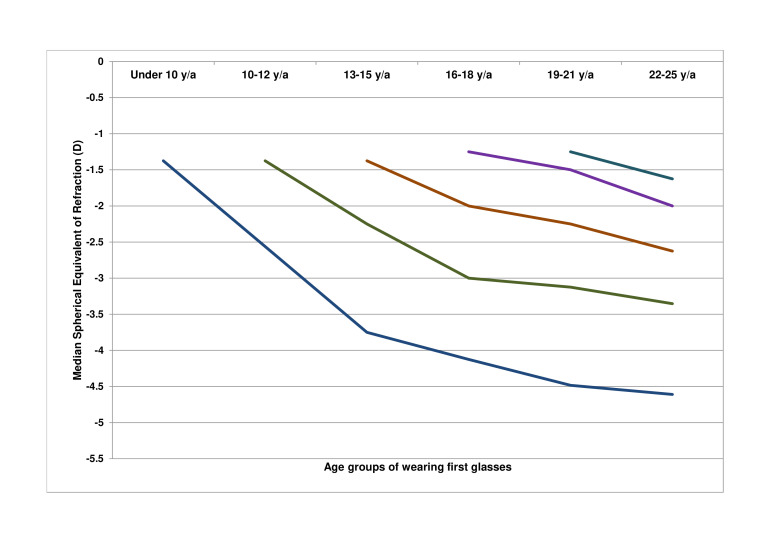
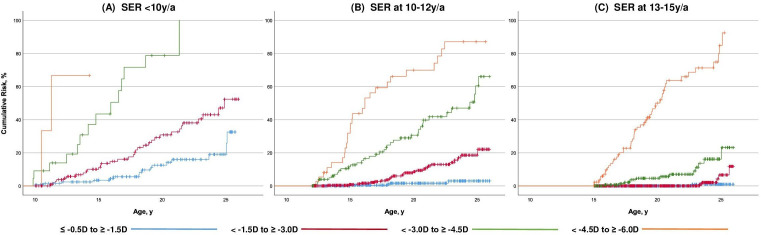
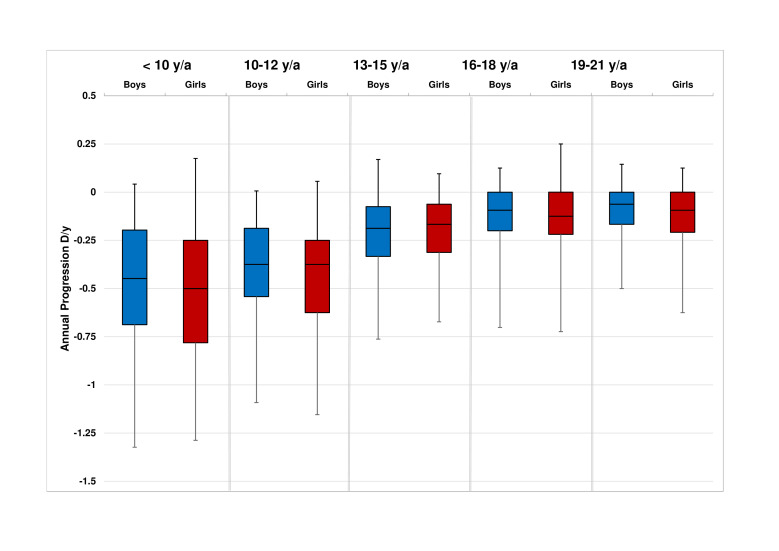
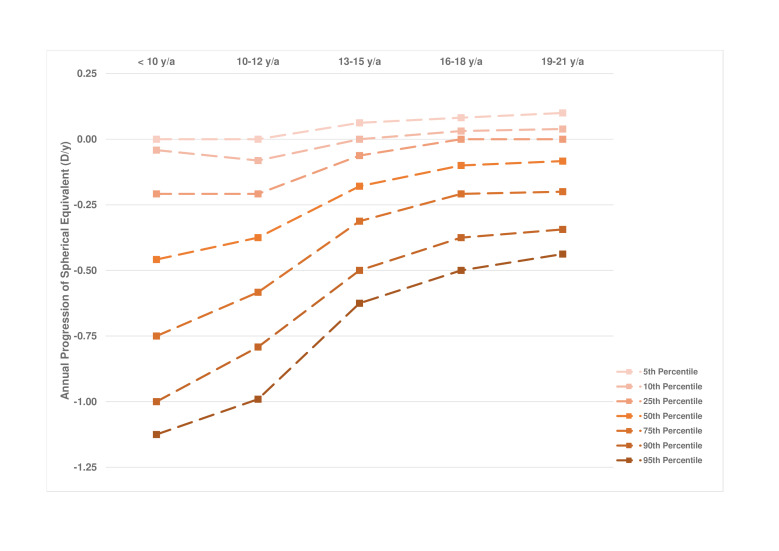
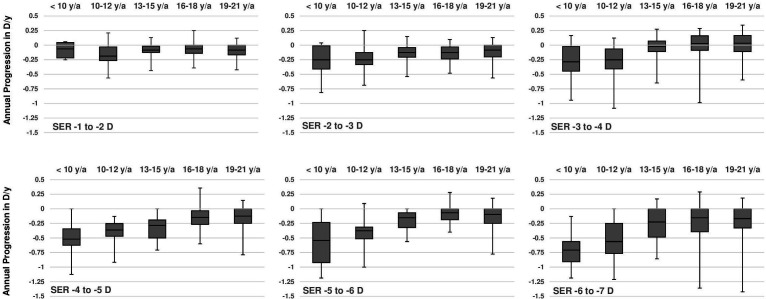
A total of 2555 persons (57.3% female) met the inclusion criteria. Those with first prescription before the age of 10 years showed the strongest progression (-0.50 D; IQR: -0.75 to -0.19) and a significantly (p<0.001) more negative median final SER (-4.48 D; IQR: -5.37 to -3.42). All children who developed SER ≤-3 D at 10 years were highly myopic (SER ≤-6D) as adults, children who had SER between -1.5 D and -3 D at 10 years had 46.0% risk of high myopia, and children with SER between -0.5 D and -1.5 D had 32.6% risk of high myopia. Myopia progression diminished with age; all refractive categories stabilised after age 15 years except for SER ≤-5 D who progressed up to -0.25 D annually until age 21 years.
Our trajectories of the natural course of myopia progression may serve as a guide for myopia management in European children. SER at 10 years is an important prognostic indicator and will help determine treatment intensity.
关于近视进展的全过程的数据很少。本研究的目的是研究从首次配镜到最终屈光不正的整个过程中,年龄和近视程度对欧洲人近视进展的影响。
Drentse 屈光不正和近视研究回顾性地评估了自 1985 年以来荷兰一家眼镜商分支机构的数据。首次配镜的定义为等效球镜度(SER)≤-0.5 D 至≥-3.0 D。至少间隔 1 年有配镜记录的患者被纳入分析。
共有 2555 人(57.3%为女性)符合纳入标准。10 岁前首次配镜的患者进展最快(-0.50 D;IQR:-0.75 至-0.19),最终 SER 的中位数明显更负(-4.48 D;IQR:-5.37 至-3.42)(p<0.001)。所有在 10 岁时发展为 SER ≤-3 D 的儿童成年后均为高度近视(SER ≤-6D),10 岁时 SER 在-1.5 D 至-3 D 之间的儿童有 46.0%的高度近视风险,而 SER 在-0.5 D 至-1.5 D 之间的儿童有 32.6%的高度近视风险。近视进展随年龄而减少;所有屈光类别在 15 岁后均稳定,除了 SER ≤-5 D 的患者,他们在 21 岁前每年进展-0.25 D。
我们的近视自然病程轨迹可作为欧洲儿童近视管理的指南。10 岁时的 SER 是一个重要的预后指标,有助于确定治疗强度。