Department of Emergency, West China Second University Hospital, Sichuan University, Chengdu, Sichuan 610041, P.R. China.
Mol Med Rep. 2021 Mar;23(3). doi: 10.3892/mmr.2021.11837. Epub 2021 Jan 26.
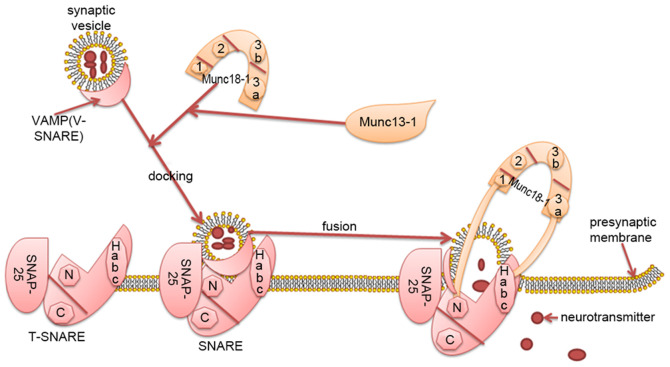
The release of neurotransmitters following the fusion of synaptic vesicles and the presynaptic membrane is an important process in the transmission of neuronal information. Syntaxin-binding protein 1 (Munc18-1) is a synaptic fusion protein binding protein, which mainly regulates synaptic vesicle fusion and neurotransmitter release by interacting with soluble N-ethylmaleimide sensitive factor attachment protein receptor. In addition to affecting neurotransmitter transmission, Munc18-1 is also involved in regulating neurosynaptic plasticity, neurodevelopment and neuroendocrine cell release functions (including thyroxine and insulin release). A number of previous studies have demonstrated that Munc18-1 has diverse and vital biological functions, and that its abnormal expression serves an important role in the pathogenesis of a variety of neurological diseases, including epileptic encephalopathy, schizophrenia, autism, Parkinson's disease, Alzheimer's disease, multiple sclerosis, Duchenne's muscular dystrophy and neuronal ceroid lipofuscinosis. The present review summarizes the function of Munc18-1 and its possible relationship to the pathogenesis of various neurological diseases.
突触小泡与突触前膜融合后神经递质的释放是神经元信息传递的一个重要过程。突触融合蛋白 1(Munc18-1)是一种突触融合蛋白结合蛋白,主要通过与可溶性 N-乙基马来酰亚胺敏感因子附着蛋白受体相互作用来调节突触囊泡融合和神经递质释放。除了影响神经递质传递外,Munc18-1 还参与调节神经突触可塑性、神经发育和神经内分泌细胞释放功能(包括甲状腺素和胰岛素释放)。一些先前的研究表明,Munc18-1 具有多种重要的生物学功能,其异常表达在多种神经疾病的发病机制中起着重要作用,包括癫痫性脑病、精神分裂症、自闭症、帕金森病、阿尔茨海默病、多发性硬化症、杜氏肌营养不良症和神经元蜡样脂褐质沉积症。本综述总结了 Munc18-1 的功能及其与各种神经疾病发病机制的可能关系。