Department of Microbiology and Immunology, Tulane University, New Orleans, LA 70112, USA.
Viruses. 2021 Jan 20;13(2):145. doi: 10.3390/v13020145.
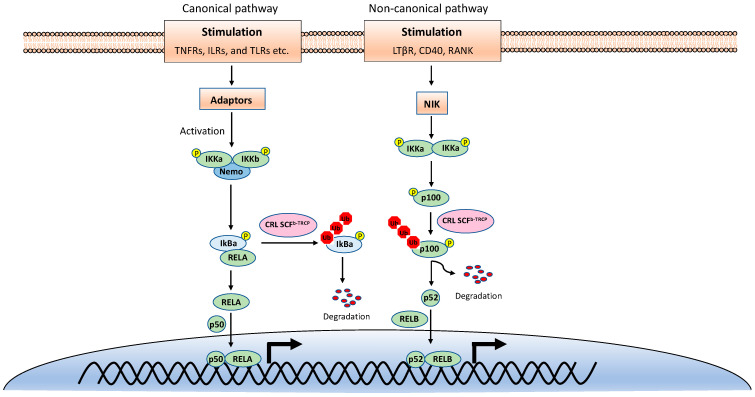
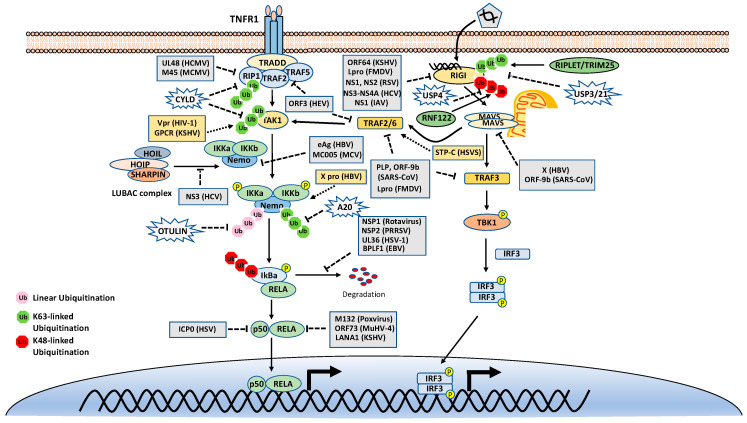
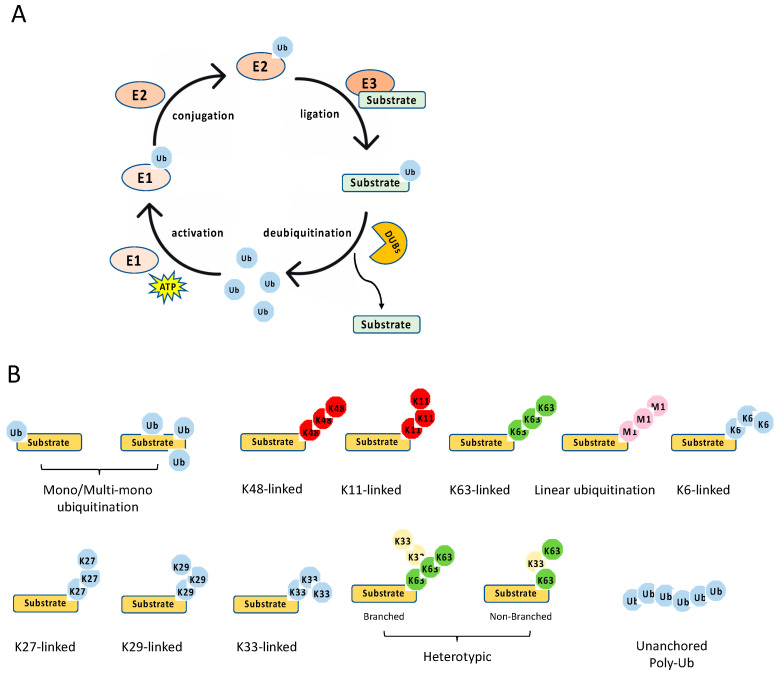
The nuclear factor κB (NF-κB) family are the master transcription factors that control cell proliferation, apoptosis, the expression of interferons and proinflammatory factors, and viral infection. During viral infection, host innate immune system senses viral products, such as viral nucleic acids, to activate innate defense pathways, including the NF-κB signaling axis, thereby inhibiting viral infection. In these NF-κB signaling pathways, diverse types of ubiquitination have been shown to participate in different steps of the signal cascades. Recent advances find that viruses also modulate the ubiquitination in NF-κB signaling pathways to activate viral gene expression or inhibit host NF-κB activation and inflammation, thereby facilitating viral infection. Understanding the role of ubiquitination in NF-κB signaling during viral infection will advance our knowledge of regulatory mechanisms of NF-κB signaling and pave the avenue for potential antiviral therapeutics. Thus, here we systematically review the ubiquitination in NF-κB signaling, delineate how viruses modulate the NF-κB signaling via ubiquitination and discuss the potential future directions.
核因子 κB(NF-κB)家族是控制细胞增殖、凋亡、干扰素和促炎因子表达以及病毒感染的主要转录因子。在病毒感染过程中,宿主固有免疫系统感知病毒产物,如病毒核酸,激活固有防御途径,包括 NF-κB 信号轴,从而抑制病毒感染。在这些 NF-κB 信号通路中,已经证明多种类型的泛素化参与信号级联的不同步骤。最近的研究进展发现,病毒还可以调节 NF-κB 信号通路中的泛素化,以激活病毒基因表达或抑制宿主 NF-κB 激活和炎症,从而促进病毒感染。了解泛素化在病毒感染过程中 NF-κB 信号转导中的作用将增进我们对 NF-κB 信号转导调控机制的认识,并为潜在的抗病毒治疗铺平道路。因此,在这里我们系统地综述了 NF-κB 信号通路中的泛素化,阐述了病毒如何通过泛素化调节 NF-κB 信号,并讨论了潜在的未来方向。