Experimental and Clinical Pharmacology Unit, Centro di Riferimento Oncologico di Aviano (CRO), IRCCS, 33081 Aviano (PN), Italy.
Department of Chemical and Pharmaceutical Sciences, University of Trieste, Via L. Giorgieri 1, 34127 Trieste, Italy.
Int J Mol Sci. 2021 Jan 22;22(3):1075. doi: 10.3390/ijms22031075.
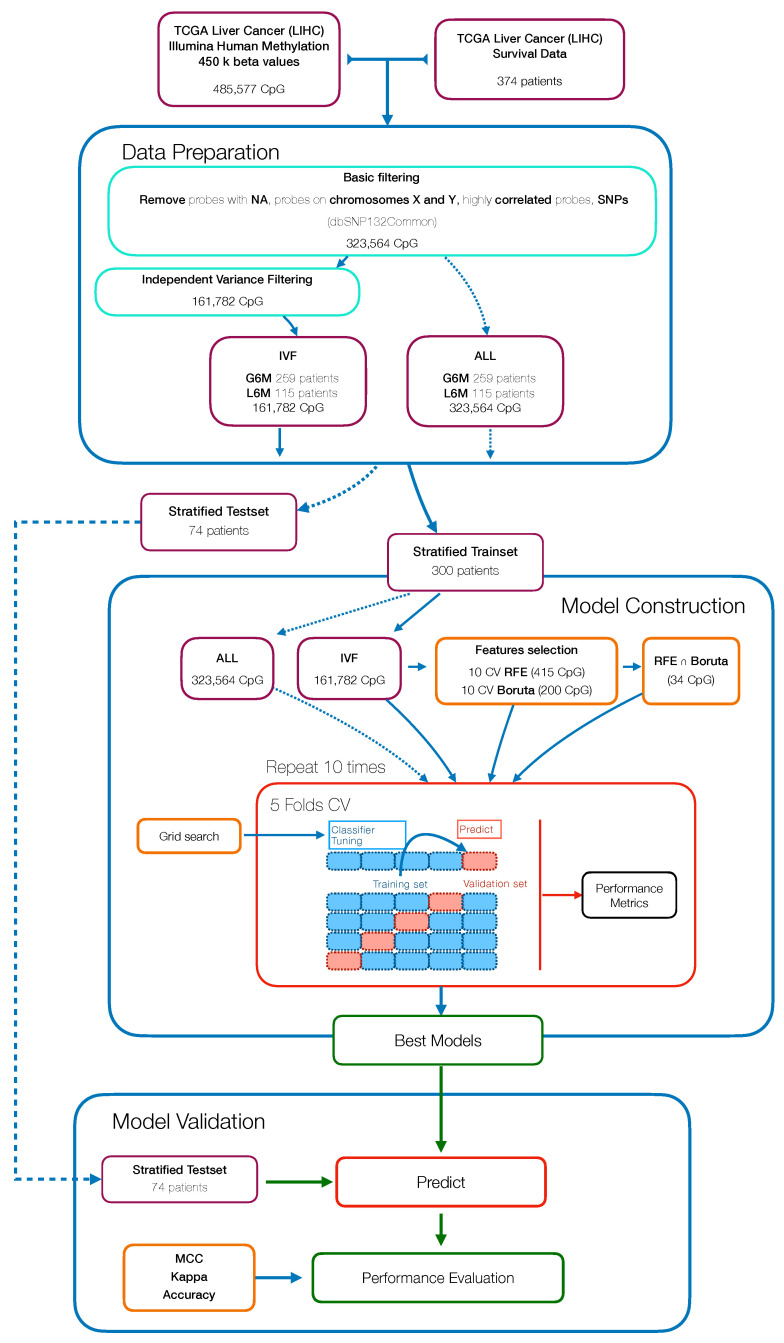
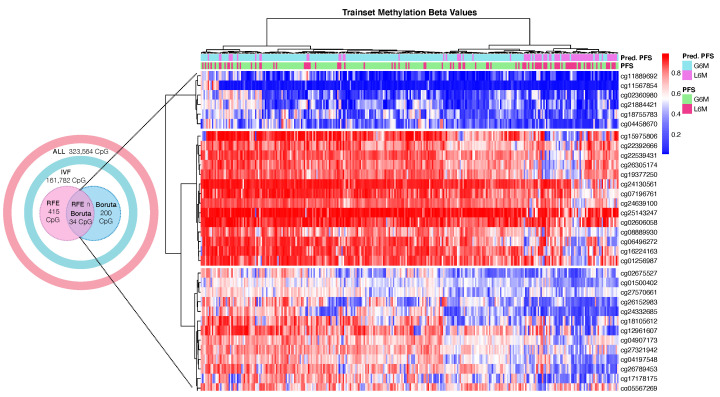
Although extensive advancements have been made in treatment against hepatocellular carcinoma (HCC), the prognosis of HCC patients remains unsatisfied. It is now clearly established that extensive epigenetic changes act as a driver in human tumors. This study exploits HCC epigenetic deregulation to define a novel prognostic model for monitoring the progression of HCC. We analyzed the genome-wide DNA methylation profile of 374 primary tumor specimens using the Illumina 450 K array data from The Cancer Genome Atlas. We initially used a novel combination of Machine Learning algorithms (Recursive Features Selection, Boruta) to capture early tumor progression features. The subsets of probes obtained were used to train and validate Random Forest models to predict a Progression Free Survival greater or less than 6 months. The model based on 34 epigenetic probes showed the best performance, scoring 0.80 accuracy and 0.51 Matthews Correlation Coefficient on testset. Then, we generated and validated a progression signature based on 4 methylation probes capable of stratifying HCC patients at high and low risk of progression. Survival analysis showed that high risk patients are characterized by a poorer progression free survival compared to low risk patients. Moreover, decision curve analysis confirmed the strength of this predictive tool over conventional clinical parameters. Functional enrichment analysis highlighted that high risk patients differentiated themselves by the upregulation of proliferative pathways. Ultimately, we propose the oncogenic gene as a methylation-driven gene of which the representative epigenetic markers could serve both as predictive and prognostic markers. Briefly, our work provides several potential HCC progression epigenetic biomarkers as well as a new signature that may enhance patients surveillance and advances in personalized treatment.
尽管在治疗肝细胞癌 (HCC) 方面取得了广泛的进展,但 HCC 患者的预后仍然不尽如人意。现在已经明确,广泛的表观遗传变化是人类肿瘤的驱动因素。本研究利用 HCC 的表观遗传失调来定义一种新的用于监测 HCC 进展的预后模型。我们使用来自癌症基因组图谱的 Illumina 450 K 阵列数据分析了 374 个原发性肿瘤标本的全基因组 DNA 甲基化谱。我们最初使用了一种新的机器学习算法(递归特征选择、Boruta)组合来捕获早期肿瘤进展特征。获得的探针子集用于训练和验证随机森林模型,以预测无进展生存期大于或小于 6 个月。基于 34 个表观遗传探针的模型表现最佳,在测试集中的准确率为 0.80,马修斯相关系数为 0.51。然后,我们基于 4 个甲基化探针生成并验证了一个进展特征,能够对 HCC 患者进行高风险和低风险进展分层。生存分析表明,高风险患者的无进展生存期明显比低风险患者差。此外,决策曲线分析证实了这种预测工具相对于传统临床参数的优势。功能富集分析突出表明,高风险患者通过上调增殖途径来区分自己。最终,我们提出了致癌基因作为一个受甲基化驱动的基因,其代表性的表观遗传标志物既可以作为预测标志物,也可以作为预后标志物。简而言之,我们的工作提供了几种潜在的 HCC 进展表观遗传生物标志物,以及一个可能增强患者监测和个性化治疗进展的新特征。