Mylonis Ilias, Chachami Georgia, Simos George
Laboratory of Biochemistry, Faculty of Medicine, University of Thessaly, 41500 Larissa, Greece.
Gerald Bronfman Department of Oncology, Faculty of Medicine, McGill University, Montreal, QC H4A 3T2, Canada.
Cancers (Basel). 2021 Jan 22;13(3):410. doi: 10.3390/cancers13030410.
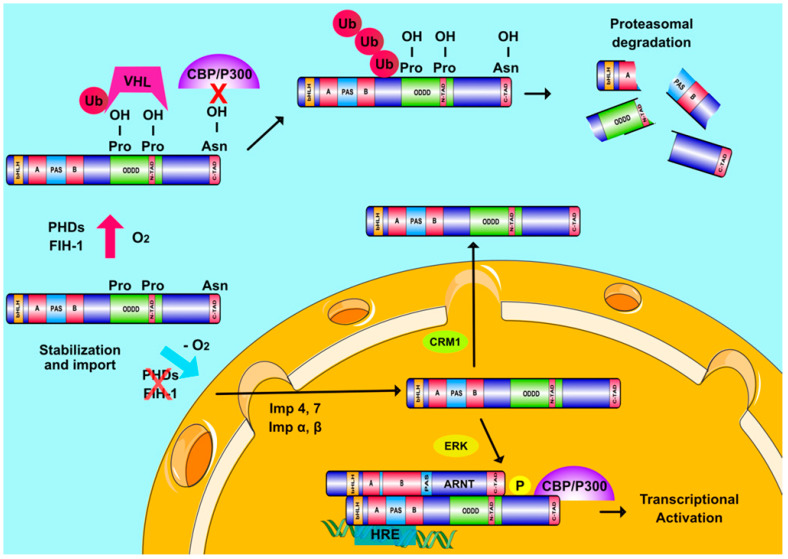
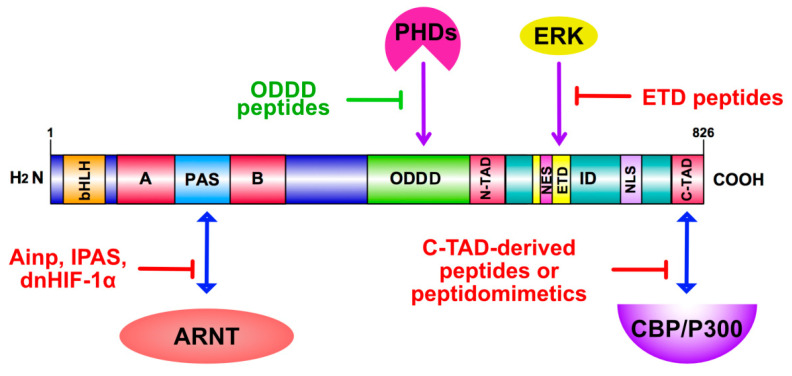
Reduced oxygen availability (hypoxia) is a characteristic of many disorders including cancer. Central components of the systemic and cellular response to hypoxia are the Hypoxia Inducible Factors (HIFs), a small family of heterodimeric transcription factors that directly or indirectly regulate the expression of hundreds of genes, the products of which mediate adaptive changes in processes that include metabolism, erythropoiesis, and angiogenesis. The overexpression of HIFs has been linked to the pathogenesis and progression of cancer. Moreover, evidence from cellular and animal models have convincingly shown that targeting HIFs represents a valid approach to treat hypoxia-related disorders. However, targeting transcription factors with small molecules is a very demanding task and development of HIF inhibitors with specificity and therapeutic potential has largely remained an unattainable challenge. Another promising approach to inhibit HIFs is to use peptides modelled after HIF subunit domains known to be involved in protein-protein interactions that are critical for HIF function. Introduction of these peptides into cells can inhibit, through competition, the activity of endogenous HIFs in a sequence and, therefore also isoform, specific manner. This review summarizes the involvement of HIFs in cancer and the approaches for targeting them, with a special focus on the development of peptide HIF inhibitors and their prospects as highly-specific pharmacological agents.
氧供应减少(缺氧)是包括癌症在内的许多疾病的一个特征。缺氧诱导因子(HIFs)是全身和细胞对缺氧反应的核心组成部分,它是一个小的异二聚体转录因子家族,直接或间接调节数百个基因的表达,这些基因的产物介导包括代谢、红细胞生成和血管生成等过程中的适应性变化。HIFs的过表达与癌症的发病机制和进展有关。此外,细胞和动物模型的证据令人信服地表明,靶向HIFs是治疗缺氧相关疾病的一种有效方法。然而,用小分子靶向转录因子是一项非常艰巨的任务,开发具有特异性和治疗潜力的HIF抑制剂在很大程度上仍然是一个难以实现的挑战。另一种有前景的抑制HIFs的方法是使用基于已知参与对HIF功能至关重要的蛋白质-蛋白质相互作用的HIF亚基结构域构建的肽。将这些肽导入细胞可以通过竞争以序列特异性(因此也是异构体特异性)的方式抑制内源性HIFs的活性。本综述总结了HIFs在癌症中的作用以及靶向它们的方法,特别关注肽类HIF抑制剂的开发及其作为高度特异性药物的前景。