Laboratorio de Micología y Diagnóstico Molecular, Cátedra de Parasitología y Micología, Facultad de Bioquímica y Ciencias Biológicas, Universidad Nacional del Litoral, Santa Fe, Argentina; Consejo Nacional de Investigaciones Científicas y Tecnológicas, Santa Fe, Argentina.
Sanatorio Adventista del Plata, Libertador San Martín, Entre Ríos, Argentina; Facultad de Ciencias de la Salud, Universidad Adventista del Plata, Libertador San Martín, Entre Ríos, Argentina.
Rev Iberoam Micol. 2021 Jan-Mar;38(1):16-18. doi: 10.1016/j.riam.2020.11.001. Epub 2020 Nov 28.
Patients with severe viral pneumonia are likely to receive high-dose immunomodulatory drugs to prevent clinical worsening. Aspergillus species have been described as frequent secondary pneumonia agents in severely ill influenza patients receiving steroids. COVID-19 patients admitted to Intensive Care Unit (ICU) are receiving steroids as part of their treatment and they share clinical characteristics with other patients with severe viral pneumonias. COVID-19 patients receiving steroids should be considered a putative risk group of invasive aspergillosis.
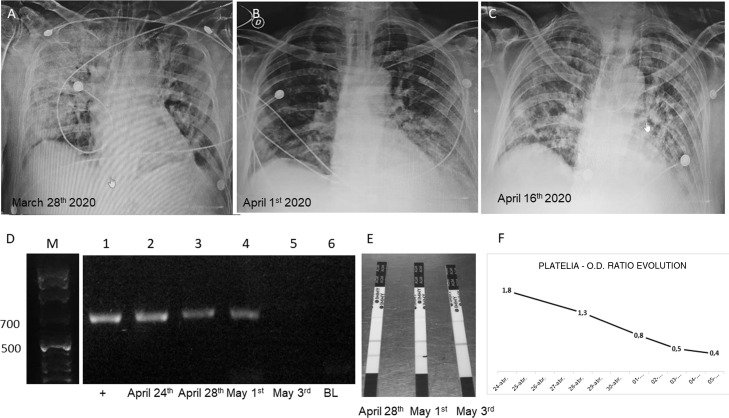
We are reporting a SARS-CoV-2/Aspergillus section Fumigati coinfection in an elderly intubated patient with a history of pulmonary embolism treated with corticosteroids. The diagnosis was made following the ad hoc definitions described for patients admitted to ICU with severe influenza, including clinical criteria (fever for 3 days refractory to the appropriate antibiotic therapy, dyspnea, pleural friction rub, worsening of respiratory status despite antibiotic therapy and need of ventilator support), a radiological criterion (pulmonary infiltrate) and a mycological criterion (several positive galactomannan tests on serum with ratio ≥0.5). In addition, Aspergillus section Fumigati DNA was found in serum and blood samples. These tests were positive 4 weeks after the patient was admitted to the ICU. The patient received voriconazole and after two month in ICU his respiratory status improved; he was discharged after 6 weeks of antifungal treatment.
Severely ill COVID-19 patients would be considered a new aspergillosis risk group. Galactomannan and Aspergillus DNA detection would be useful methods for Aspergillus infection diagnosis as they allow avoiding the biosafety issues related to these patients.
患有严重病毒性肺炎的患者可能需要接受大剂量免疫调节药物治疗,以防止病情恶化。曲霉属物种已被描述为在接受类固醇治疗的重症流感患者中常见的继发性肺炎病原体。入住重症监护病房(ICU)的 COVID-19 患者正在接受类固醇治疗,作为其治疗的一部分,他们与其他患有严重病毒性肺炎的患者具有相似的临床特征。接受类固醇治疗的 COVID-19 患者应被视为侵袭性曲霉病的潜在高危人群。
我们报告了一例 SARS-CoV-2/曲霉属 Fumigati 合并感染的病例,患者为老年插管患者,有肺栓塞病史,正在接受皮质类固醇治疗。该诊断是根据为入住 ICU 的重症流感患者制定的特定定义得出的,包括临床标准(发热超过 3 天,对适当的抗生素治疗无反应,呼吸困难,胸膜摩擦音,尽管进行了抗生素治疗但呼吸状况仍恶化,需要呼吸机支持)、影像学标准(肺部浸润)和真菌学标准(血清中半乳甘露聚糖检测多次阳性,比值≥0.5)。此外,在血清和血液样本中发现了曲霉属 Fumigati DNA。这些检测在患者入住 ICU 4 周后呈阳性。患者接受了伏立康唑治疗,在入住 ICU 2 个月后,他的呼吸状况有所改善;在接受 6 周抗真菌治疗后出院。
重症 COVID-19 患者可能被视为新的曲霉病高危人群。半乳甘露聚糖和曲霉属 DNA 检测将是曲霉属感染诊断的有用方法,因为它们可以避免与这些患者相关的生物安全问题。