Zhexenova Zhanel, Amirova Aida, Abdikarimova Manshuk, Kudaibergenov Kuanysh, Baimakhan Nurakhmet, Tleubayev Bolat, Asselborn Thibault, Johal Wafa, Dillenbourg Pierre, CohenMiller Anna, Sandygulova Anara
Department of Robotics and Mechatronics, School of Engineering and Digital Sciences, Nazarbayev University, Nur-Sultan, Kazakhstan.
Graduate School of Education, Nazarbayev University, Nur-Sultan, Kazakhstan.
Front Robot AI. 2020 Oct 7;7:99. doi: 10.3389/frobt.2020.00099. eCollection 2020.
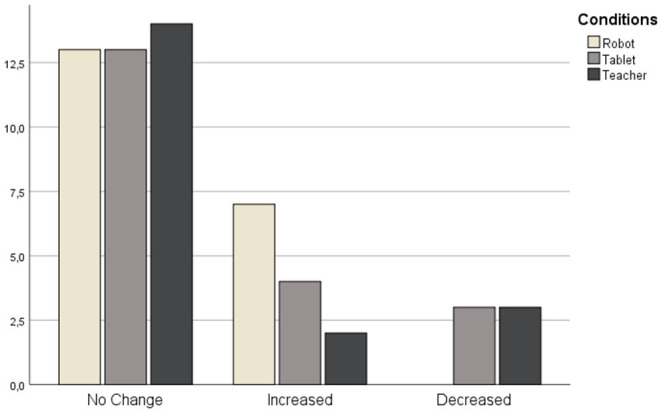
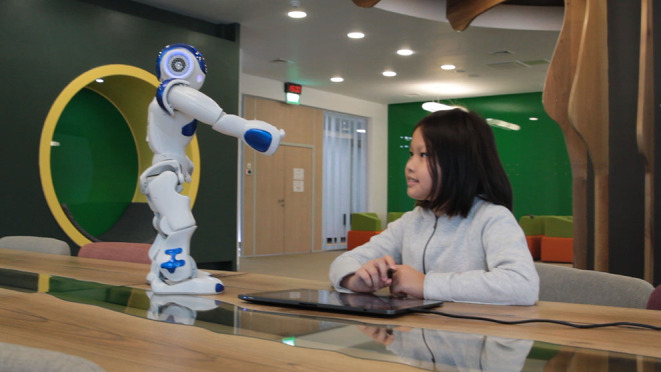
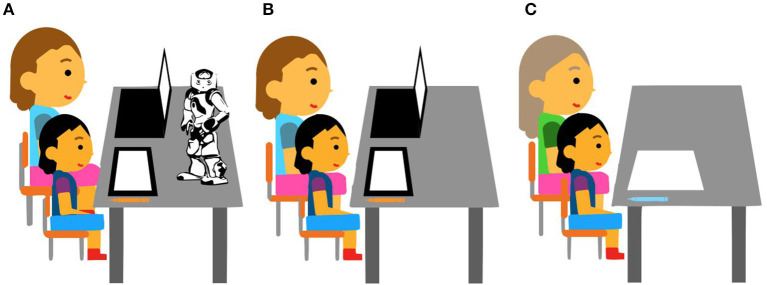
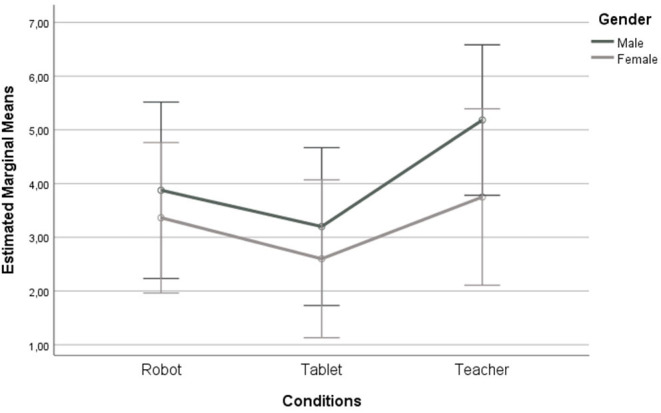
This research occurred in a special context where Kazakhstan's recent decision to switch from Cyrillic to the Latin-based alphabet has resulted in challenges connected to teaching literacy, addressing a rare combination of research hypotheses and technical objectives about language learning. Teachers are not necessarily trained to teach the new alphabet, and this could result in a challenge for children with learning difficulties. Prior research studies in Human-Robot Interaction (HRI) have proposed the use of a robot to teach handwriting to children (Hood et al., 2015; Lemaignan et al., 2016). Drawing on the Kazakhstani case, our study takes an interdisciplinary approach by bringing together smart solutions from robotics, computer vision areas, and educational frameworks, language, and cognitive studies that will benefit diverse groups of stakeholders. In this study, a human-robot interaction application is designed to help primary school children learn both a newly-adopted script and also its handwriting system. The setup involved an experiment with 62 children between the ages of 7-9 years old, across three conditions: a robot and a tablet, a tablet only, and a teacher. Based on the paradigm-learning by teaching-the study showed that children improved their knowledge of the Latin script by interacting with a robot. Findings reported that children gained similar knowledge of a new script in all three conditions without gender effect. In addition, children's likeability ratings and positive mood change scores demonstrate significant benefits favoring the robot over a traditional teacher and tablet only approaches.
这项研究发生在一个特殊背景下,哈萨克斯坦最近决定从西里尔文改用基于拉丁字母的字母表,这带来了与扫盲教学相关的挑战,涉及到关于语言学习的一系列罕见的研究假设和技术目标。教师不一定接受过教授新字母表的培训,这可能给有学习困难的儿童带来挑战。此前在人机交互(HRI)方面的研究提出使用机器人教儿童书写(胡德等人,2015年;勒迈尼昂等人,2016年)。借鉴哈萨克斯坦的案例,我们的研究采用跨学科方法,整合了机器人技术、计算机视觉领域以及教育框架、语言和认知研究等方面的智能解决方案,这将使不同利益相关群体受益。在本研究中,设计了一个人机交互应用程序,以帮助小学生学习新采用的文字及其书写系统。该设置涉及对62名7至9岁儿童进行的一项实验,分为三种情况:一个机器人和一台平板电脑、仅一台平板电脑以及一名教师。基于“通过教学进行学习”的范式,研究表明儿童通过与机器人互动提高了对拉丁文字的了解。研究结果报告称,在所有三种情况下,儿童对新文字的了解程度相似,且不存在性别差异。此外,儿童的喜爱度评分和积极情绪变化得分表明,与传统教师和仅使用平板电脑的方法相比,机器人具有显著优势。