Division of Gastroenterology and Hepatology, Department of Medicine, Indiana University School of Medicine, Indianapolis, Indiana.
Molecular Stethoscope, San Diego, California.
Am J Physiol Gastrointest Liver Physiol. 2021 Apr 1;320(4):G439-G449. doi: 10.1152/ajpgi.00397.2020. Epub 2021 Jan 27.
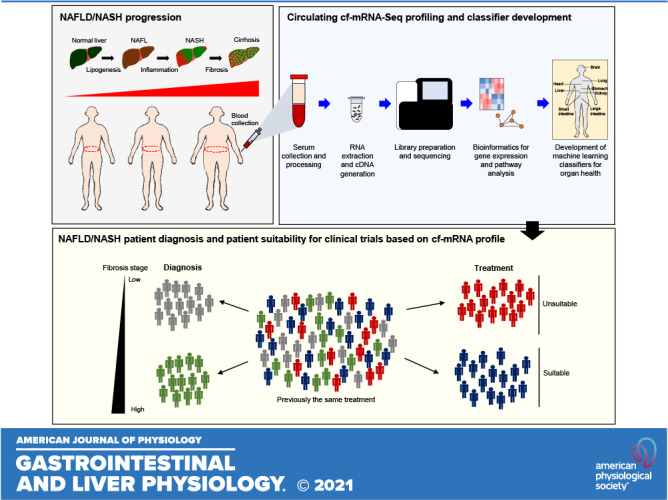
Hepatic fibrosis stage is the most important determinant of outcomes in patients with nonalcoholic fatty liver disease (NAFLD). There is an urgent need for noninvasive tests that can accurately stage fibrosis and determine efficacy of interventions. Here, we describe a novel cell-free (cf)-mRNA sequencing approach that can accurately and reproducibly profile low levels of circulating mRNAs and evaluate the feasibility of developing a cf-mRNA-based NAFLD fibrosis classifier. Using separate discovery and validation cohorts with biopsy-confirmed NAFLD ( = 176 and 59, respectively) and healthy subjects ( = 23), we performed serum cf-mRNA RNA-Seq profiling. Differential expression analysis identified 2,498 dysregulated genes between patients with NAFLD and healthy subjects and 134 fibrosis-associated genes in patients with NAFLD. Comparison between cf-mRNA and liver tissue transcripts revealed significant overlap of fibrosis-associated genes and pathways indicating that the circulating cf-mRNA transcriptome reflects molecular changes in the livers of patients with NAFLD. In particular, metabolic and immune pathways reflective of known underlying steatosis and inflammation were highly dysregulated in the cf-mRNA profile of patients with advanced fibrosis. Finally, we used an elastic net ordinal logistic model to develop a classifier that predicts clinically significant fibrosis (F2-F4). In an independent cohort, the cf-mRNA classifier was able to identify 50% of patients with at least 90% probability of clinically significant fibrosis. We demonstrate a novel and robust cf-mRNA-based RNA-Seq platform for noninvasive identification of diverse hepatic molecular disruptions and for fibrosis staging with promising potential for clinical trials and clinical practice. This work is the first study, to our knowledge, to utilize circulating cell-free mRNA sequencing to develop an NAFLD diagnostic classifier.
肝纤维化分期是影响非酒精性脂肪性肝病(NAFLD)患者预后的最重要因素。目前迫切需要能够准确分期纤维化并评估干预效果的非侵入性检测方法。在这里,我们描述了一种新的无细胞(cf)-mRNA 测序方法,该方法可以准确和可重复地分析低水平的循环 mRNA,并评估开发基于 cf-mRNA 的 NAFLD 纤维化分类器的可行性。我们使用经活检证实的 NAFLD 患者的独立发现和验证队列(分别为 = 176 和 59)和健康受试者( = 23)进行了血清 cf-mRNA RNA-Seq 分析。差异表达分析鉴定出 NAFLD 患者与健康受试者之间存在 2,498 个失调基因和 134 个与纤维化相关的基因。cf-mRNA 与肝组织转录本的比较显示纤维化相关基因和途径存在显著重叠,表明循环 cf-mRNA 转录组反映了 NAFLD 患者肝脏的分子变化。特别是,反映已知潜在脂肪变性和炎症的代谢和免疫途径在纤维化患者的 cf-mRNA 谱中高度失调。最后,我们使用弹性网有序逻辑模型开发了一种预测临床显著纤维化(F2-F4)的分类器。在一个独立的队列中,cf-mRNA 分类器能够以至少 90%的概率识别出 50%的至少有临床显著纤维化的患者。我们展示了一种新颖而强大的基于 cf-mRNA 的 RNA-Seq 平台,用于非侵入性识别各种肝分子紊乱和纤维化分期,具有在临床试验和临床实践中应用的巨大潜力。据我们所知,这是第一项利用循环无细胞 mRNA 测序开发 NAFLD 诊断分类器的研究。