Department of Environmental Health, Harvard University T.H. Chan School of Public Health, Boston, Massachusetts, United States.
Department of Occupational and Environmental Medicine, National Cheng Kung University Hospital, College of Medicine, National Cheng Kung University, Tainan, Taiwan.
Infect Control Hosp Epidemiol. 2021 Dec;42(12):1473-1478. doi: 10.1017/ice.2021.17. Epub 2021 Jan 28.
To better understand coronavirus disease 2019 (COVID-19) transmission among healthcare workers (HCWs), we investigated occupational and nonoccupational risk factors associated with cumulative COVID-19 incidence among a Massachusetts HCW cohort.
DESIGN, SETTING, AND PARTICIPANTS: The retrospective cohort study included adult HCWs in a single healthcare system from March 9 to June 3, 2020.
The SARS-CoV-2 nasopharyngeal RT-PCR results and demographics of the study participants were deidentified and extracted from an established occupational health, COVID-19 database at the healthcare system. HCWs from each particular job grouping had been categorized into frontline or nonfrontline workers. Incidence rate ratios (IRRs) and odds ratios (ORs) were used to compare subgroups after excluding HCWs involved in early infection clusters before universal masking began. A sensitivity analysis was performed comparing jobs with the greatest potential occupational risks with others.
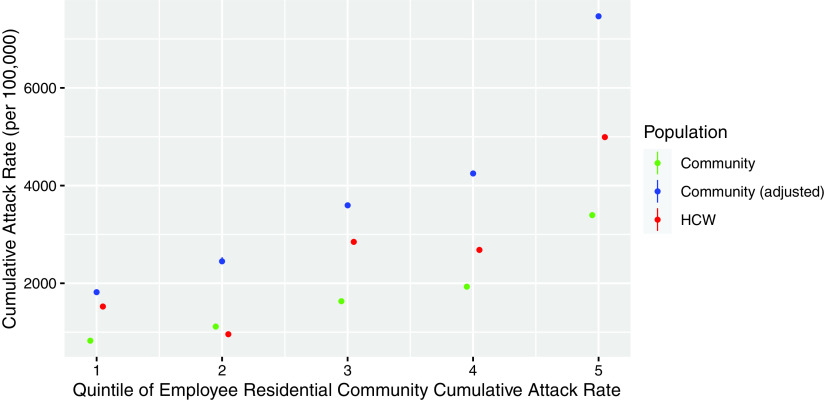
Of 5,177 HCWs, 152 (2.94%) were diagnosed with COVID-19. Affected HCWs resided in areas with higher community attack rates (median, 1,755.2 vs 1,412.4 cases per 100,000; P < .001; multivariate-adjusted IRR, 1.89; 95% CI, 1.03-3.44 comparing fifth to first quintile of community rates). After multivariate adjustment, African-American and Hispanic HCWs had higher incidence of COVID-19 than non-Hispanic white HCWs (IRR, 2.78; 95% CI, 1.78-4.33; and IRR, 2.41, 95% CI, 1.42-4.07, respectively). After adjusting for race and residential rates, frontline HCWs had a higher IRR (1.73, 95% CI, 1.16-2.54) than nonfrontline HCWs overall, but not within specific job categories nor when comparing the highest risk jobs to others.
After universal masking was instituted, the strongest risk factors associated with HCW COVID-19 infection were residential community infection rate and race.
为了更好地了解医护人员(HCWs)之间的 2019 年冠状病毒病(COVID-19)传播,我们调查了与马萨诸塞州 HCW 队列中 COVID-19 累计发病率相关的职业和非职业危险因素。
设计、地点和参与者:这项回顾性队列研究纳入了 2020 年 3 月 9 日至 6 月 3 日期间来自单一医疗保健系统的成年 HCWs。
从医疗保健系统中建立的职业健康 COVID-19 数据库中提取研究参与者的 SARS-CoV-2 鼻咽 RT-PCR 结果和人口统计学数据。将来自每个特定工作分组的 HCWs 归类为一线或非一线工作人员。在开始普遍戴口罩之前,排除参与早期感染群的 HCWs 后,使用发病率比(IRR)和优势比(OR)比较亚组。进行了敏感性分析,比较了具有最大潜在职业风险的工作与其他工作。
在 5177 名 HCWs 中,有 152 名(2.94%)被诊断患有 COVID-19。受影响的 HCWs 居住在社区发病率较高的地区(中位数,每 100,000 人中有 1,755.2 与 1,412.4 例;P<0.001;多变量调整后的 IRR,第五五分位与第一五分位比较,社区发病率为 1.89;95%CI,1.03-3.44)。经过多变量调整后,非裔美国人和西班牙裔 HCWs 患 COVID-19 的发病率高于非西班牙裔白人 HCWs(IRR,2.78;95%CI,1.78-4.33;IRR,2.41,95%CI,1.42-4.07)。在调整了种族和居住率后,一线 HCWs 的 IRR(1.73;95%CI,1.16-2.54)高于非一线 HCWs,但在特定工作类别中没有,也没有在将风险最高的工作与其他工作进行比较时。
在普遍戴口罩后,与 HCW COVID-19 感染相关的最强危险因素是居住社区感染率和种族。