Martínez-Orgado José, Villa María, Del Pozo Aarón
Division of Neonatology, Hospital Clínico San Carlos - IdISSC, Madrid, Spain.
Biomedical Research Foundation Hospital Clinico San Carlos, Madrid, Spain.
Front Pharmacol. 2021 Jan 11;11:584533. doi: 10.3389/fphar.2020.584533. eCollection 2020.
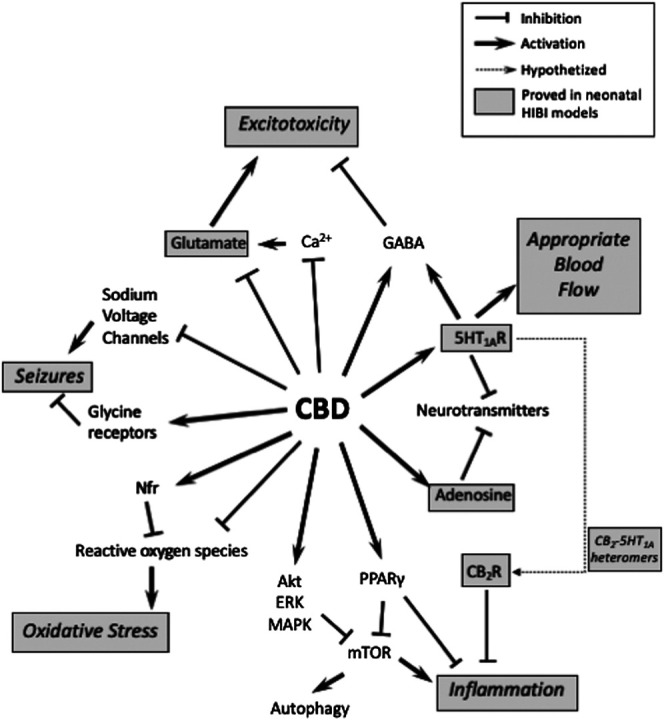
Each year, more than two million babies die or evolve to permanent invalidating sequelae worldwide because of Hypoxic-Ischemic Brain Injury (HIBI). There is no current treatment for that condition except for therapeutic hypothermia, which benefits only a select group of newborns. Preclinical studies offer solid evidence of the neuroprotective effects of Cannabidiol (CBD) when administered after diffuse or focal HI insults to newborn pigs and rodents. Such effects are observable in the short and long term as demonstrated by functional, neuroimaging, histologic and biochemical studies, and are related to the modulation of excitotoxicity, inflammation and oxidative stress-the major components of HIBI pathophysiology. CBD protects neuronal and glial cells, with a remarkable effect on preserving normal myelinogenesis. From a translational point of view CBD is a valuable tool for HIBI management since it is safe and effective. It is administered by the parenteral route with a broad therapeutic time window. Those findings consolidate CBD as a promising treatment for neonatal HIBI, which is to be demonstrated in clinical trials currently in progress.
每年,全球有超过两百万婴儿因缺氧缺血性脑损伤(HIBI)死亡或发展为永久性致残后遗症。除了治疗性低温疗法外,目前尚无针对该病症的治疗方法,而治疗性低温疗法仅对特定的新生儿群体有益。临床前研究提供了确凿证据,表明在对新生猪和啮齿动物进行弥漫性或局灶性缺氧缺血性损伤后给予大麻二酚(CBD)具有神经保护作用。功能、神经影像学、组织学和生化研究表明,这种作用在短期和长期内均可观察到,并且与兴奋性毒性、炎症和氧化应激(HIBI病理生理学的主要组成部分)的调节有关。CBD可保护神经元和神经胶质细胞,对维持正常的髓鞘形成有显著作用。从转化医学的角度来看,CBD是一种用于管理HIBI的有价值工具,因为它安全有效。它通过肠胃外途径给药,具有广泛的治疗时间窗。这些发现巩固了CBD作为新生儿HIBI一种有前景的治疗方法的地位,这将在目前正在进行的临床试验中得到证实。