Cao Xi, Ren Xinyu, Zhou Yidong, Mao Feng, Lin Yan, Wu Huanwen, Sun Qiang
Department of Breast Surgery, Peking Union Medical College Hospital, Peking Union Medical College, Chinese Academy of MedicalSciences, Beijing, China.
Department of Pathology, Peking Union Medical College Hospital, Peking Union Medical College, Chinese Academy of Medical Sciences, Beijing, China.
Front Oncol. 2021 Jan 11;10:583966. doi: 10.3389/fonc.2020.583966. eCollection 2020.
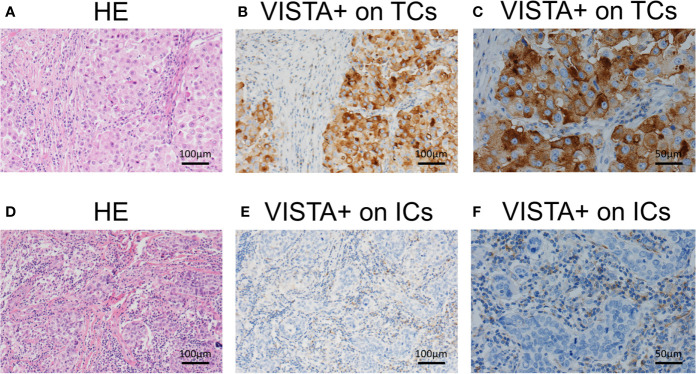
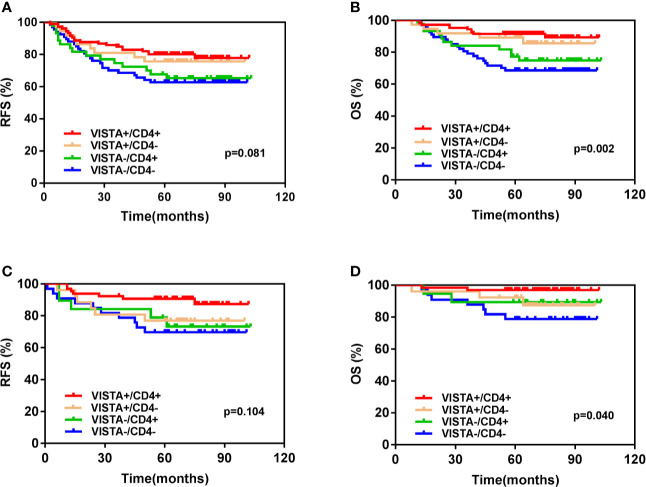
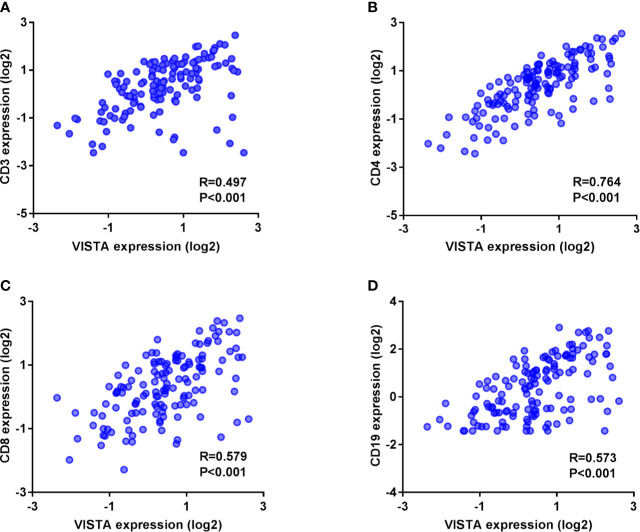
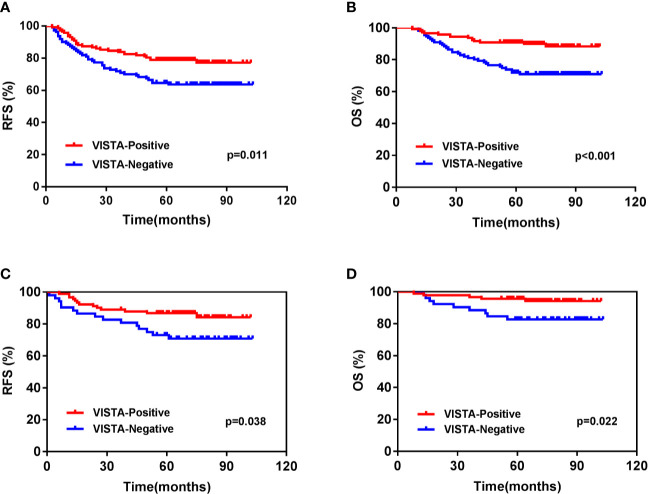
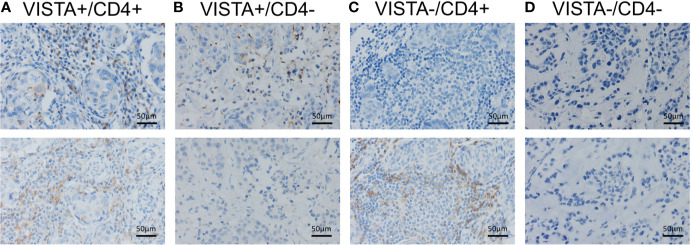
V-domain Ig suppressor of T-cell activation (VISTA), a newly discovered negative immune checkpoint, is thought to be related to immunotherapy resistance and may become a new immune therapeutic target. Here, we evaluated the expression of VISTA in a cohort containing 254 patients with untreated triple-negative breast cancer. The relevance of VISTA expression, clinicopathologic parameters, expression of other immune markers, and prognosis were investigated in the whole cohort. Genomic analysis of 139 triple-negative breast cancer (TNBC) patients from the cancer genome atlas (TCGA) was also performed. VISTA was expressed in the immune cells (ICs) and in the tumor cells (TCs) in 87.8% (223/254) and 18.5% (47/254) of the cohort, respectively. VISTA-positive ICs were associated with no lymph node metastasis (p < 0.001), American Joint Committee on Cancer (AJCC) stage I and II (p = 0.001) and basal-like subtype (p < 0.001). VISTA expression in ICs positively correlated with some tumor-infiltrating lymphocytes (TILs) types, particularly with the CD4TILs, which was consistent with mRNA level analysis from the TCGA database. Survival analysis showed that patients with VISTA-positive ICs had prolonged relapse-free and overall survival compared with the negative ones, especially among T1-2N0 stage patients. Multivariate analysis showed that it independently predicted the prognosis. These data confirmed the regulatory role of VISTA in anti-tumor immunity, changed our perception of VISTA as a negative immune checkpoint, and suggested VISTA as a potential therapeutic target for TNBC.
T细胞活化的V结构域免疫球蛋白抑制因子(VISTA)是一种新发现的负性免疫检查点,被认为与免疫治疗耐药性有关,可能成为新的免疫治疗靶点。在此,我们评估了VISTA在一个包含254例未经治疗的三阴性乳腺癌患者队列中的表达情况。在整个队列中研究了VISTA表达、临床病理参数、其他免疫标志物表达与预后的相关性。还对来自癌症基因组图谱(TCGA)的139例三阴性乳腺癌(TNBC)患者进行了基因组分析。在该队列中,VISTA分别在87.8%(223/254)的免疫细胞(ICs)和18.5%(47/254)的肿瘤细胞(TCs)中表达。VISTA阳性的ICs与无淋巴结转移(p<0.001)、美国癌症联合委员会(AJCC)I期和II期(p = 0.001)以及基底样亚型(p<0.001)相关。ICs中VISTA表达与某些肿瘤浸润淋巴细胞(TILs)类型呈正相关,特别是与CD4TILs,这与TCGA数据库中的mRNA水平分析结果一致。生存分析表明,与VISTA阴性的患者相比,VISTA阳性ICs的患者无复发生存期和总生存期延长,尤其是在T1-2N0期患者中。多变量分析表明它可独立预测预后。这些数据证实了VISTA在抗肿瘤免疫中的调节作用,改变了我们对VISTA作为负性免疫检查点的认识,并提示VISTA作为TNBC的潜在治疗靶点。