
美西螈的口腔和腭部牙列源自沿外胚层-内胚层边界的一个共同的牙源性区域。
Oral and Palatal Dentition of Axolotl Arises From a Common Tooth-Competent Zone Along the Ecto-Endodermal Boundary.
作者信息
Soukup Vladimír, Tazaki Akira, Yamazaki Yosuke, Pospisilova Anna, Epperlein Hans-Henning, Tanaka Elly M, Cerny Robert
机构信息
Department of Zoology, Faculty of Science, Charles University, Prague, Czechia.
Max-Planck Institute of Molecular Cell Biology and Genetics (MPI-CBG), Dresden, Germany.
出版信息
Front Cell Dev Biol. 2021 Jan 11;8:622308. doi: 10.3389/fcell.2020.622308. eCollection 2020.
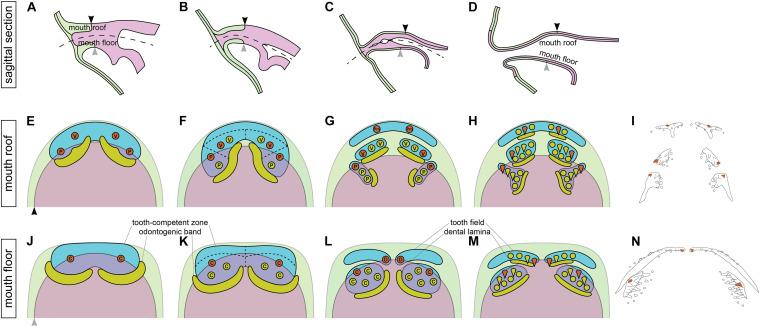
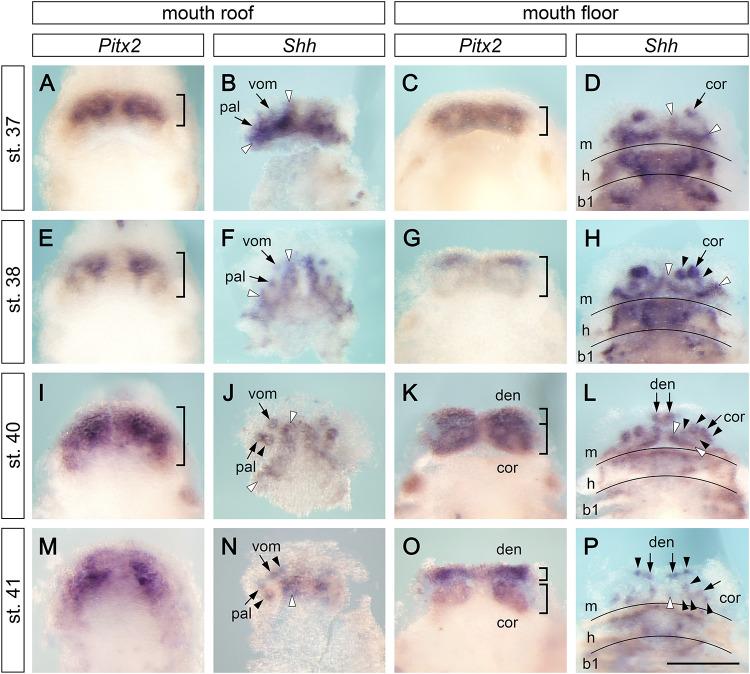
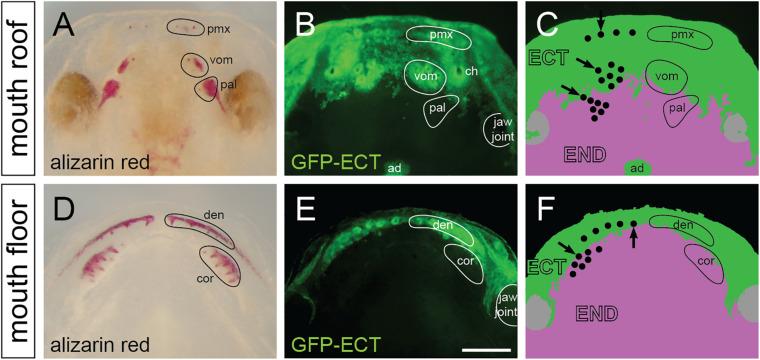
Vertebrate dentitions arise at various places within the oropharyngeal cavity including the jaws, the palate, or the pharynx. These dentitions develop in a highly organized way, where new tooth germs are progressively added adjacent to the initiator center, the first tooth. At the same time, the places where dentitions develop house the contact zones between the outer ectoderm and the inner endoderm, and this colocalization has instigated various suggestions on the roles of germ layers for tooth initiation and development. Here, we study development of the axolotl dentition, which is a complex of five pairs of tooth fields arranged into the typically tetrapod outer and inner dental arcades. By tracking the expression patterns of odontogenic genes, we reason that teeth of both dental arcades originate from common tooth-competent zones, one present on the mouth roof and one on the mouth floor. Progressive compartmentalization of these zones and a simultaneous addition of new tooth germs distinct for each prospective tooth field subsequently control the final shape and composition of the axolotl dentition. Interestingly, by following the fate of the GFP-labeled oral ectoderm, we further show that, in three out of five tooth field pairs, the first tooth develops right at the ecto-endodermal boundary. Our results thus indicate that a single tooth-competent zone gives rise to both dental arcades of a complex tetrapod dentition. Further, we propose that the ecto-endodermal boundary running through this zone should be accounted for as a potential source of instruction factors instigating the onset of the odontogenic program.
脊椎动物的牙列出现在口咽腔内的不同位置,包括颌骨、腭部或咽部。这些牙列以高度有组织的方式发育,新的牙胚在起始中心(第一颗牙齿)附近逐渐添加。同时,牙列发育的位置是外胚层和内胚层之间的接触区域,这种共定位引发了关于胚层在牙齿起始和发育中作用的各种推测。在这里,我们研究了蝾螈牙列的发育,它是由五对齿域组成的复合体,排列成典型的四足动物的外牙弓和内牙弓。通过追踪牙源性基因的表达模式,我们推断两个牙弓的牙齿都起源于共同的牙源性区域,一个位于口顶,一个位于口底。这些区域的逐步分隔以及随后为每个预期齿域同时添加独特的新牙胚,控制了蝾螈牙列的最终形状和组成。有趣的是,通过追踪绿色荧光蛋白标记的口腔外胚层的命运,我们进一步表明,在五对齿域中的三对中,第一颗牙齿正好在外胚层 - 内胚层边界处发育。因此,我们的结果表明,一个单一的牙源性区域产生了复杂四足动物牙列的两个牙弓。此外,我们提出,穿过该区域的外胚层 - 内胚层边界应被视为引发牙源性程序开始的指令因子的潜在来源。




 Zotero 插件