Meta-Research Innovation Center at Stanford, Stanford University School of Medicine, Stanford, California.
Stanford Prevention Research Center, Department of Medicine, Stanford University School of Medicine, Stanford, California.
JAMA Netw Open. 2021 Jan 4;4(1):e2033972. doi: 10.1001/jamanetworkopen.2020.33972.
The benefits of responsible sharing of individual-participant data (IPD) from clinical studies are well recognized, but stakeholders often disagree on how to align those benefits with privacy risks, costs, and incentives for clinical trialists and sponsors. The International Committee of Medical Journal Editors (ICMJE) required a data sharing statement (DSS) from submissions reporting clinical trials effective July 1, 2018. The required DSSs provide a window into current data sharing rates, practices, and norms among trialists and sponsors.
To evaluate the implementation of the ICMJE DSS requirement in 3 leading medical journals: JAMA, Lancet, and New England Journal of Medicine (NEJM).
DESIGN, SETTING, AND PARTICIPANTS: This is a cross-sectional study of clinical trial reports published as articles in JAMA, Lancet, and NEJM between July 1, 2018, and April 4, 2020. Articles not eligible for DSS, including observational studies and letters or correspondence, were excluded. A MEDLINE/PubMed search identified 487 eligible clinical trials in JAMA (112 trials), Lancet (147 trials), and NEJM (228 trials). Two reviewers evaluated each of the 487 articles independently.
Publication of clinical trial reports in an ICMJE medical journal requiring a DSS.
The primary outcomes of the study were declared data availability and actual data availability in repositories. Other captured outcomes were data type, access, and conditions and reasons for data availability or unavailability. Associations with funding sources were examined.
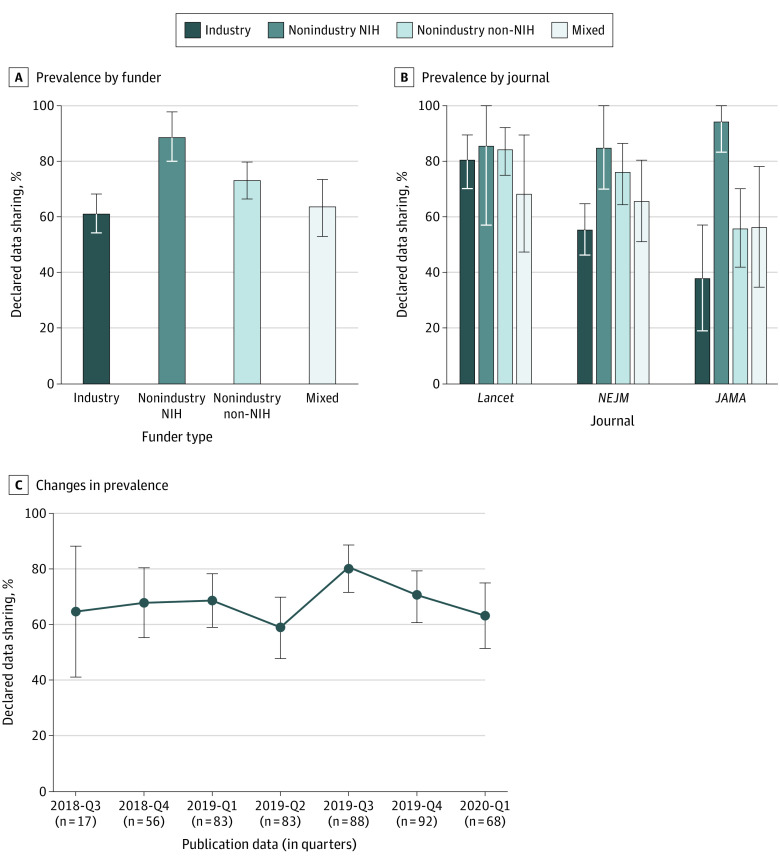
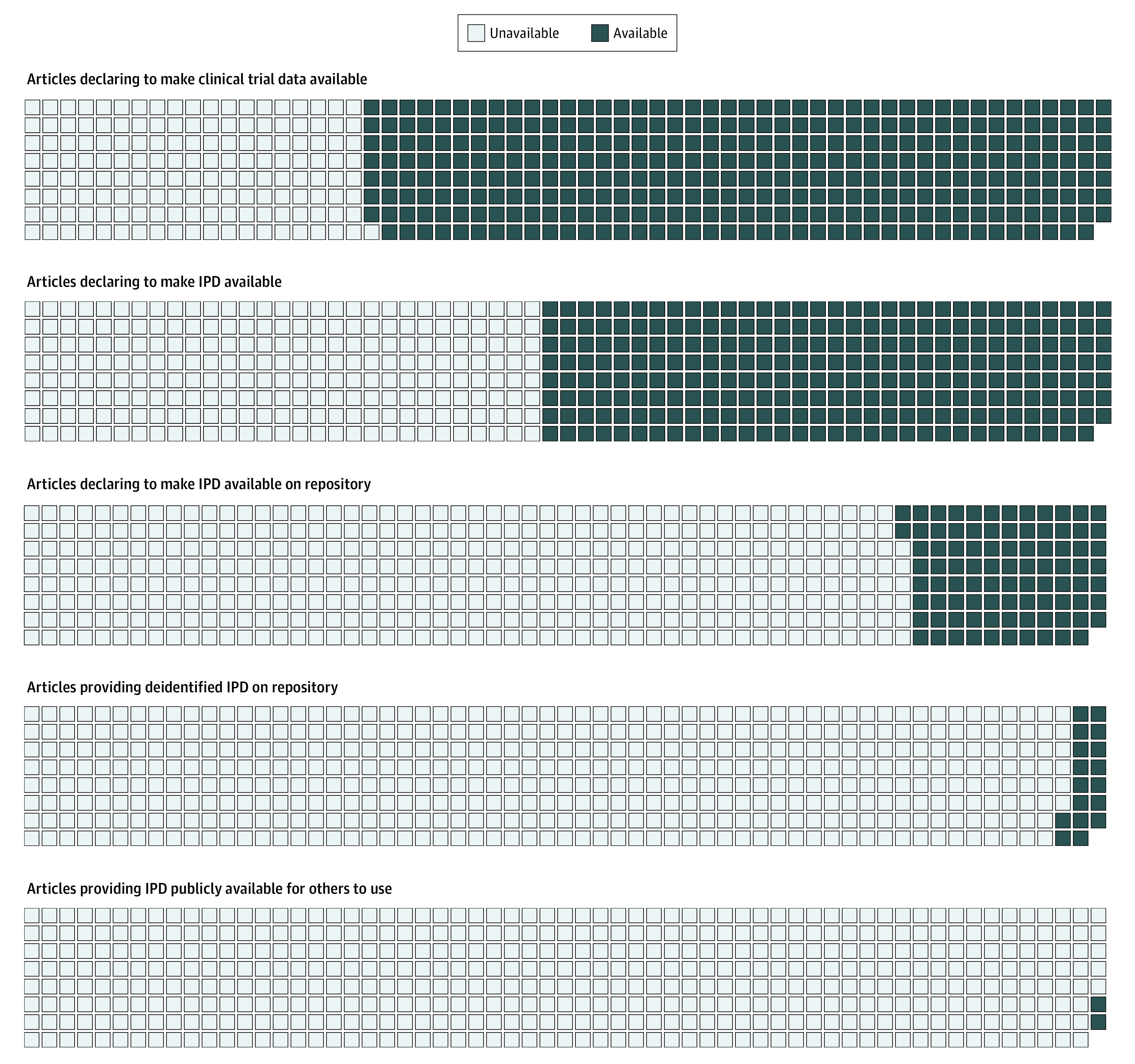
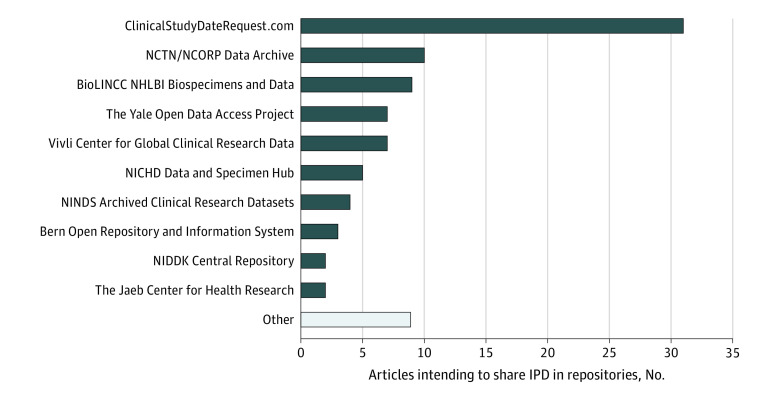
A total of 334 of 487 articles (68.6%; 95% CI, 64%-73%) declared data sharing, with nonindustry NIH-funded trials exhibiting the highest rates of declared data sharing (89%; 95% CI, 80%-98%) and industry-funded trials the lowest (61%; 95% CI, 54%-68%). However, only 2 IPD sets (0.6%; 95% CI, 0.0%-1.5%) were actually deidentified and publicly available as of April 10, 2020. The remaining were supposedly accessible via request to authors (143 of 334 articles [42.8%]), repository (89 of 334 articles [26.6%]), and company (78 of 334 articles [23.4%]). Among the 89 articles declaring that IPD would be stored in repositories, only 17 (19.1%) deposited data, mostly because of embargo and regulatory approval. Embargo was set in 47.3% of data-sharing articles (158 of 334), and in half of them the period exceeded 1 year or was unspecified.
Most trials published in JAMA, Lancet, and NEJM after the implementation of the ICMJE policy declared their intent to make clinical data available. However, a wide gap between declared and actual data sharing exists. To improve transparency and data reuse, journals should promote the use of unique pointers to data set location and standardized choices for embargo periods and access requirements.
负责任地共享临床研究的个体参与者数据(IPD)的好处是众所周知的,但利益相关者常常在如何平衡这些好处与隐私风险、临床试验者和赞助商的成本和激励措施方面存在分歧。国际医学期刊编辑委员会(ICMJE)要求自 2018 年 7 月 1 日起,提交报告临床试验的文章需包含数据共享声明(DSS)。所需的 DSS 提供了当前临床试验者和赞助商的数据共享率、实践和规范的窗口。
评估 3 种主要医学期刊(JAMA、柳叶刀和新英格兰医学杂志(NEJM))中 ICMJE DSS 要求的实施情况。
设计、地点和参与者:这是一项在 2018 年 7 月 1 日至 2020 年 4 月 4 日期间在 JAMA、柳叶刀和 NEJM 上发表的临床研究报告的横断面研究。不适合 DSS 的文章,包括观察性研究和信件或通讯,被排除在外。一项 MEDLINE/PubMed 搜索确定了 JAMA(112 项试验)、柳叶刀(147 项试验)和 NEJM(228 项试验)中 487 项合格的临床试验。两名评审员独立评估了这 487 篇文章中的每一篇。
在需要 DSS 的 ICMJE 医学期刊上发表的临床试验报告。
该研究的主要结果是报告的数据可用性和存储库中的实际数据可用性。其他捕获的结果是数据类型、访问权限以及数据可用性或不可用的条件和原因。研究了与资金来源的关联。
共有 334 篇文章中的 334 篇(68.6%;95%CI,64%-73%)宣布了数据共享,非工业 NIH 资助的试验报告的宣布数据共享率最高(89%;95%CI,80%-98%),而工业资助的试验报告的宣布数据共享率最低(61%;95%CI,54%-68%)。然而,截至 2020 年 4 月 10 日,只有 2 个 IPD 集(0.6%;95%CI,0.0%-1.5%)被实际去标识并公开可用。其余的据称可以通过向作者(334 篇文章中的 143 篇[42.8%])、存储库(334 篇文章中的 89 篇[26.6%])和公司(334 篇文章中的 78 篇[23.4%])请求获得。在宣布将 IPD 存储在存储库中的 89 篇文章中,只有 17 篇(19.1%)存入了数据,主要是因为存在封锁和监管批准。在数据共享文章中,有 47.3%(158 篇)设置了封锁期,其中一半的封锁期超过 1 年或未指定。
在 ICMJE 政策实施后,在 JAMA、柳叶刀和 NEJM 上发表的大多数临床试验都宣布了他们愿意提供临床数据。然而,在宣布的数据共享和实际数据共享之间存在很大差距。为了提高透明度和数据重用,期刊应促进使用指向数据集位置的唯一指针以及用于封锁期和访问要求的标准化选择。