Department of Surgery, Graduate School of Medicine, Kyoto University, 54, Shogoin-Kawahara-Cho, Sakyo-Ku, Kyoto, Japan.
NPO to support Peritoneal Surface Malignancy Treatment, Japanese/Asian School of Peritoneal Surface Oncology, Kyoto, Japan.
World J Surg Oncol. 2021 Jan 28;19(1):31. doi: 10.1186/s12957-021-02145-1.
Cytoreductive surgery (CRS) combined with hyperthermic intraperitoneal chemotherapy (HIPEC) improves survival in selected patients with peritoneal metastasis (PM) from colorectal cancer (CRC). However, little has been reported on characteristics and clinical course of long-term survivors with CRC-PM beyond 5 years. The objective of this study was to identify the clinical and oncological features affecting long-term survival of CRC-PM after comprehensive treatment.
Between January 1990 and April 2015, CRC-PM patients who underwent CRS with or without HIPEC in two Japanese tertiary hospitals were analyzed. Clinicopathological parameters and therapeutic details for long-term survivors (patients surviving ≥ 5 years after CRS) were described and compared with those for non-survivors (patients surviving < 5 years).
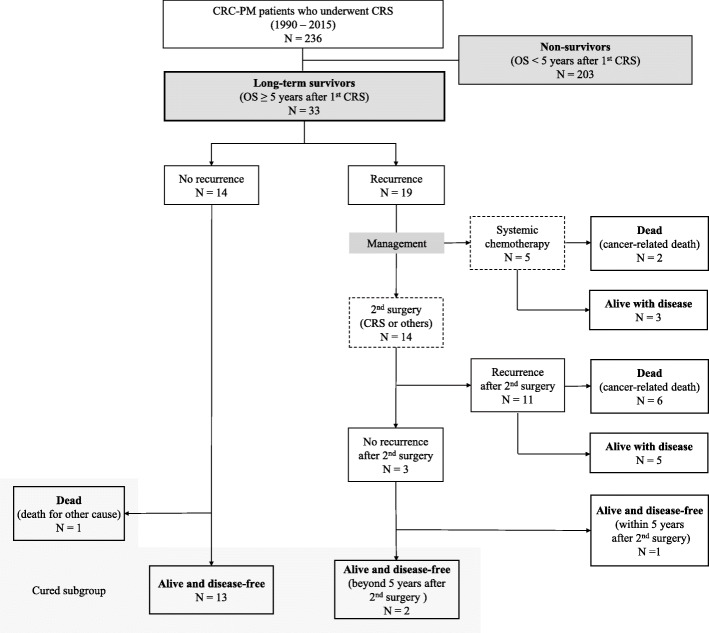
The study identified 236 patients with CRC-PM who underwent CRS, with a median follow-up period of 2.5 years. Thirty-three patients (14.0%) were considered as long-term survivors. Compared with non-survivors, long-term survivors had a lower median peritoneal cancer index (PCI) [4 (1-27) vs 9 (0-39), p < 0.001]. Complete cytoreduction (CCR-0) was achieved in all long-term survivors, with a significantly higher rate [33/33 (100%) vs 141/203 (69.8%), p < 0.001]. Metachronous onsets of PM were more frequently observed in the long-term survivor group [26/33 (78.8%) vs 103/203 (50.3%), p = 0.018]. Regarding histopathology, long-term survivors more frequently had mucinous adenocarcinoma than non-survivors [8/33 (24.2%) vs 27/203 (13.3%)] and less likely exhibited poorly differentiated or signet ring cell carcinoma [2/33 (6.1%) vs 48/203 (23.7%)] (p < 0.001).
One in seven patients with CRC-PM achieved the long-term milestone after CRS. A long-term survival was associated with the presence of low PCI, CCR-0, metachronous onset, and mucinous histology.
细胞减灭术(CRS)联合腹腔热灌注化疗(HIPEC)可提高结直肠癌(CRC)腹膜转移(PM)患者的生存率。然而,关于 CRC-PM 患者经过综合治疗后生存时间超过 5 年的特征和临床病程,目前报道甚少。本研究的目的是确定影响 CRC-PM 患者 CRS 后长期生存的临床和肿瘤学特征。
本研究纳入了 1990 年 1 月至 2015 年 4 月在日本两家三级医院接受 CRS 联合或不联合 HIPEC 治疗的 CRC-PM 患者。对长期生存(CRS 后生存时间≥5 年)患者的临床病理参数和治疗细节进行描述,并与非生存(CRS 后生存时间<5 年)患者进行比较。
本研究共纳入 236 例 CRC-PM 患者,中位随访时间为 2.5 年。33 例(14.0%)患者被认为是长期生存者。与非生存者相比,长期生存者的中位腹膜肿瘤指数(PCI)较低[4(1-27)比 9(0-39),p<0.001]。所有长期生存者均达到完全肿瘤细胞减灭术(CCR-0),且这一比例显著更高[33/33(100%)比 141/203(69.8%),p<0.001]。长期生存者中更常发生异时性 PM 发病[26/33(78.8%)比 103/203(50.3%),p=0.018]。在组织病理学方面,长期生存者更常患有黏液性腺癌,而非生存者更常患有低分化或印戒细胞癌[8/33(24.2%)比 27/203(13.3%)]和[2/33(6.1%)比 48/203(23.7%)](p<0.001)。
CRC-PM 患者中有七分之一在接受 CRS 后达到了长期生存这一里程碑。长期生存与低 PCI、CCR-0、异时性发病和黏液组织学相关。