Department of Periodontology, Peking University Hospital and School of Stomatology, 22 Zhongguancun South Avenue, Haidian District, Beijing, 100081, China.
National Clinical Research Center for Oral Diseases, Peking University Hospital and School of Stomatology, 22 Zhongguancun South Avenue, Haidian District, Beijing, 100081, China.
Trials. 2021 Jan 28;22(1):101. doi: 10.1186/s13063-021-05047-5.
The volume of residual alveolar bone is critical to the survival of dental implants. When the volume of alveolar bone in the posterior maxillary region is less than 4 mm, maxillary sinus floor elevation (MSFE) with the lateral approach is an effective option. Traditionally, this standard approach is usually conducted at 4-6 months after tooth extraction (standard MSFE). However, defective dentition due to extraction can impair mastication during the period of bone remodeling, especially if the molars on both sides are severely compromised and must be extracted. MSFE before extraction (modified MSFE) can take full advantage of residual tooth strength. However, the effectiveness and practicability of the modified MSFE procedure remain unknown. Therefore, the aim of this study was to compare the clinical outcomes of modified vs. standard MSFE, in order to provide references to periodontists.
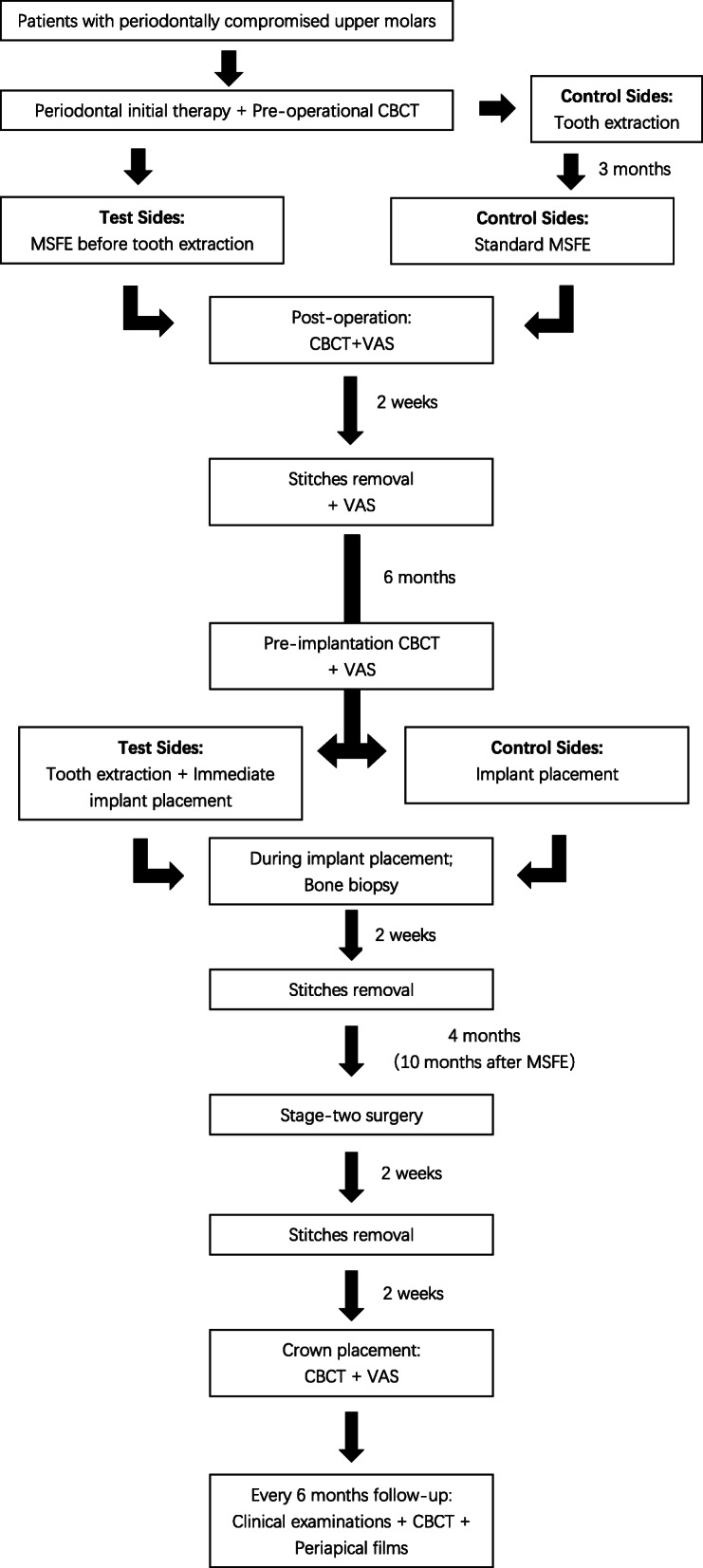
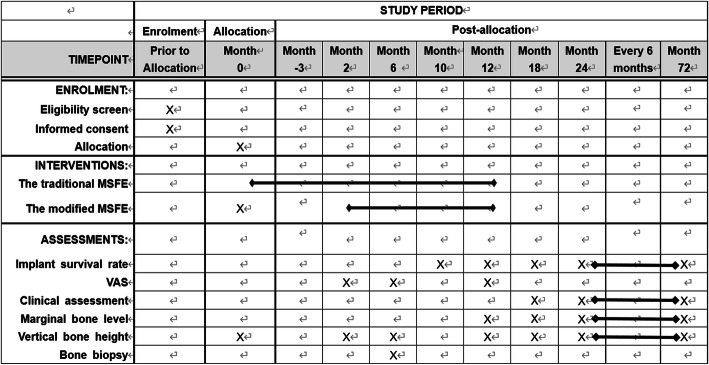
METHODS/DESIGN: The study cohort included 25 adult patients (50 surgery sites) recruited from Peking University Hospital and School of Stomatology who met the inclusion criteria. The two sides of each patient will be randomly divided into two groups: a test group-modified MSFE or a control group-standard MSFE. The surgical duration and patient-reported outcomes (visual analog scale for discomfort) will be documented. Clinical indicators, including implant survival rates, mucosal conditions, and complications, will be recorded every 6 months during the 5-year follow-up period. The volume of the alveolar bone and marginal bone level will be assessed radiographically (cone-beam CT and periapical films) every 6 months. Histological analysis of biopsy samples retrieved from both sides will be performed to evaluate the biological features of the bone.
The current study will explore the implant survival rates, safety, reliability, effectiveness, and practicability of the modified MSFE procedure. Moreover, the extent of osteogenesis on the sinus floor will also be assessed. The results of this trial will provide strategies for the modified MSFE procedure to achieve ideal clinical outcomes.
International Clinical Trials Registry Platform ChiCTR1900020648 . Registered on 1 January 2019.
残余牙槽骨量对牙种植体的存活至关重要。当下颌后牙区牙槽骨量小于 4mm 时,外侧入路上颌窦底提升术(MSFE)是一种有效的选择。传统上,这种标准方法通常在拔牙后 4-6 个月进行(标准 MSFE)。然而,由于拔牙导致的缺牙会在骨重塑期间影响咀嚼功能,尤其是当两侧的磨牙严重受损且必须拔除时。拔牙前进行 MSFE(改良 MSFE)可以充分利用剩余牙齿的强度。然而,改良 MSFE 手术的有效性和实用性尚不清楚。因此,本研究旨在比较改良 MSFE 与标准 MSFE 的临床效果,为牙周病医生提供参考。
方法/设计:本研究队列纳入了 25 名符合纳入标准的来自北京大学口腔医院和口腔医学院的成年患者(共 50 个手术部位)。每位患者的两侧将随机分为两组:实验组-改良 MSFE 或对照组-标准 MSFE。将记录手术时间和患者报告的结果(不适的视觉模拟评分)。在 5 年的随访期间,每 6 个月记录临床指标,包括种植体存活率、黏膜状况和并发症。每 6 个月通过锥形束 CT 和根尖片评估牙槽骨和边缘骨水平的体积。从两侧取出活检样本进行组织学分析,以评估骨的生物学特征。
本研究将探讨改良 MSFE 手术的种植体存活率、安全性、可靠性、有效性和实用性,还将评估窦底成骨的程度。该试验的结果将为改良 MSFE 手术提供策略,以达到理想的临床效果。
国际临床试验注册平台 ChiCTR1900020648 ,于 2019 年 1 月 1 日注册。