Wang Jie, Jaramillo-Torres Alexander, Li Yanxian, Kortner Trond M, Gajardo Karina, Brevik Øyvind Jakobsen, Jakobsen Jan Vidar, Krogdahl Åshild
Department of Paraclinical Sciences, Faculty of Veterinary Medicine, Norwegian University of Life Sciences (NMBU), P.O. Box 5003, 1432, Ås, Norway.
Cermaq Group AS, Dronning Eufemias gate 16, 0191, Oslo, Norway.
Anim Microbiome. 2021 Jan 28;3(1):14. doi: 10.1186/s42523-021-00075-7.
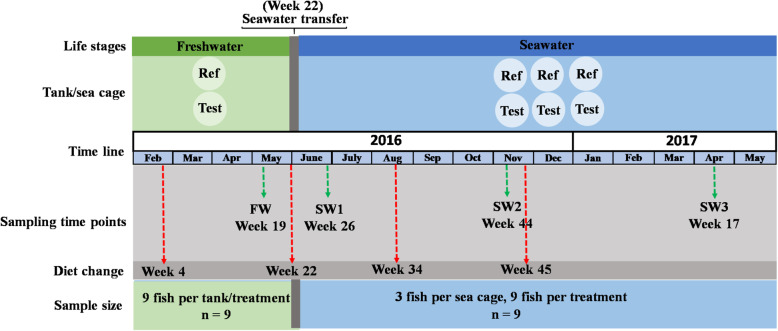
The importance of the gut microbiota for health and wellbeing is well established for humans and some land animals. The gut microbiota is supposedly as important for fish, but existing knowledge has many gaps, in particular for fish in the Arctic areas. This study addressed the dynamics of Atlantic salmon digesta-associated gut microbiota assemblage and its associations with host responses from freshwater to seawater life stages under large-scale, commercial conditions in the Arctic region of Norway, and explored the effects of functional ingredients. The microbiota was characterized by 16S rRNA gene sequencing in distal intestinal digesta at four time points: 2 weeks before seawater transfer (in May, FW); 4 weeks after seawater transfer (in June, SW1); in November (SW2), and in April (SW3) the following year. Two series of diets were fed, varying throughout the observation time in nutrient composition according to the requirements of fish, one without (Ref diet), and the other with functional ingredients (Test diet). The functional ingredients, i.e. nucleotides, yeast cell walls, one prebiotic and essential fatty acids, were supplemented as single or mixtures based on the strategies from the feed company.
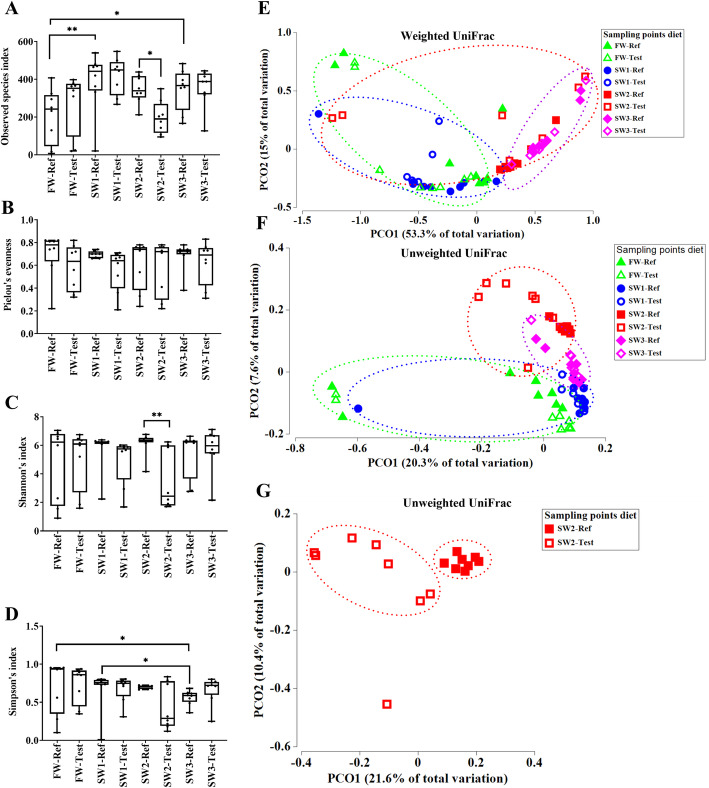
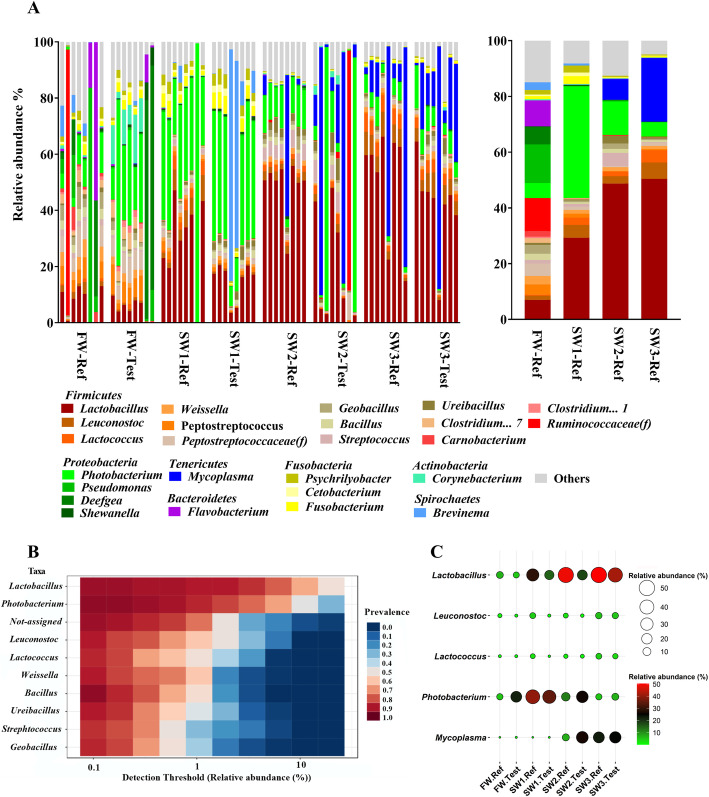
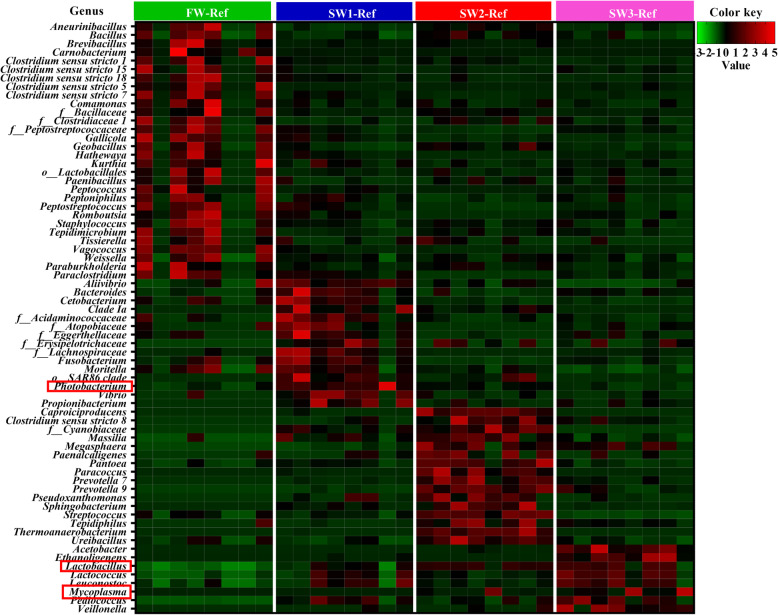
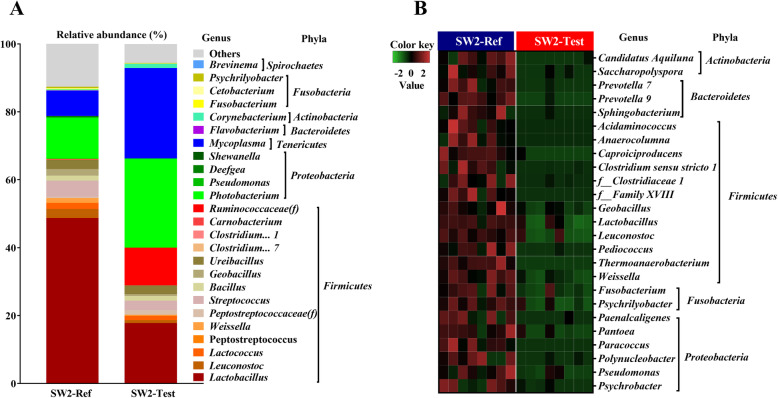
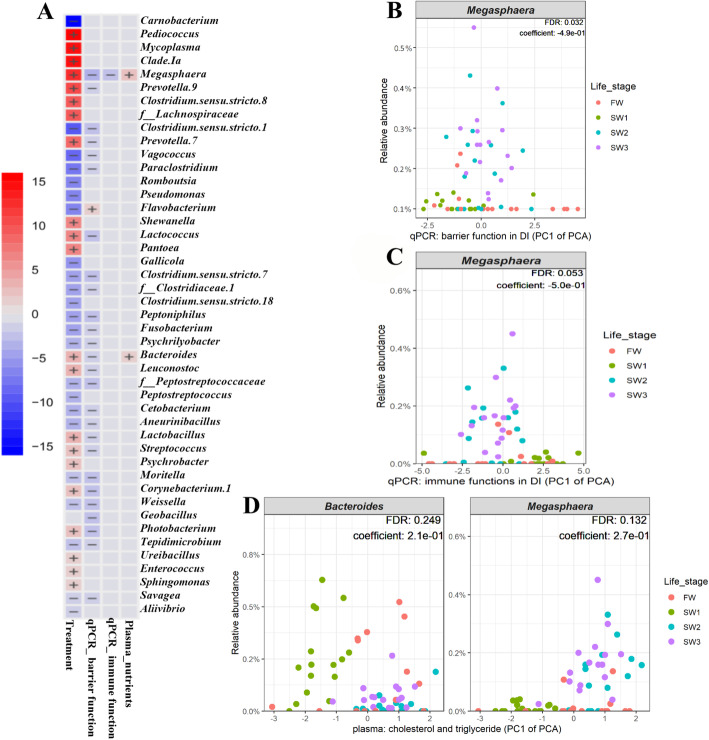
Overall, the fish showed higher microbial richness and lactic acid bacteria (LAB) abundance after seawater transfer, while Simpson's diversity decreased throughout the observation period. At SW1, the gut microbiota was slightly different from those at FW, and was dominated by the genera Lactobacillus and Photobacterium. As the fish progressed towards SW2 and SW3, the genera Lactobacillus and Mycoplasma became more prominent, with a corresponding decline in genus Photobacterium. The overall bacterial profiles at these time points showed a clear distinction from those at FW. A significant effect of functional ingredients (a mixture of nucleotides, yeast cell walls and essential fatty acids) was observed at SW2, where Test-fed fish showed lower microbial richness, Shannon's diversity, and LAB abundance. The multivariate association analysis identified differentially abundant taxa, especially Megasphaera, to be significantly associated with gut immune and barrier gene expressions, and plasma nutrients.
The gut microbiota profile varied during the observation period, and the Mycoplasma became the dominating bacteria with time. Megasphaera abundance was associated with gut health and plasma nutrient biomarkers. Functional ingredients modulated the gut microbiota profile during an important ongrowing stage.
肠道微生物群对人类和一些陆地动物的健康和福祉的重要性已得到充分证实。肠道微生物群对鱼类也同样重要,但现有知识存在许多空白,特别是对于北极地区的鱼类。本研究探讨了在挪威北极地区大规模商业养殖条件下,大西洋鲑从淡水到海水生活阶段与消化物相关的肠道微生物群组合的动态变化及其与宿主反应的关系,并探究了功能性成分的影响。通过对四个时间点的远端肠道消化物进行16S rRNA基因测序来表征微生物群:海水转移前2周(5月,淡水期);海水转移后4周(6月,海水期1);11月(海水期2);以及次年4月(海水期3)。投喂了两组饲料,在整个观察期内根据鱼类需求在营养成分上有所不同,一组不添加功能性成分(对照饲料),另一组添加功能性成分(试验饲料)。功能性成分,即核苷酸、酵母细胞壁、一种益生元和必需脂肪酸,根据饲料公司的策略以单一成分或混合物的形式添加。
总体而言,海水转移后鱼类的微生物丰富度和乳酸菌(LAB)丰度较高,而辛普森多样性在整个观察期内下降。在海水期1,肠道微生物群与淡水期略有不同,以乳杆菌属和发光杆菌属为主。随着鱼生长到海水期2和海水期3,乳杆菌属和支原体属变得更加突出,发光杆菌属相应减少。这些时间点的总体细菌谱与淡水期明显不同。在海水期2观察到功能性成分(核苷酸、酵母细胞壁和必需脂肪酸的混合物)有显著影响,投喂试验饲料的鱼的微生物丰富度、香农多样性和LAB丰度较低。多变量关联分析确定了差异丰富的分类群,特别是巨球型菌属,与肠道免疫和屏障基因表达以及血浆营养物质显著相关。
在观察期内肠道微生物群谱发生变化,支原体随时间推移成为优势细菌。巨球型菌属丰度与肠道健康和血浆营养生物标志物相关。功能性成分在重要的生长阶段调节了肠道微生物群谱。