Department of Nephrology, Graduate School of Medicine, Chiba University, Chiba, Japan.
The Laboratory for Kidney Research (TMK project), Medical Innovation Center, Graduate School of Medicine, Kyoto University, Kyoto, Japan.
J Am Soc Nephrol. 2021 Mar;32(3):597-613. doi: 10.1681/ASN.2019101025. Epub 2021 Jan 28.
The ubiquitin-proteasome system (UPS) and the autophagy-lysosomal system (APLS) are major intracellular degradation procedures. The importance of the APLS in podocytes is established, but the role of the UPS is not well understood.
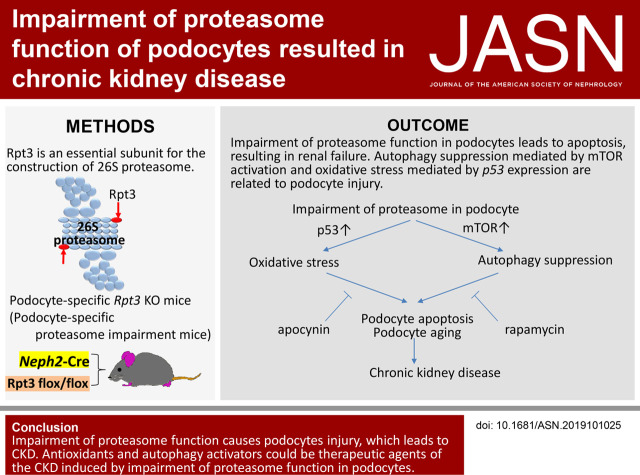
To investigate the role of the UPS in podocytes, mice were generated that had deletion of (), which encodes an essential regulatory subunit required for construction of the 26S proteasome and its deubiquitinating function.
mice showed albuminuria and glomerulosclerosis, leading to CKD. Impairment of proteasome function caused accumulation of ubiquitinated proteins and of oxidative modified proteins, and it induced podocyte apoptosis. Although impairment of proteasome function normally induces autophagic activity, the number of autophagosomes was lower in podocytes of 3 mice than in control mice, suggesting the autophagic activity was suppressed in podocytes with impairment of proteasome function. In an study, antioxidant apocynin and autophagy activator rapamycin suppressed podocyte apoptosis induced by proteasome inhibition. Moreover, rapamycin ameliorated the glomerular injury in the mice. The accumulation of ubiquitinated proteins and of oxidative modified proteins, which were detected in the podocytes of mice, is a characteristic feature of aging. An aging marker was increased in the podocytes of mice, suggesting that impairment of proteasome function promoted signs of aging in podocytes.
Impairment of proteasome function in podocytes led to CKD, and antioxidants and autophagy activators can be therapeutic agents for age-dependent CKD.
泛素-蛋白酶体系统 (UPS) 和自噬溶酶体系统 (APLS) 是主要的细胞内降解途径。APLS 在足细胞中的重要性已得到确立,但 UPS 的作用尚不清楚。
为了研究 UPS 在足细胞中的作用,生成了 ()缺失的小鼠,该基因编码构建 26S 蛋白酶体及其去泛素化功能所必需的调节亚基。
小鼠出现白蛋白尿和肾小球硬化,导致 CKD。蛋白酶体功能的损害导致泛素化蛋白和氧化修饰蛋白的积累,并诱导足细胞凋亡。尽管蛋白酶体功能的损害通常会诱导自噬活性,但 3 小鼠的足细胞中自噬体的数量低于对照小鼠,这表明蛋白酶体功能损害时足细胞中的自噬活性受到抑制。在一项 研究中,抗氧化剂 apocynin 和自噬激活剂 rapamycin 抑制了蛋白酶体抑制诱导的足细胞凋亡。此外,rapamycin 改善了 小鼠的肾小球损伤。在 小鼠的足细胞中检测到泛素化蛋白和氧化修饰蛋白的积累,这是衰老的特征。衰老标志物在 小鼠的足细胞中增加,表明蛋白酶体功能的损害促进了足细胞的衰老迹象。
足细胞中蛋白酶体功能的损害导致 CKD,抗氧化剂和自噬激活剂可作为治疗与年龄相关的 CKD 的药物。