Sun Xiaolei, Gao Rifeng, Li Wenjia, Zhao Yongchao, Yang Heng, Chen Hang, Jiang Hao, Dong Zhen, Hu Jingjing, Liu Jin, Zou Yunzeng, Sun Aijun, Ge Junbo
Shanghai Institute of Cardiovascular Diseases, Zhongshan Hospital, Fudan University, Shanghai, 200032, China.
Shanghai Fifth People's Hospital, Fudan University, Shanghai, 200240, China.
Bioact Mater. 2021 Jan 8;6(7):2058-2069. doi: 10.1016/j.bioactmat.2020.12.024. eCollection 2021 Jul.
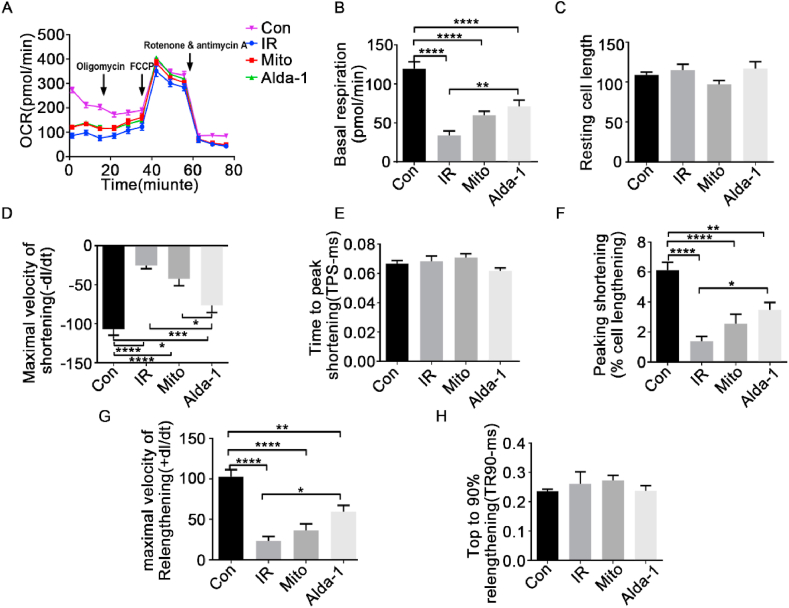
Mitochondrial damage is a critical driver in myocardial ischemia-reperfusion (I/R) injury and can be alleviated via the mitochondrial transplantation. The efficiency of mitochondrial transplantation is determined by mitochondrial vitality. Because aldehyde dehydrogenase 2 (ALDH2) has a key role in regulating mitochondrial homeostasis, we aimed to investigate its potential therapeutic effects on mitochondrial transplantation via the use of ALDH2 activator, Alda-1. Our present study demonstrated that time-dependent internalization of exogenous mitochondria by cardiomyocytes along with ATP production were significantly increased in response to mitochondrial transplantation. Furthermore, Alda-1 treatment remarkably promoted the oxygen consumption rate and baseline mechanical function of cardiomyocytes caused by mitochondrial transplantation. Mitochondrial transplantation inhibited cardiomyocyte apoptosis induced by the hypoxia-reoxygenation exposure, independent of Alda-1 treatment. However, promotion of the mechanical function of cardiomyocytes exposed to hypoxia-reoxygenation treatment was only observed after mitochondrial Alda-1 treatment and transplantation. By using a myocardial I/R mouse model, our results revealed that transplantation of Alda-1-treated mitochondria into mouse myocardial tissues limited the infarction size after I/R injury, which was at least in part due to increased mitochondrial potential-mediated fusion. In conclusion, ALDH2 activation in mitochondrial transplantation shows great potential for the treatment of myocardial I/R injury.
线粒体损伤是心肌缺血再灌注(I/R)损伤的关键驱动因素,可通过线粒体移植得到缓解。线粒体移植的效率取决于线粒体活力。由于醛脱氢酶2(ALDH2)在调节线粒体稳态中起关键作用,我们旨在通过使用ALDH2激活剂Alda-1来研究其对线粒体移植的潜在治疗作用。我们目前的研究表明,心肌细胞对外源线粒体的时间依赖性内化以及ATP生成在接受线粒体移植后显著增加。此外,Alda-1处理显著促进了线粒体移植引起的心肌细胞耗氧率和基线机械功能。线粒体移植抑制了缺氧复氧暴露诱导的心肌细胞凋亡,这与Alda-1处理无关。然而,仅在进行线粒体Alda-1处理和移植后,才观察到缺氧复氧处理的心肌细胞机械功能得到改善。通过使用心肌I/R小鼠模型,我们的结果显示,将经Alda-1处理的线粒体移植到小鼠心肌组织中可限制I/R损伤后的梗死面积,这至少部分归因于线粒体电位介导的融合增加。总之,线粒体移植中的ALDH2激活在治疗心肌I/R损伤方面显示出巨大潜力。