Laboratory of Cancer Metabolism, Molecular Mechanisms and Experimental Therapy in Oncology Program, Bellvitge Biomedical Research Institute (IDIBELL), Barcelona, Spain.
Division of Hematology Oncology, Department of Internal Medicine, University of Cincinnati, Cincinnati, OH.
Blood. 2021 Jun 17;137(24):3351-3364. doi: 10.1182/blood.2020007452.
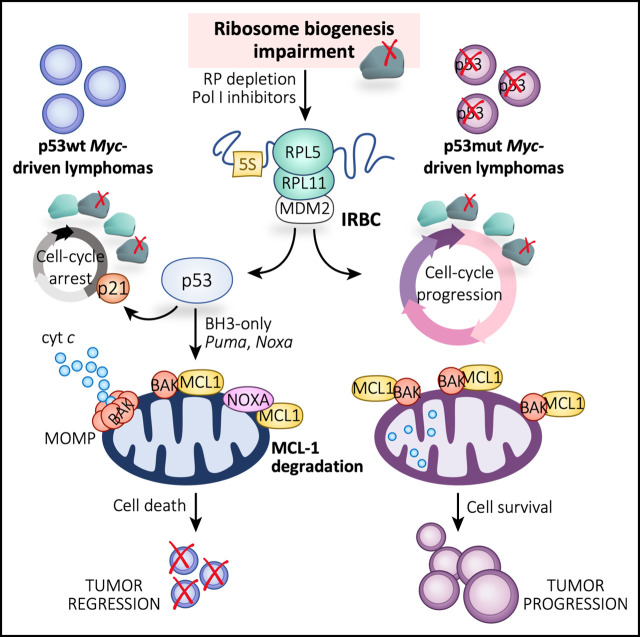
MYC-driven B-cell lymphomas are addicted to increased levels of ribosome biogenesis (RiBi), offering the potential for therapeutic intervention. However, it is unclear whether inhibition of RiBi suppresses lymphomagenesis by decreasing translational capacity and/or by p53 activation mediated by the impaired RiBi checkpoint (IRBC). Here we generated Eμ-Myc lymphoma cells expressing inducible short hairpin RNAs to either ribosomal protein L7a (RPL7a) or RPL11, the latter an essential component of the IRBC. The loss of either protein reduced RiBi, protein synthesis, and cell proliferation to similar extents. However, only RPL7a depletion induced p53-mediated apoptosis through the selective proteasomal degradation of antiapoptotic MCL-1, indicating the critical role of the IRBC in this mechanism. Strikingly, low concentrations of the US Food and Drug Administration-approved anticancer RNA polymerase I inhibitor Actinomycin D (ActD) dramatically prolonged the survival of mice harboring Trp53+/+;Eμ-Myc but not Trp53-/-;Eμ-Myc lymphomas, which provides a rationale for treating MYC-driven B-cell lymphomas with ActD. Importantly, the molecular effects of ActD on Eμ-Myc cells were recapitulated in human B-cell lymphoma cell lines, highlighting the potential for ActD as a therapeutic avenue for p53 wild-type lymphoma.
MYC 驱动的 B 细胞淋巴瘤依赖于核糖体生物发生(RiBi)水平的增加,这为治疗干预提供了潜力。然而,尚不清楚 RiBi 的抑制是否通过降低翻译能力和/或通过受损的 RiBi 检查点(IRBC)介导的 p53 激活来抑制淋巴瘤发生。在这里,我们生成了表达诱导型短发夹 RNA 的 Eμ-Myc 淋巴瘤细胞,以靶向核糖体蛋白 L7a(RPL7a)或 RPL11,后者是 IRBC 的必需组成部分。这两种蛋白的缺失都以相似的程度降低了 RiBi、蛋白质合成和细胞增殖。然而,只有 RPL7a 的耗竭通过选择性蛋白酶体降解抗凋亡 MCL-1 诱导了 p53 介导的细胞凋亡,表明 IRBC 在这种机制中起着关键作用。引人注目的是,美国食品和药物管理局批准的抗癌 RNA 聚合酶 I 抑制剂放线菌素 D(ActD)的低浓度显著延长了携带 Trp53+/+;Eμ-Myc 但不携带 Trp53-/-;Eμ-Myc 淋巴瘤的小鼠的存活时间,这为用 ActD 治疗 MYC 驱动的 B 细胞淋巴瘤提供了依据。重要的是,ActD 对 Eμ-Myc 细胞的分子作用在人 B 细胞淋巴瘤细胞系中得到了重现,突出了 ActD 作为 p53 野生型淋巴瘤治疗途径的潜力。