Center for Precision Medicine, Department of Medicine, School of Medicine, University of Missouri, 1 Hospital Drive, Columbia, MO 65212, USA.
Department of Pathology and Anatomical Sciences, School of Medicine, University of Missouri, 1 Hospital Drive, Columbia, MO 65212, USA.
Cardiovasc Res. 2022 Jan 29;118(2):585-596. doi: 10.1093/cvr/cvab031.
Elevated sympathetic outflow is associated with primary hypertension. However, the mechanisms involved in heightened sympathetic outflow in hypertension are unclear. The central amygdala (CeA) regulates autonomic components of emotions through projections to the brainstem. The neuronal Kv7 channel is a non-inactivating voltage-dependent K+ channel encoded by KCNQ2/3 genes involved in stabilizing the neuronal membrane potential and regulating neuronal excitability. In this study, we investigated if altered Kv7 channel activity in the CeA contributes to heightened sympathetic outflow in hypertension.
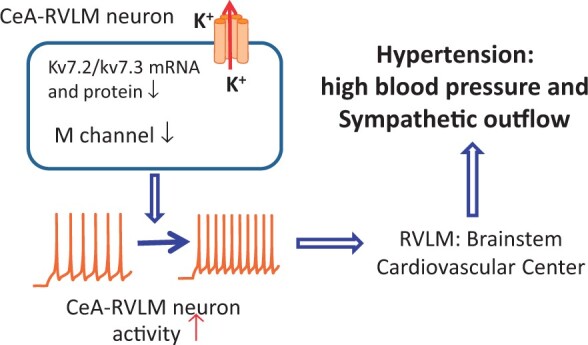
The mRNA and protein expression levels of Kv7.2/Kv7.3 in the CeA were significantly reduced in spontaneously hypertensive rats (SHRs) compared with Wistar-Kyoto (WKY) rats. Lowering blood pressure with coeliac ganglionectomy in SHRs did not alter Kv7.2 and Kv7.3 channel expression levels in the CeA. Fluospheres were injected into the rostral ventrolateral medulla (RVLM) to retrogradely label CeA neurons projecting to the RVLM (CeA-RVLM neurons). Kv7 channel currents recorded from CeA-RVLM neurons in brain slices were much smaller in SHRs than in WKY rats. Furthermore, the basal firing activity of CeA-RVLM neurons was significantly greater in SHRs than in WKY rats. Bath application of specific Kv7 channel blocker 10, 10-bis (4-pyridinylmethyl)-9(10H)-anthracnose (XE-991) increased the excitability of CeA-RVLM neurons in WKY rats, but not in SHRs. Microinjection of XE-991 into the CeA increased arterial blood pressure (ABP) and renal sympathetic nerve activity (RSNA), while microinjection of Kv7 channel opener QO-58 decreased ABP and RSNA, in anaesthetized WKY rats but not SHRs.
Our findings suggest that diminished Kv7 channel activity in the CeA contributes to elevated sympathetic outflow in primary hypertension. This novel information provides new mechanistic insight into the pathogenesis of neurogenic hypertension.
交感神经传出增加与原发性高血压有关。然而,高血压中交感神经传出增加的机制尚不清楚。杏仁中央核(CeA)通过投射到脑干来调节情绪的自主成分。神经元 Kv7 通道是一种非失活的电压依赖性 K+通道,由 KCNQ2/3 基因编码,参与稳定神经元膜电位和调节神经元兴奋性。在这项研究中,我们研究了 CeA 中 Kv7 通道活性的改变是否导致高血压中交感神经传出增加。
与 Wistar-Kyoto(WKY)大鼠相比,自发性高血压大鼠(SHR)CeA 中的 Kv7.2/Kv7.3mRNA 和蛋白表达水平显著降低。在 SHR 中通过腹腔神经节切除术降低血压并没有改变 CeA 中的 Kv7.2 和 Kv7.3 通道表达水平。荧光微球注入延髓腹外侧头端(RVLM)以逆行标记投射到 RVLM 的 CeA 神经元(CeA-RVLM 神经元)。在脑切片中从 CeA-RVLM 神经元记录到的 Kv7 通道电流在 SHR 中比在 WKY 大鼠中小得多。此外,CeA-RVLM 神经元的基础放电活性在 SHR 中比在 WKY 大鼠中显著增加。Kv7 通道阻滞剂 10,10-双(4-吡啶基甲基)-9(10H)-蒽酮(XE-991)的浴应用增加了 WKY 大鼠 CeA-RVLM 神经元的兴奋性,但在 SHR 中没有。XE-991 微注射到 CeA 增加了动脉血压(ABP)和肾交感神经活动(RSNA),而 Kv7 通道 opener QO-58 的微注射降低了 ABP 和 RSNA,在麻醉的 WKY 大鼠中,但不是 SHR 中。
我们的发现表明,CeA 中 Kv7 通道活性的降低导致原发性高血压中交感神经传出增加。这一新发现为神经源性高血压的发病机制提供了新的机制见解。