Papp Kim A, de Vente Saskia, Zeng Jiewei, Flack Mary, Padilla Byron, Tyring Stephen K
K Papp Clinical Research and Probity Medical Research, Waterloo, ON, Canada.
AbbVie Inc., North Chicago, IL, USA.
Dermatol Ther (Heidelb). 2021 Apr;11(2):487-497. doi: 10.1007/s13555-021-00490-3. Epub 2021 Jan 29.
Although many biologic therapies are effective for clearing skin of patients with psoriasis, some lose effectiveness over time. This phase 2 open-label extension (OLE) trial was designed to investigate the long-term safety and efficacy of risankizumab.
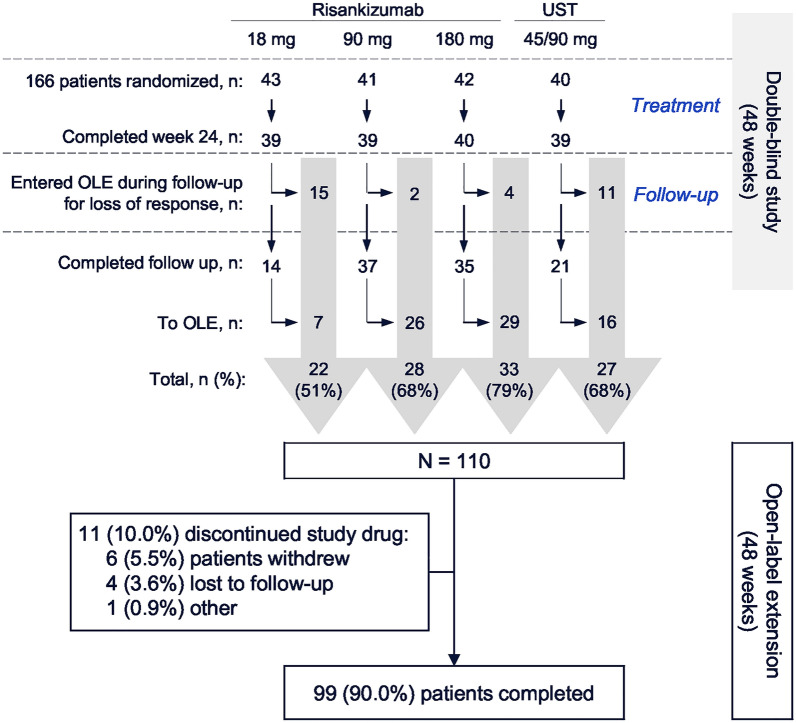
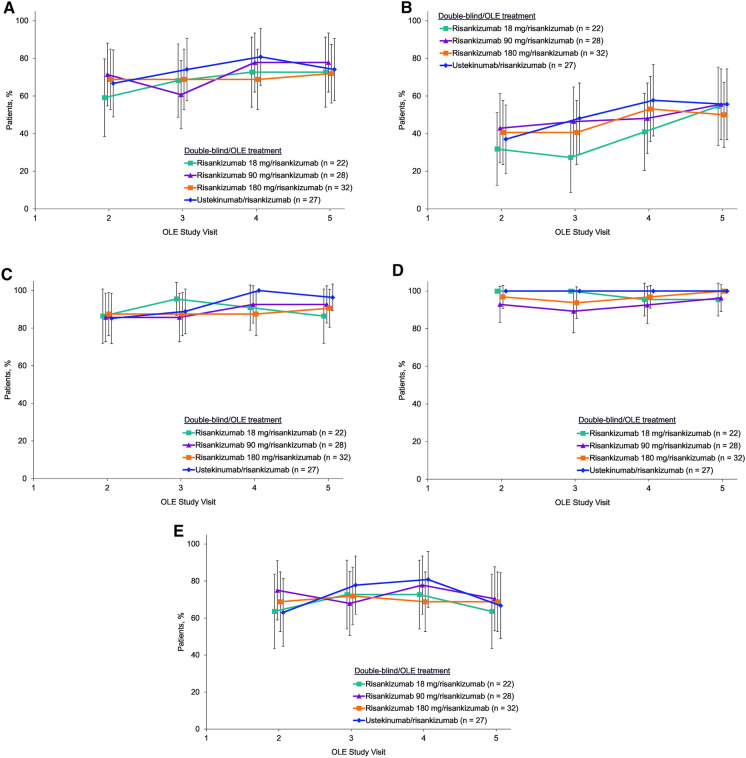
In the phase 2, double-blind, active comparator, predecessor trial (NCT02054481), patients with moderate-to-severe chronic plaque psoriasis were treated for 24 weeks with subcutaneous (SC) risankizumab or ustekinumab, followed by a 24-week follow-up without treatment administration. Patients could enroll in the OLE (NCT02203851) when they experienced loss of treatment response (< 50% improvement in the Psoriasis Area Severity Index [PASI 50]) during follow-up) or at the end of follow-up if treatment response was ongoing. In the OLE, patients were treated every 12 weeks for at least 48 weeks with SC risankizumab 90 or 180 mg, beginning at week 12 (OLE visit 2), if the patient had not achieved PASI 90. Efficacy endpoints included the proportions of patients who achieved PASI 50/75/90/100 and static Physician's Global Assessment (sPGA) of clear or almost clear skin at week 48 (sPGA 0/1; OLE visit 5).
Of the 110 enrolled patients, 99 (90.0%) completed the OLE. No patients discontinued the study because of adverse events. At week 48, 74.1% of patients achieved PASI 90, whereas 98.1, 91.7, 53.7, and 67.6% achieved PASI 50/75/100 and sPGA 0/1, respectively. All efficacy results were consistent or slightly increased at OLE week 48 compared with week 12. No new safety findings were observed.
Risankizumab treatment was well tolerated with sustained clinical efficacy for at least 48 weeks.
ClinicalTrials.gov identifier; NCT02203851.
尽管许多生物疗法对清除银屑病患者的皮损有效,但有些疗法会随着时间推移而失效。这项2期开放标签扩展(OLE)试验旨在研究瑞莎珠单抗的长期安全性和疗效。
在2期双盲、活性对照的前期试验(NCT02054481)中,中度至重度慢性斑块状银屑病患者接受皮下注射(SC)瑞莎珠单抗或乌司奴单抗治疗24周,随后进行24周的无治疗随访。患者在随访期间出现治疗反应丧失(银屑病面积和严重程度指数[PASI]改善<50%[PASI 50])或随访结束时治疗反应仍在持续,即可参加OLE试验(NCT022)。在OLE试验中,如果患者未达到PASI 90,则从第12周(OLE访视2)开始,每12周接受一次SC瑞莎珠单抗90或180mg治疗,至少治疗48周。疗效终点包括在第48周时达到PASI 50/75/90/100的患者比例以及静态医师整体评估(sPGA)为皮肤清除或几乎清除(sPGA 0/1;OLE访视5)。
110名入组患者中,99名(90.0%)完成了OLE试验。没有患者因不良事件而停止研究。在第48周时,74.1%的患者达到PASI 90,而达到PASI 50/75/100和sPGA 0/1的患者分别为98.1%、91.7%、53.7%和67.6%。与第12周相比,OLE试验第48周时所有疗效结果均保持一致或略有提高。未观察到新的安全性发现结论:瑞莎珠单抗治疗耐受性良好,临床疗效持续至少48周。
ClinicalTrials.gov标识符;NCT02203851。